Get all your news in one place.
100’s of premium titles.
One app.
Start reading
Tom’s Guide
Tom’s Guide
Technology
Jason England

I just tested the redesigned Asus Zenbook Duo — my favorite 2-in-1 just got even better by fixing 3 key gripes

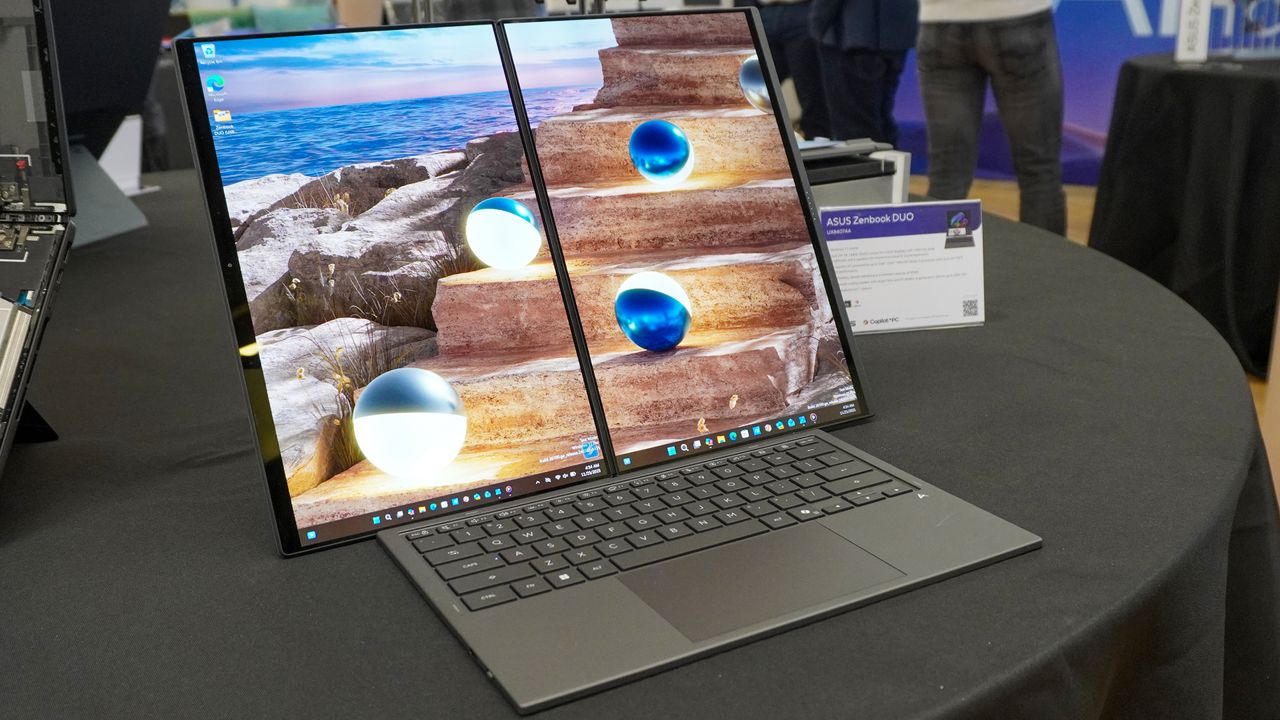
Asus Zenbook Duo (2026).

Dual-screen laptops seem to always have their time in the sun early in the year — normally a CES announcement to drive plenty of hype — followed by a whimper of interest as people haven’t yet gotten comfortable enough actually buying one.

Tom's Guide at CES

(Image credit: Future)

Follow all of our CES 2026 live coverage for the biggest gadget news straight from Las Vegas. And be sure to follow Tom's Guide on TikTok for the coolest videos from the show.

Well, Asus is back with something to prove and a drastically redesigned Zenbook Duo that could be the 2-in-1 that finally breaks through with the mainstream laptop crowd.

And it could do so by fixing the fundamentals and just being a really great laptop to use, which just so happens to be a banger of a multi-screen system too. Let me take you through my hands-on time with it.

Off to the hideaway

(Image credit: Future)

The concept of the Zenbook Duo has always been one I’ve loved, but the lack of seamlessness always irked me. By that, I mean the giant bezel and lip between the two screens caused a bit of asymmetry that I was never a fan of.

For this generation’s system, Asus has fixed the problem with a new hideaway hinge. On paper, it reduces the gap between the two 14-inch 3K OLED screens by 70% from 26mm to 8.3mm. In person, it really helped me stay in my flow when multitasking between both panels.

(Image credit: Future)

On top of that, it makes for a much more sturdy structure on the desk too. No more wobbling when trying to use it in book mode!

Intel brains and (power efficient) brawn

(Image credit: Future)

Yep, Intel Core Ultra Series 3 (Codenamed Panther Lake) is coming to the Zenbook Duo, and you can spec it with up to the Intel core Ultra X9 chipset. You know the one — that monster with the 12-core GPU that can deliver up to 50% higher multi-core performance while consuming 40% lower power than previous generation Intel chips.

This would resolve a lot of the power efficiency issues I had with last year’s Duo. There’s no getting around the fact it’s two OLED displays in terms of power consumption, but the shared battery capacity between both panels and Intel’s new super efficient chips should combat this. Asus claims 18 hours of video playback on that 99 Wh cell.

Plus, even distributing the battery between both sides allows for a much better weight distribution in the hand and on your desk.

Re-engineered edges

(Image credit: Future)

And with that new hinge, Asus could have called it a day. But instead, the company has looked at other elements of the body and given them a makeover.

That Ceraluminum finish looks and feels as premium and gorgeous as it did the first time I grabbed it. That kickstand now feels much more rigid and durable when opening and closing it — tested to withstand 15KG of pressure.

And the body is now made with 90% post-industrial recycled magnesium-aluminum alloy, which is a big check in the green credentials of this system, while also being impressively scratch resistant to boot.

Follow Tom's Guide on Google News and add us as a preferred source to get our up-to-date news, analysis, and reviews in your feeds.

More from Tom's Guide

Sign up to read this article
Read news from 100’s of titles, curated specifically for you.
Already a member? Sign in here
Related Stories
Top stories on inkl right now
Our Picks
Fourteen days free
Download the app
One app. One membership.
100+ trusted global sources.