
What is it?
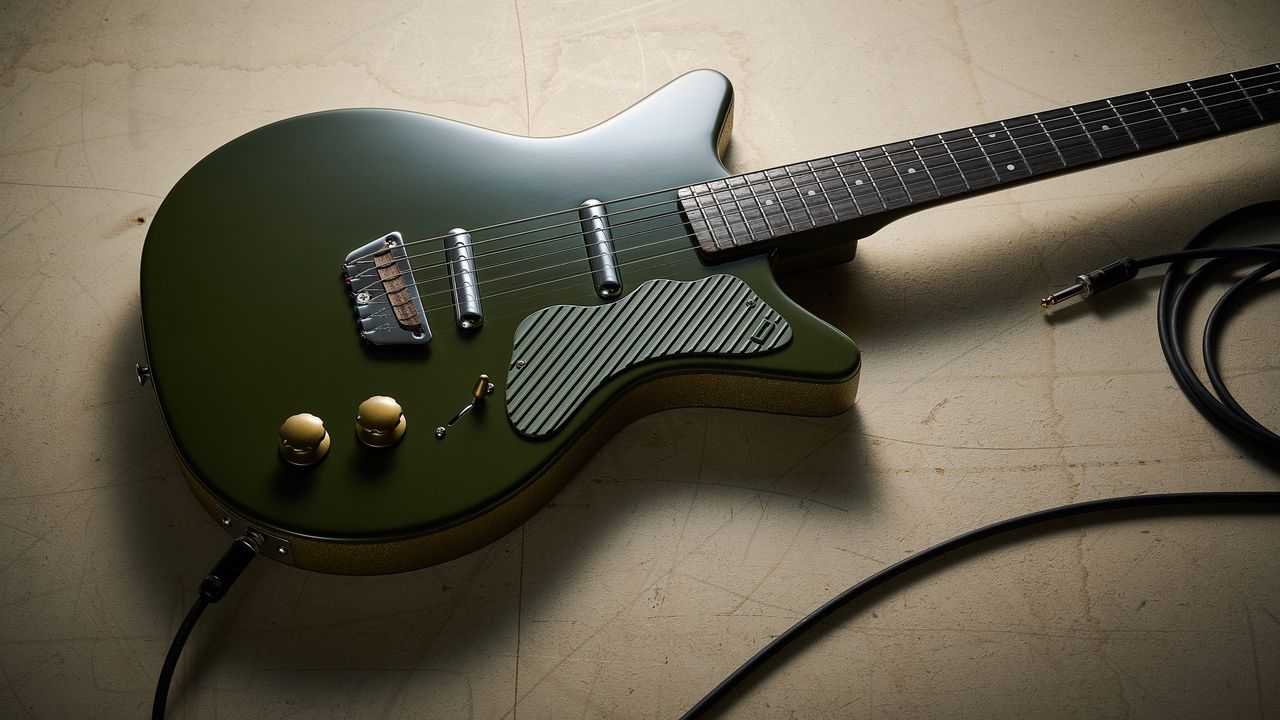
This year, Danelectro has launched a wave of new, retro-inspired guitars under the moniker Dan O, looking to inject some 50s vibes into the lives of the modern guitar player. Today’s review model, the Danelectro Dan O Cool Baritone, stood out to me and many others when I briefly tested it at the UK Guitar Show earlier in the year, so now it’s time to get my hands properly on it to see what it’s capable of.

Featuring a semi-hollow body with a center block, it has an aluminum nut with a rosewood fretboard and a gigantic 29.75" scale length, which is large even for a baritone guitar. It also boasts ‘skate key’ tuners, which look very vintage and are arranged in a 3x3 format. At the opposite end is an aluminum bridge piece, which is raised from the body and has a rosewood saddle, as you’ll find on a lot of Danelectros, but is quite rare to see on an electric guitar.
In terms of electronics, we have two '50s lipstick single coils, modified to be a little hotter than Danelectro’s typical offering. These are controlled by a single master and single tone control, while a 3-way pickup switch handles switching duties.
Specs

- Launch price: $649 | £689.99 | €801
- Made: Korea
- Type: Six-string baritone guitar
- Body: Solid spruce frame with hardboard panels
- Neck: Canadian maple
- Fingerboard: Rosewood
- Scale length: 29.75" (755mm)
- Nut/width: Aluminium, 41.5mm
- Frets: 24
- Hardware: Skate key tuners, rosewood saddle bridge
- String spacing at bridge: 54.9mm
- Electrics: 2x 1950s lipstick pickups, 3-way toggle pickup selector, 1x volume, 1x tone
- Weight: 3 kg (6.61 lbs)
- Left-handed options: No
- Finish: Green
- Cases: No
- Contact: Danelectro
Build quality

Build quality rating: ★★★★☆
The body is semi-hollow with a center block, comprising a solid spruce frame with hardwood panels for the front and back, the same design that Danelectro guitars had in the '50s. It’s a rosewood fretboard with a maple bolt-on neck, with the whole guitar finished in a very US Army-esque olive drab green. The outer of the body is wrapped with a textured gold that’s very unusual, but well applied here.

The nut sits ever so slightly proud on the bass side of the neck, but it doesn’t get in the way, while similarly, on the back of the guitar, the control plate hasn’t been sunk into the guitar body but instead sits on top of it. The screws for the pickups and those for the neck are also non-recessed, presumably as a way to save on costs. There are a couple of dark spots on the fretboard, but these small niggles aside, my review model is well put together overall.
Playability

Playability rating: ★★★★½
I find myself having to make some adjustments when playing larger stretches near the neck
Sitting down to play it, even I’m impressed with the monster scale length, and I regularly play a baritone in a metal band. It’s absolutely huge at 29.75”, and I find myself having to make some adjustments when playing larger stretches near the neck. It also takes me a while to warm up just playing power chords there, such is the size of the thing.
Despite that, the action is pretty good out of the box, measuring around 1.5mm at the 12th fret with my finger on the 1st fret, and I can quite easily clamp down with some barre chords when playing near the nut.

Moving onto some lead work, it’s surprisingly slinky for legato runs after the 12th fret, but I definitely need a supporting finger or two for the bends, thanks to that 14-gauge high ‘B’ string. They’re not impossible, but players new to baritones will need to build up some stamina for full tone bends and beyond here. Despite my hands getting tired a little sooner than might be expected, I find it to be a very playable guitar indeed, despite its huge dimensions.
Sounds

Sounds rating: ★★★★☆
Plugging into a Fender Princeton, my first impression of the lipstick pickup in the bridge position is that it’s incredibly bright, to the point that I immediately reach for the tone knob and dial it back most of the way. Paired with some spring reverb and a hint of tremolo, it sounds incredibly inspiring whether I’m playing open chords or picking single note licks. It’s a very bright and dynamic sound, with a hint of that sitar like twang from the bridge and nut combo. It doesn’t sustain particularly well, but I don’t mind that at all.
Switching to the neck pickup, this quickly becomes my favorite position versus the spikiness of the bridge sound. It’s still bright, but loses a bit of that icepickiness in the upper registers that make it great for long open chords with plenty of depth on the tremolo knob from my amp. Pairing it with some slide guitar licks I spend a good few hours experimenting with different playstyles, finding the sound to be endlessly entertaining no matter what I play on it from my back catalogue of rock, country, and blues I’ve picked up over the years.

The question that's no doubt on many players' minds; does it djent?
There’s a certain contingent of players who have been using these types of guitars for heavy stuff, so knocking the tuning to drop A and switching to the high gain channel of a Mesa/Boogie Mk VIII combo I’m testing, I start laying into some heavy stuff to answer the question that's no doubt on many players' minds, does it djent? The answer is, kinda.
For less precise stuff, it can moonlight as a good metal guitar with sludgy power chord licks and loosely played riffs sounding pretty good. If you want those super tight breakdowns of modern metal however, the single coils are just a bit too noisy, even with a decent noise gate engaged.
Verdict

The Danelectro Dan O. Cool Baritone kept me playing for hours and hours, which is as good an indicator of a great guitar as any. Once I got used to the massive scale, I found it to be an incredibly fun instrument to play for a wide variety of styles. Whether playing fingerpicked moody triads or strumming open chords, it delivered some fantastic sounds, especially with the neck pickup.
The bridge pickup is a little too bright for my tastes
The bridge pickup is a little too bright for my tastes though. Even when taming it with the tone knob, I found myself mostly using the neck pickup, as it was articulate enough to handle most duties without getting into icepick territory. I also found that the strap end is awkwardly placed when I took it to a recording session, so although my strap eventually went on, I never really felt secure with it like that, and the fit is so tight you can’t get a strap lock on it.
Guitar World verdict: If you’re looking for a baritone guitar that djents, this ain’t it. For nearly every other low-tuning duty, however, the Dan O. Cool Baritone is a good value extended range instrument that can cater to a wide variety of styles. It’s lightweight and resonant body gives it a very unique and characterful tone, and although the scale will take some getting used to, once you master it, you’ll find some very satisfying sounds indeed.
Test |
Results |
Score |
|---|---|---|
Build quality |
Very well put together, but the strap button is awkwardly placed. |
★★★★☆ |
Playability |
Really nice to play once you get used to the large scale. |
★★★★½ |
Sounds |
The bridge pickup is a bit too bright, but the neck tone is fantastic. |
★★★★☆ |
Overall |
A great baritone for rock, country, and blues, but not ideal for metal. |
★★★★☆ |