
In the early 2000s, Esquire published a column called “The Indefensible Position.” This was a sort of proto-hot-take clearinghouse, intended sarcastically, presaging a time when every idea—no matter how implausible, counterintuitive or just flat wrong—was given a platform. Writers took turns mounting seemingly unpardonable arguments, such as “Smoking Has Its Benefits” and “Adultery Is Good for Your Marriage.”
The column debuted in 2001, the same year that a Las Vegas sports promotion called Zuffa (Italian for “fight”) paid $2 million for the rights to stage the Ultimate Fighting Championship: two men––and at the time the fighters were exclusively male––beating the bejesus out of each other while locked inside a steel octagon. Though not in the pages of Esquire, plenty of pulp and pixels were devoted to the supposed indefensibility of cage-fighting, an activity that at the time was banned in most states (and banned from pay-per-view, which is really saying something).
We all know how this story broke. Many of us (myself included) grew accepting, then fond, of the UFC, which steadily penetrated the defenses of the mainstream. We became less squeamish. The athletes revealed themselves as generally likable and decent. The fight cards grew to include women. Those health and safety concerns were largely assuaged. The predictions of death, happily, never came to be.
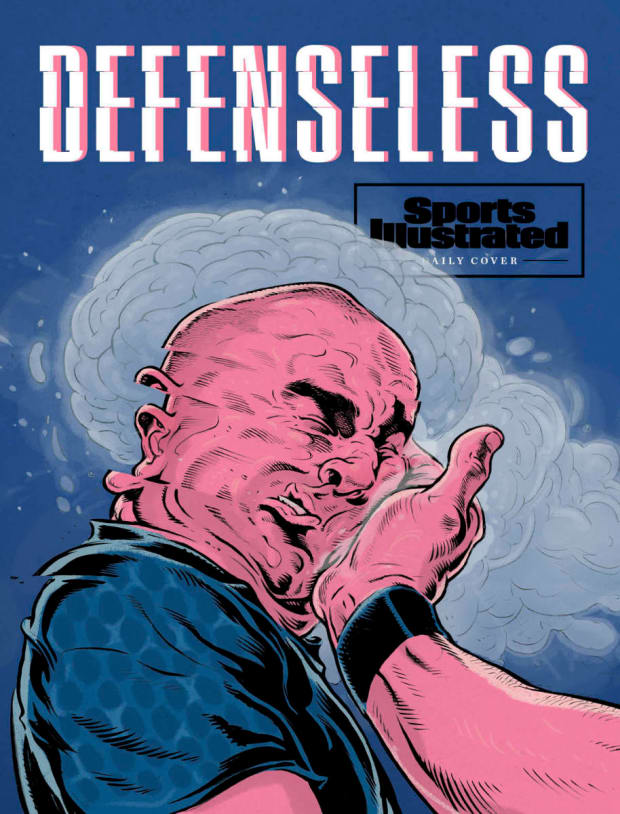
Illustration by Lars Leetaru
In 2016 the UFC was purchased by IMG/William Morris for $4 billion, a 2,000x return on Zuffa’s investment. Today, every state has legalized and sanctioned mixed martial arts, the UFC is helping to prop up ESPN’s streaming service, and fights have even aired on network television.
Emboldened by this success, the UFC is now doubling down—emphasis on down—and taking a truly indefensible position. For years, frontman/president Dana White has evangelized the virtues of slap fighting, and in November—in conjunction, criticality, with UFC events––he announced that he would be joining forces with UFC founder Lorenzo Fertitta, COO Lawrence Epstein and longtime TV producer Craig Piligian in promoting Power Slap, “the premiere competition for the world’s best open-hand strikers!” (Let’s pause here and note the ensuing unpleasant irony: Over New Year’s, White appeared in a video that went viral, striking his wife, Anne, with an open fist. Afterward, he said, “There’s never ever an excuse for a guy to put his hands on a woman,” and “all the criticism that I have received… is 100% warranted.” But, stating the obvious: A slap-fighting league headed by a man who recently slapped his wife makes for, at a minimum, deeply problematic optics.)
Slap fighting is … well, essentially, what you think it is. Two combatants stand opposing each other, as if playing Family Feud. But rather than reflexively naming, say, a popular dessert or a reason someone quits their job, each contestant cocks back an arm, rotates their hips, opens a hand and goes full Will Smith on their opponent’s face.
There are rules. And penalties. Both for the slugger (no “clubbing,” meaning hits to the ear or chin; no illegal wind-up) and the sluggee (no flinching; no blocking). There are weight classes. There are men’s and women’s divisions. There are, inevitably, “power slap girls” to titillate fans between bouts. There’s a clock, ticking off the 30 seconds that Combatant A has to slap Combatant B. And then the 30 seconds Combatant B is allowed to recover from the aforementioned slap. Like in MMA and in boxing, bouts are judged on a 10-point-must system, and victory comes via knockout, by TKO or by points. The winner is often, literally, the last one standing.
Mixing sports metaphors here, to get this across the finish line the Power Slap group dusted off its playbook from 20 years ago, essentially revisiting the tactics that worked so well in bringing MMA in from the margins:
1) Make a libertarian, assumption-of-the-risk argument. Fighters know what they’re getting into when they agree to do this. No one is fighting under duress. Will everyone take to this form of entertainment? No. But should it be banned? No.
2) Set up a reality show, winnowing down the hopefuls as they train, culminating in a competition. This gives fans a chance to connect with the central figures and allows skeptics an opportunity to acquire an acquired taste. During a November press conference in New York, White announced that TBS—not, pointedly, ESPN, the obvious television partner—will air an eight-episode Power Slap series. (The series was originally slated to debut Jan. 11, but after the video of White striking his wife was released, TBS delayed a week. TBS has not commented on the incident.) Also, to douse the skepticism, the league has attracted celebrity investors. Hey, if it’s O.K. with Arnold Schwarzenegger …














