Get all your news in one place.
100's of premium titles.
One app.
Start reading
Tom’s Guide
Tom’s Guide
Technology
Jason England

'I did not say it's coming': We spoke to AMD VP David McAfee about bringing FSR 4.1 to Ryzen handhelds to catch up to Intel Arc G3

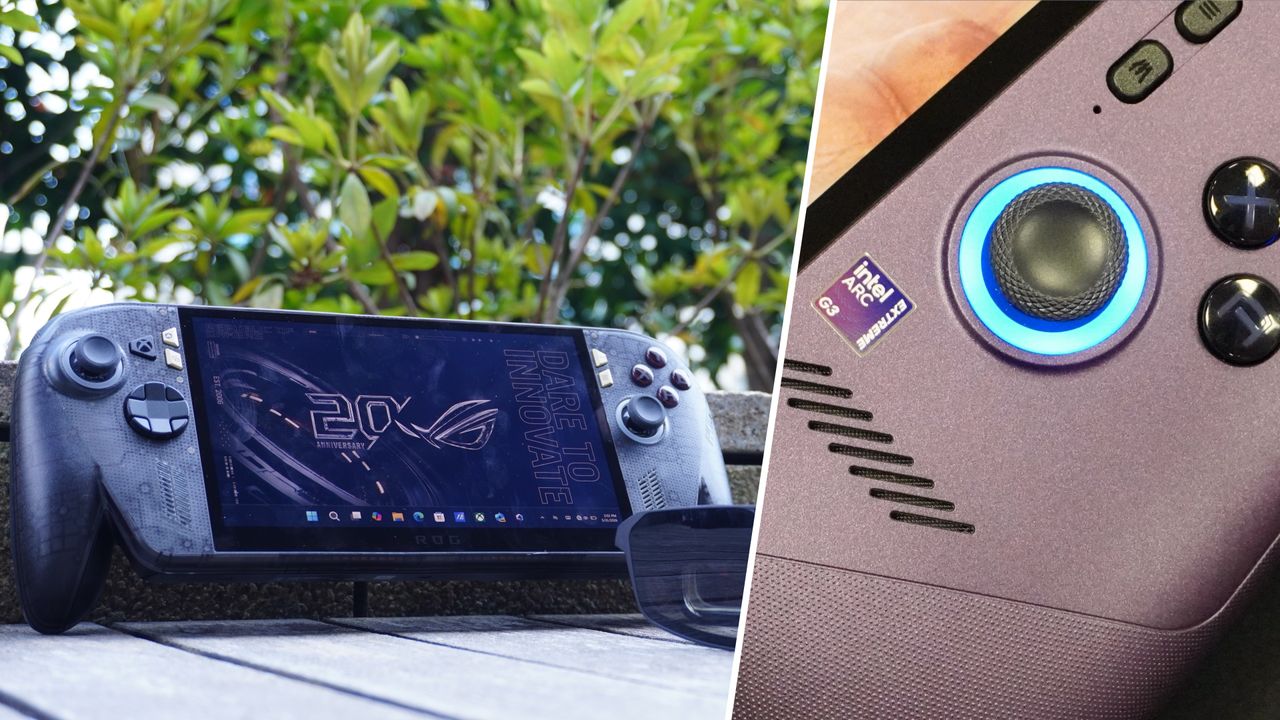
Asus ROG Xbox Ally X20 and MSI Claw 8 EX AI+.

This post was temporarily removed and reposted to correct an error in attribution. Comments attributed to Jack Huynh, SVP of Computing and Graphics, were actually made by David McAfee, Corporate VP and General Manager of Client. We sincerely apologize for the error.

Intel Arc G3 is leaving AMD’s handheld gaming silicon in the dust with 42% better performance than the Ryzen Z2 Extreme, and similar frame rates to the ROG Xbox Ally X20 at half the power.

This has left everyone thinking how AMD will respond? And after announcing FSR 4.1 coming to older RDNA 3 desktop GPUs like the Radeon RX 7900 (the same graphics architecture as what you see on the company’s handheld chip), we all thought this would be the answer.

And then…the internet exploded. HardwareLuxx reported that in a conversation with David McAfee, Corporate VP and General Manager of AMD’s Client Division, he said that FSR 4.1 is “not currently planned” for RDNA 3.5, but “nothing is set in stone yet” — meaning it’s still being considered.

Following that, other publications picked up and reported on the decision “leaning towards “no.”” Then head of AMD’s Client and Graphics Marketing Frank Azor said “no such decision” has been made.

So to get to the bottom of this, we put the question ourselves to David McAfee, Corporate VP and General Manager of Client, and his answer was an interesting one.

‘Quality of service’

(Image credit: Tom's Guide)

David started by sharing the company’s “philosophy around FSR 4 on non-RDNA 4 products” — talking about how the company is focused on making sure it’s right before releasing.

“We want to make sure the experience and the quality is right, and so having a sufficient amount of compute within that product, whether it's a GPU or an APU or whatever, to ensure that you know the performance benefit.” McAfee commented.

To go into the specifics here, AMD-based handhelds are currently locked to FSR 3.1, which is basically an AI-free version of resolution scaling and frame generation — opting to do it purely through math and code. It’s obviously more complicated than that, but for brevity, that’s the barebones explanation.

I did not say it’s coming. I said there is a high-quality bar that we care about a great deal.

David McAfee, Corporate VP and General Manager of AMD’s Client Division

Now, FSR 4.1 is actual AI-based upscaling and frame generation (similar to the XeSS 3 that unlocks Intel Arc G3’s superpowers), which is now available on every chip from Core 100 all the way up to Core 300. So what gives with AMD?

“I guess you'd call it quality of service, so that you're always delivering frames within an appropriate frame time. All of those boxes have to be checked, so that we're delivering a quality experience that Gamers are going to be happy with and advancing the experience that they get through the use of that product.”

“The team are reading the comments and reviews about what we announced, and there is a lot of interest in taking [FSR 4.1] to other parts of the market. These first steps in our roadmap were very important, as we brought it to other architectures.”

Not a yes…but not a no either

(Image credit: Future)

This is probably the more critical part of this question, as we then followed up after this statement with a simple “can I take your answer as “it’s coming” then?”

His answer: “I did not say it’s coming. I said there is a high-quality bar that we care about a great deal. And as we look at other places to apply our FSR technology, the critical factor is ensuring that the quality and gaming experience is uncompromised.”

So it’s not a no, but it’s not a yes as well. It all lines up with the “decision has not been made” comment Azor made, but my personal take is that it’s only a matter of time. Architecturally, the underlying logic to bring FSR 4.1 to the table on this chip is totally possible — that’s been proven by bringing it to RDNA 3 cards.

(Image credit: Tom's Guide)

The challenge is going to come with running a heavy, AI-driven spatial and temporal upscaler on those precious compute units on the chip. But again, given how underpowered Intel’s past two generations have been in comparison to AMD silicon, the fact these run XeSS shows that it’s doable.

AMD needs to respond, fast

(Image credit: Future)

But however you view it’s clear that AMD needs to respond quickly to this, as with a regular annual roadmap of upgrading its hardware and software tech for gaming, Intel’s now in a position to drink Team Red’s milkshake in the PC handheld gaming space.

Maybe it’s a quick switch to FSR 4.1, maybe it’s something that’s cooked up from its work with Sony on PlayStation Spectral Super Resolution — don’t forget the PS5 Pro chip is running on a Frankenstein creation of RDNA 2 and 3 cores, and yet that can do AI acceleration.

But whatever it is, the reasons to go AMD over Intel have almost all gone. Team Blue has a clear integrated GPU plan heading into the future (as well as a team-up with Nvidia for its RTX graphics in a couple years time).

More from Tom's Guide

Sign up to read this article
Read news from 100's of titles, curated specifically for you.
Already a member? Sign in here
Related Stories
Top stories on inkl right now
One subscription that gives you access to news from hundreds of sites
Already a member? Sign in here
Our Picks
Fourteen days free
Download the app
One app. One membership.
100+ trusted global sources.