
Get all your news in one place.
100's of premium titles.
One app.
Start reading
Barchart
Barchart
Ebube Jones

‘I’d Love to Be Able to Save an Airline,’ Says Trump About Spirit. But Is There Any Saving FLYYQ Stock?

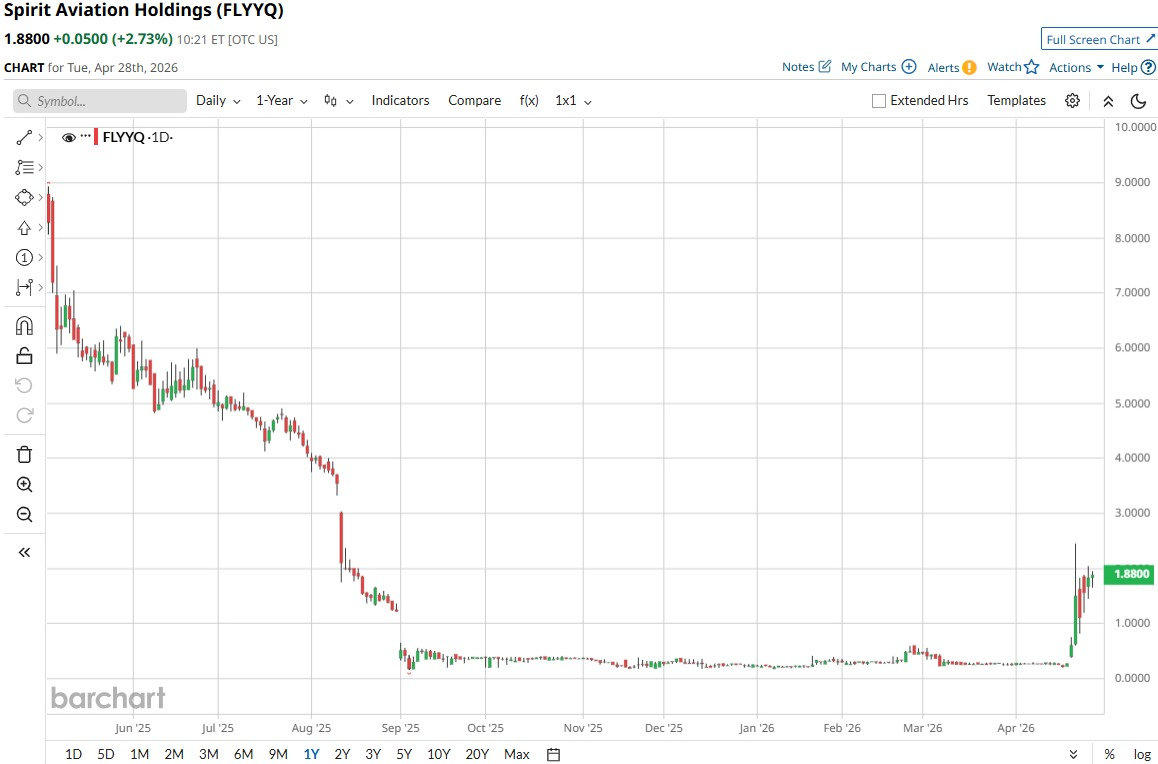
Spirit Airlines (FLYYQ), the ultra‑low‑cost carrier famous for its bright yellow jets and rock‑bottom fares, is back in bankruptcy court and fighting to stay alive. President Donald Trump recently said that he'd “love to be able to save an airline,” even floating the idea that the government could step in. That kind of talk has lit a fire under the stock. Now trading as FLYYQ on the over-the-counter (OTC) market, shares are up about 498% so far this year, recently changing hands at around $1.50.

www.barchart.com

The catch is that the whole company is still only valued at roughly $48.7 million — a reminder that this is a highly distressed, high‑risk bet. For retail traders and opportunistic investors, the mix of politics, bankruptcy, and a soaring chart is hard to ignore.


Yet the rapid moves also raise a critical question. Can presidential comments and potential government support deliver real, sustainable value for current common stockholders of this twice-bankrupt airline? Or is the latest surge simply another volatile chapter in Spirit’s turbulent story?

Trump’s Motive for Backing Spirit Airlines

Trump has been very clear that he wants to help Spirit Airlines. The president has said more than once that he would love to save the company and that he sees value in its planes and other assets, especially if fuel costs come down in the future. In his view, the government could step in at the right price, take over a cleaner balance sheet after bankruptcy, steady the business, then sell it later for a profit once oil prices cool and travel demand holds up.

Jobs are a big part of why Trump is interested. Spirit supports thousands of workers, and shutting it down would hit a lot of families in the cities that it serves. Trump also sees a reason to keep its fleet flying and its airport slots in play, especially on popular leisure routes where budget options matter to everyday travelers. 

Trump is talking about this less like a long rescue and more like a deal where the government steps in, fixes things enough to keep the lights on, then hands the airline off once it looks stronger. His team has been working on a financing package that could reach about $500 million in support to help Spirit out of bankruptcy and keep planes in the air.

There is also politics in the mix. Some people around President Trump and some Republicans in Congress are not keen on the idea of the government owning part of an airline, saying it clashes with free-market thinking.

Trump still sounds ready to spend public money to avoid another big failure in a very visible industry. For him, stepping in to save Spirit is a way to protect workers, keep fares competitive, and show that he is willing to act when a company and its employees are on the line.

Under the Hood of Spirit

Spirit Airlines is still in a very tough spot as an ultra-low-cost carrier in a crowded market. The company has gone into Chapter 11 bankruptcy twice in less than a year, after piling up more than $2.5 billion in losses since 2020, and the old playbook of very cheap fares with lots of extra fees is not holding up the way it once did. 

Bigger airlines have rolled out their own bare-bones tickets and taken more of the budget crowd, and the failed JetBlue (JBLU) deal left Spirit without the extra size and savings it was counting on. To keep going through bankruptcy, Spirit has lined up a $475 million loan to shore up its cash for now. 

The recent jump in jet fuel costs has made the hole even deeper. Oil has moved above $100 per barrel on the back of the Iran war, and that spike has blown up the numbers behind Spirit’s latest turnaround plan. With fuel eating into every ticket, creditors are asking hard questions about how long the airline can survive under its current structure.

Wall Street is not offering much comfort, either. Because of the bankruptcy, delisting, and move to over-the-counter trading, analyst coverage has mostly disappeared. The few forecasts that remain point to big losses ahead, with expected losses per share of around $5.80 for fiscal 2025 and $3.05 for fiscal 2026. 

Even with an estimated year-over-year (YOY) change of about −100% in 2025 and 47% in 2026, the business still sits deep in loss-making territory. FLYYQ stock has a consensus “Moderate Sell” rating based on two analysts, which says a lot about how little faith the market has in Spirit’s current setup. 

www.barchart.com

Conclusion

In the end, the picture is pretty clear. Government help might keep Spirit in the air and protect a lot of jobs, but most existing shareholders are likely looking at heavy dilution or a total wipeout in the final plan. New money from Washington and other lenders will come with strings, and those strings usually mean they move to the front of the line on ownership. While FLYYQ stock has enjoyed a wild run on bailout talk, the more realistic outcome is a much lower value once the bankruptcy process finishes and the waterfall does its work.

Sign up to read this article
Read news from 100's of titles, curated specifically for you.
Already a member? Sign in here
Related Stories
Top stories on inkl right now
Our Picks
Fourteen days free
Download the app
One app. One membership.
100+ trusted global sources.