Get all your news in one place.
100’s of premium titles.
One app.
Start reading
Digital Camera World
Mike Harris

I chose the Nikon Z 180-600mm for its value and reach, but my chiropractor would recommend the Z 100-400mm

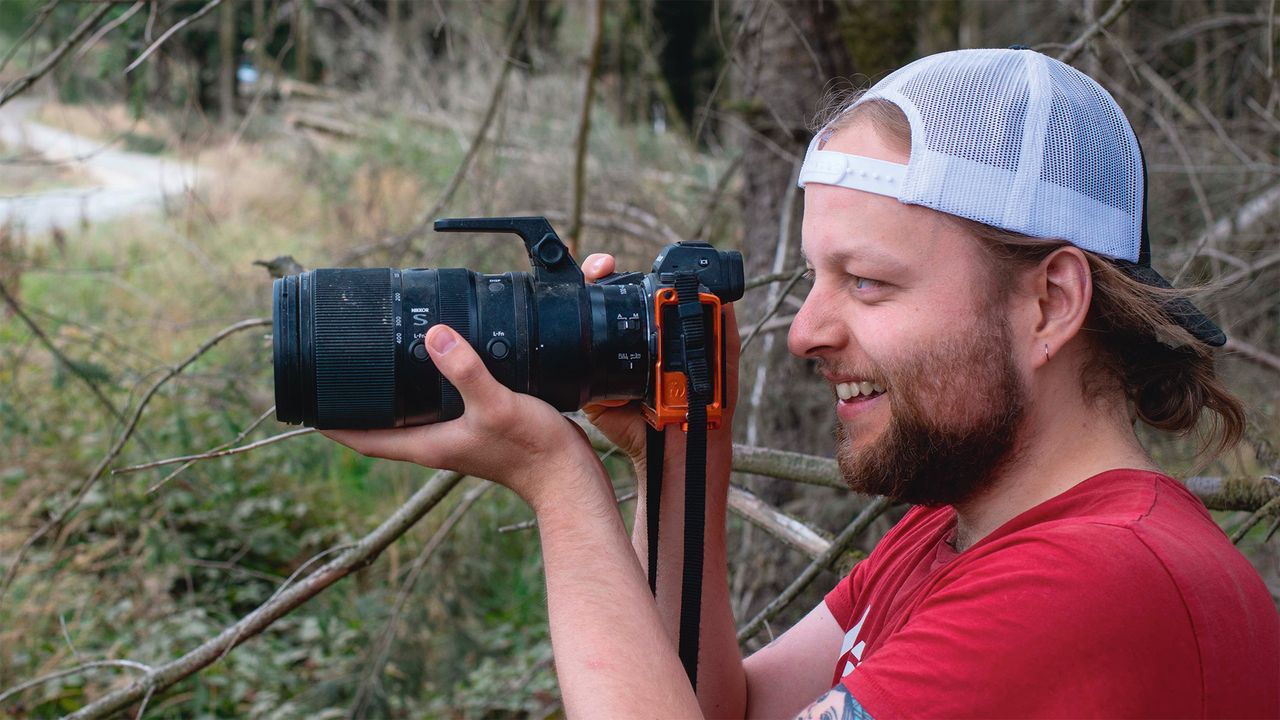
Mike Harris with Nikon Z 100-400mm f/4.5-5.6 VR S .

The Nikon Z 100-400mm f/4.5-5.6 VR S is trending, and I often think of it as the one that got away. You see, I’ve proclaimed that my Nikon Z 180-600mm f/5.6-6.3 VR is my favorite Z lens, and it is. But sometimes, I do get a little jealous of the Nikon 100-400mm.

When I bought the 180-600mm, it was right at the top of my budget and I couldn’t really afford to stretch to the S-Line 100-400mm. I figured the difference between the aperture ranges wasn't all that much, while also being counteracted by the additional 200mm of focal length headroom. And I still stand by that.
But having used the Nikon Z 100-400mm f/4.5-5.6 VR S a few times over the years, there’s something about it I find myself appreciating more and more as I get older: It weighs 1,435g and is 222mm long. Compare that to the 180-600mm, which is 2,140g and 315.5mm, and it’s a big difference that only gets bigger as the day wears on. And if you’re a wildlife photographer, the faster aperture range definitely makes a difference, too.

The Nikon Z 180-600mm f/5.6-6.3 VR is a lovely lens, but it is quite hefty (Image credit: Mike Harris)

Don’t get me wrong, I still absolutely love the Nikon Z 180-600mm f/5.6-6.3 VR. Its internal zoom gives it a premium feel, even though it isn’t an S-Line lens, and that 600mm focal length is an absolute dream for full-frame photographers. But it’s a big lens to fit in a kit bag. So much so, not all camera bags can accommodate it.

And while I can hand hold it, I have to resort to using a monopod when I’m photographing motorsport (something I never bothered with when using the Nikon AF-S 80-400mm f/4.5-5.6 G ED VR). The Nikon Z 100-400mm, on the other hand, is light enough to hand hold all day. I’m not saying it won’t start to feel heavy, but it’s definitely doable. It’s also a much smaller presence in your kit bag.

Both lenses are optically superb, and even though the 180-600mm isn’t S-Line, it delivers fantastic image quality. As such, I wouldn’t hesitate to recommend either lens to anybody interested in sports or wildlife. And if you need a 600mm lens, it’s the cheapest native Nikon Z lens available. But if you’re on the fence about needing 600mm, struggle with back pain, or prefer to use a smaller kit bag, I would consider the Nikon Z 100-400mm.

When I bought my 180-600mm, the 100-400mm was still very expensive on the used market, but the prices have since dropped. I’ve seen it under $1,850 / £1,600, which is a lot better than the near-RRP prices I was dealing with, bearing in mind that the Nikon Z 100-400mm f/4.5-5.6 VR S retails for $2,949.95 / £2,499 and the Nikon Z 180-600mm f/5.6-6.3 VR retails for $2,199.95 / £1,799.

If you’re working with a really tight budget and you’re looking for a long lens, you could always opt for a Nikon DSLR lens paired with a Nikon FTZ Mount Adapter. If you’re happy with a prime lens, the Nikon AF-S 300mm f/4E PF ED VR is my favorite F-mount lens that you can find for a fraction of the price of the aforementioned Z-mount options. Its phase-fresnel element also makes it incredibly compact for a DSLR-era lens.

You might also like...

Calling all Nikon fans, here's why I think the Nikon Z8 could remain in my kit bag for a decade at least! Who needs mirrorless cameras? NASA Artemis II astronauts are taking a trusty-old DSLR around the moon. And if you're thinking of buying a long lens for a new system – here are the best cameras for wildlife photography.

Sign up to read this article
Read news from 100’s of titles, curated specifically for you.
Already a member? Sign in here
Related Stories
Top stories on inkl right now
Our Picks
Fourteen days free
Download the app
One app. One membership.
100+ trusted global sources.