
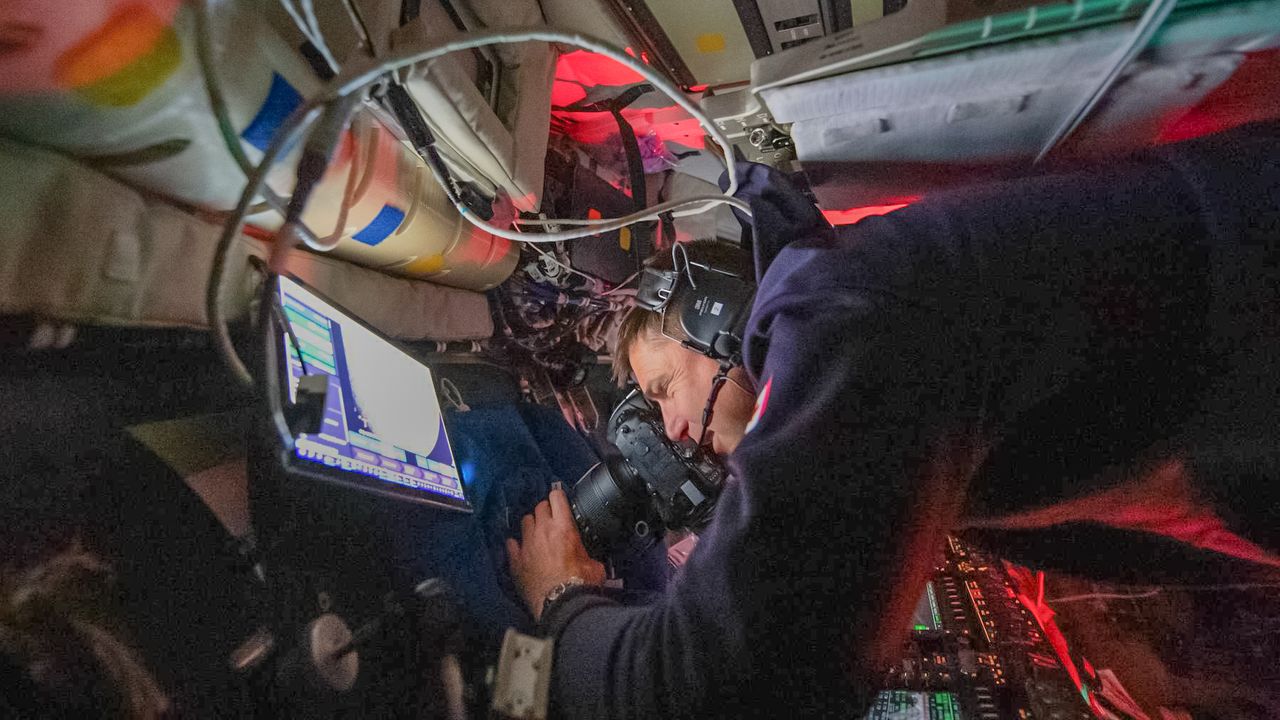
I’ve written opinion pieces on this platform recently about why digital SLRs might be due a comeback – and what still appeals to many photographers about the format.
Even so, you’d expect a multi-billion-dollar fly-by of the Moon to be using the very latest in cutting-edge technology.

So, I was as surprised – and intrigued – as anyone, to discover NASA’s recent Artemis II mission was using the decade-old Nikon D5 as a primary image capture device.
Yes, there were multiple GoPros used both inside and outside the capsule, plus selfies taken with the latest iPhone 17 Pro – while the flagship mirrorless Nikon Z9 also squeezed onto the mission at the last minute.
But the most amazing shots I’ve seen from the trip – of the Moon’s crater-scarred surface and those showing its proximity to, and distance from, Earth – were taken on a DSLR, as widely reported.

Does that now mean we can stop declaring mirrorless better in all respects, and that DSLRs should remain in the past? Even if that’s the stance most camera manufacturers have taken in their desire to get us all to replace and upgrade existing kit?
While some keyboard warriors / worriers might automatically assume NASA’s deployment of the Nikon D5 sheer lunar lunacy, there was method in the astronauts’ madness.
Mission insiders suggested that the D5’s low light performance when it came to deep shadow detail was still peerless, even when pitted against its much newer Z9.
However, while the D5 offers a stratospheric maximum sensitivity setting of ISO3,280,000 compared with the Z9’s top whack ISO102,400, a look at the EXIF data accessible on NASA’s official Flickr page – where it’s posted the now most widely publicised images – reveals that, whichever camera was used, ISO400 was uniformly selected.

Now, I don’t know whether the cameras were not taken off this baseline because that provided consistency, whatever they were being pointed at, or if the desire for maximum clarity, high dynamic range and the lowest possible noise in challenging conditions was of paramount concern.
Yet the quality from both the D5 and Z9 when used in space is so very impressive that I couldn’t slip a slice of dehydrated cheese between them when comparing performance.
To paraphrase the tagline for the original Alien movie: in space no one can hear you scream about whether mirrorless or DSLR is better!
Simply put, now that Artemis II has been around the Moon and back with a DSLR on board, I believe there’s no longer any reason on Earth to have that debate.







