Get all your news in one place.
100's of premium titles.
One app.
Start reading
The Times of India
The Times of India
World
TOI World Desk

'I am alive', 'Israel acted alone': 10 takeaways from Netanyahu’s address after Iran hits Gulf energy hubs

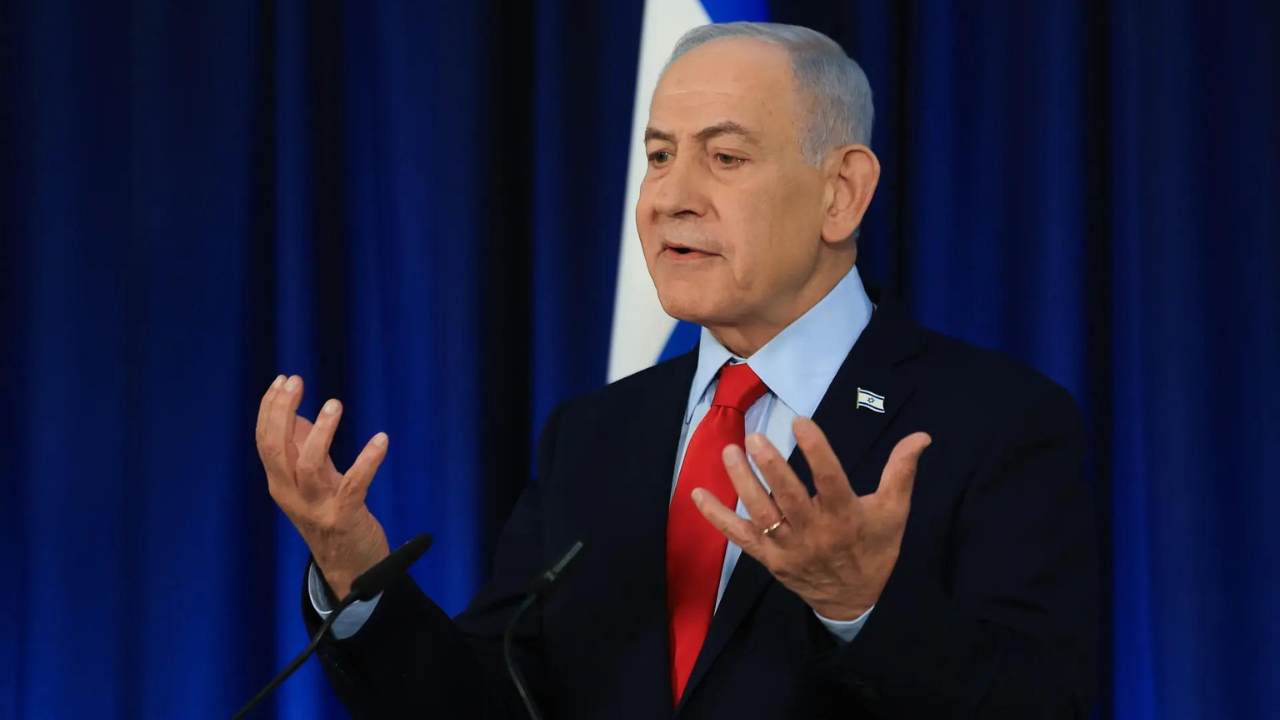
Israeli Prime Minister Benjamin Netanyahu has delivered one of his most expansive defences of the ongoing war with Iran, framing it as a defining global struggle rather than a regional conflict. Speaking amid intensifying strikes and mounting economic fallout across the Gulf, Netanyahu repeatedly cast Israel’s actions as part of a wider effort led alongside the United States to counter what he described as an existential threat.

The remarks come as the conflict, launched on February 28 with backing from the United States, approaches its third week. Iran’s retaliatory strikes on key energy infrastructure have rattled global markets, while diplomatic calls for restraint continue to grow across Europe and the Middle East.
Netanyahu struck a confident tone, claiming the war was progressing faster than expected and that Iran had already been significantly weakened. At the same time, he acknowledged uncertainty around Tehran’s leadership following the killing of Supreme Leader Ali Khamenei, suggesting internal instability could shape the conflict’s next phase.

He also addressed criticism in the United States, rejecting suggestions that Israel had drawn Washington into the war and instead presenting the partnership as strategic and necessary to counter a larger global threat.

What Netanyahu said

On US-Israel partnership

“And I hope that in time, people will see the wisdom and the courage of President Trump’s decision, and his leadership, and the fact that we’re working together. America is not fighting for Israel. America is fighting with Israel for a common goal: to protect our future, to protect civilization against these barbarians.”

On the gas field strike and coordination

“Fact number one, Israel acted alone against the Asaluyeh gas compound. Fact number two, President Trump asked us to hold off on future attacks, and we’re holding off.”

On signs of regime instability

“A lot of signs. A lot of signs. I wish I could divulge all of them, but I see that. But will I tell you, will I commit right now that it’s going to collapse? I can tell you that we’re working to create the conditions for it to collapse, but it may survive, it may not.”

On weakening Iran’s capabilities

“If it survives, it’ll be a lot weaker. There’s no comparison. It’ll be at its weakest point, shorn of industries that it built over decades, death industries, shorn of many other capabilities that they have.”

On military and intelligence strength

“Israel has shown that it can do wondrous things, and in partnership with our American allies, we can do amazing things… It’s the two most amazing air forces in the world… the two most amazing intelligence services in the world.”

On the nature of the conflict

“In this world, it’s not enough to be moral. It’s not enough to be just. It’s not enough to be right… if you are strong enough, ruthless enough, powerful enough, evil will overcome good… you have to be more powerful than the barbarians.”

On accusations of misleading the US

“Well, I misled no one, and I didn’t have to convince President Trump about the need to prevent Iran from developing its nuclear program… He understood that. He explained it to me. I didn’t explain it to him.”

On the cost of war

“Freedom is precious. It has its costs. But if you’re not prepared to defend it, if you’re not prepared to resist the tyrannies that are trying to arm themselves with the weapons of mass death, you will have no future.”

On oil prices and Hormuz tensions

“But if you say, all right, I’m suffering right now — and people are — then I shouldn’t do anything… let Iran develop nuclear weapons… then you’re going to be blackmailed in ways that you can’t even imagine.”

On Iran as a global threat

“The total and utter ruthlessness of this regime makes it uniquely dangerous… not only to Israel and to the United States, but to everything in between and far beyond.”

Beyond these remarks, Netanyahu repeatedly framed the war as part of a broader historical and ideological struggle. He warned that democracies cannot afford hesitation when faced with what he described as a ruthless adversary, arguing that early action is essential to prevent a larger catastrophe.

He also pointed to visible cracks within Iran’s system, including uncertainty in leadership and signs of fear among military ranks, though he stopped short of predicting imminent collapse. Instead, he described Israel’s strategy as one aimed at steadily weakening the regime while creating conditions for potential change.

On ties with Washington, Netanyahu emphasised deep coordination while acknowledging occasional differences, particularly over strikes on energy infrastructure. He maintained that the partnership remains central to the campaign.

Sign up to read this article
Read news from 100's of titles, curated specifically for you.
Already a member? Sign in here
Related Stories
Top stories on inkl right now
One subscription that gives you access to news from hundreds of sites
Already a member? Sign in here
Our Picks
Fourteen days free
Download the app
One app. One membership.
100+ trusted global sources.