
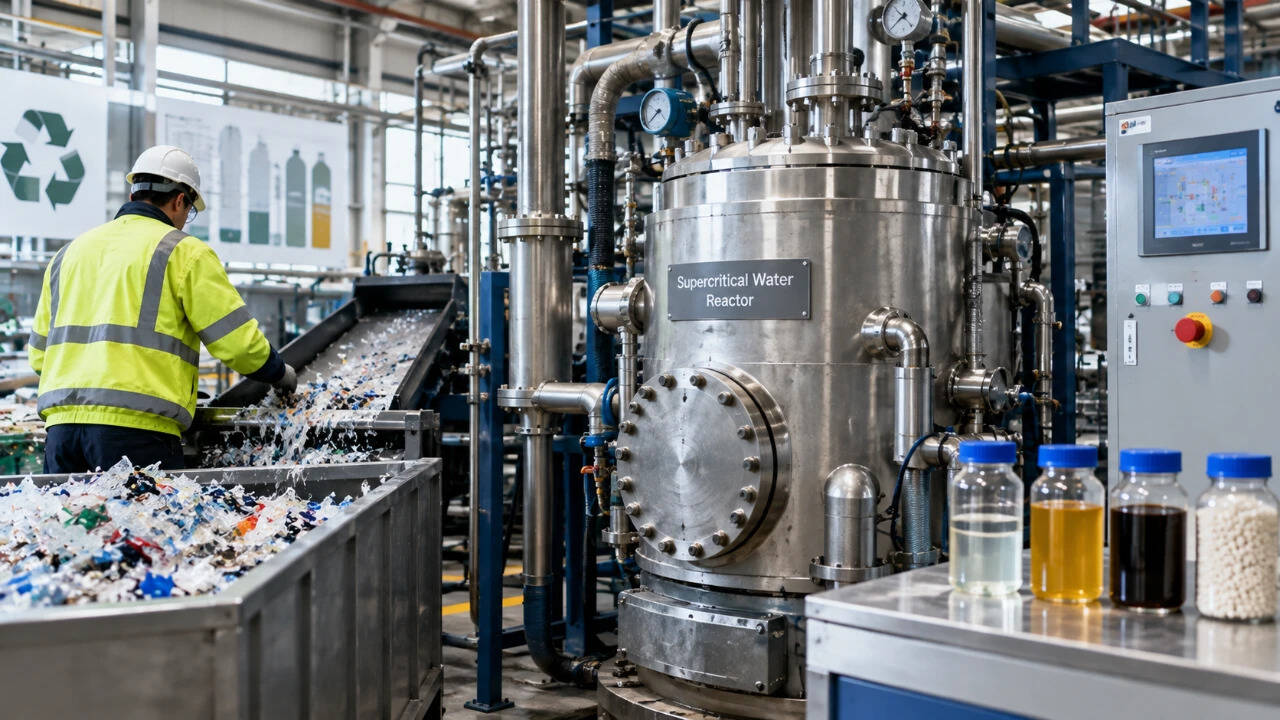
Plastic recycling works best when waste is clean, sorted and made from a single polymer. Mixed packaging, films and contaminated plastics are much harder to process and often end up being incinerated or sent to landfill. In 2023, a British company began experimenting with a different approach at Teesside, using water at extremely high temperatures and pressures to break down difficult plastic waste into hydrocarbons that could be used again in manufacturing.
Get breaking news anytime, anywhere. Download the TOI app now!

According to Reuters, the facility developed by Mura Technology at Wilton International was designed to process 20,000 tonnes of plastic waste a year in its first phase. Rather than burning the material, its HydroPRS process uses supercritical water to break the plastic down into hydrocarbons. These outputs can then be separated and used as chemical feedstock for new plastic and other products.
Using water under extreme conditions
The process starts with plastic waste that is difficult to recycle mechanically using conventional methods. These include films, flexible packaging, pots, tubs, and trays, even those which consist of mixed types of plastics. After preparation, the waste is subjected to water superheated above its critical point of 373 degrees Celsius and pressurised to more than 220 bars. In this state, water behaves differently from liquid water. It becomes a solvent that breaks long-chain polymers into short hydrocarbons.
Research published in the Journal of Polymers and the Environment examined the environmental performance of this type of hydrothermal treatment using data modelled on the Teesside facility. The study estimated a global warming impact of 478kg of CO₂ equivalent per tonne of input plastic and found that the process could have about 80% lower climate impacts than incinerating comparable waste. However, the researchers also identified electricity consumption as a major contributor to the process's environmental impact. This is one reason the technology is different from simply putting plastic through a furnace. The plastic itself is not directly combusted. The aim is to recover its chemical building blocks so they can remain within the manufacturing system.
A 20,000-tonne-a-year starting point
According to Mura Technology, it started its first commercial plant known as HydroPRS at Wilton in October 2023 and initiated its commissioning process. In the beginning, the capacity of the first plant would generate 20,000 tonnes of recycled liquid hydrocarbon products per annum, although there was enough capacity at the site to triple this figure. The company further stated that the first recycled hydrocarbon products would be ready to be supplied to their commercial partners in 2024. These products are not just simple plastic pellets. Some fractions of the hydrocarbons generated could be used as raw materials for petrochemicals and replace a portion of the naphtha used to manufacture plastics from fossil fuels.
Balancing carbon savings with energy costs
An environmental benefit of the technology is linked to what happens to plastic that would otherwise be burned rather than chemically recycled. Reuters reported in 2023 that the company estimated that treating each tonne of plastic could avoid about 1.8 tonnes of CO₂ emissions by preventing the waste from being burned. The life-cycle analysis produced a broadly similar result. It found a global warming impact of 478 kg of CO₂ equivalent per tonne for hydrothermal treatment, compared with 2,340 kg of CO₂ equivalent for burning a tonne of mixed waste plastic. This represents a difference of about 1.86 tonnes of CO₂ equivalent per tonne of plastic, or roughly an 80% reduction in global warming impact compared with burning.
The experiment also highlighted an environmental cost associated with the technology. During the hydrothermal treatment stage, electricity accounted for almost 59% of the process's carbon footprint. The researchers suggested that improving energy efficiency and using lower-carbon electricity could reduce this impact. The Teesside project therefore addresses a specific recycling problem rather than offering a blanket solution for plastic waste. Plastics that are simple to separate can still be mechanically recycled, while more complex materials could potentially be broken down into chemical feedstock. In this sense, the project is not simply about finding another way to dispose of plastic, but about finding a route for difficult waste materials to remain in the production cycle.







