Get all your news in one place.
100's of premium titles.
One app.
Start reading
The Economic Times
The Economic Times

Red Balloon Aerospace launches India's first indigenous super-pressure balloon

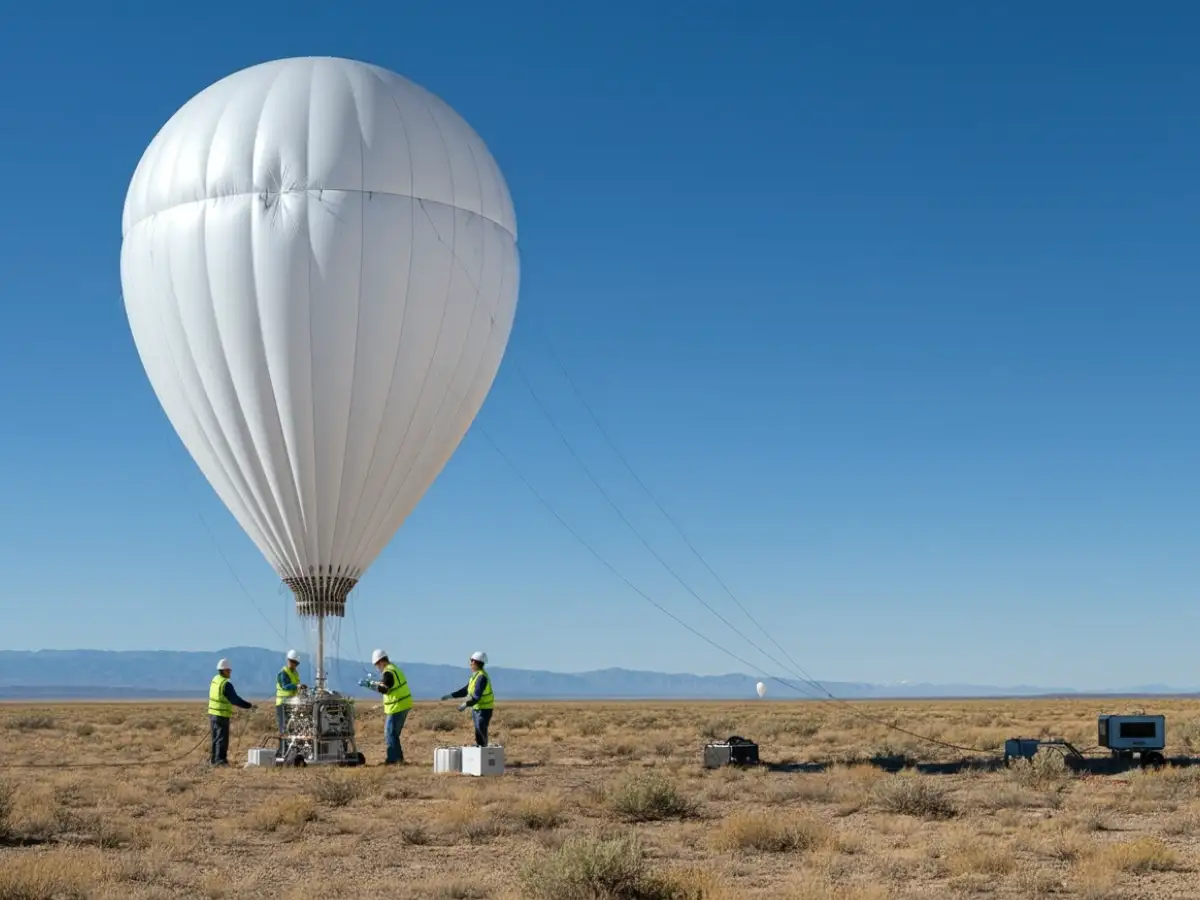
Red Balloon Aerospace on Wednesday launched the country's first indigenous super-pressure balloon (SPB) carrying commercial payloads from seven national and international partners.

SPBs are high-altitude balloons designed to maintain internal pressure higher than the surrounding atmospheric pressure, enabling them to carry payloads for extended periods.
Launched from the Indira Gandhi Stadium in Vijayawada, the SPB, named VISTA, ascended to an altitude of about 25 km.

Speaking to PTI, CVS Kiran, co-founder and CEO of Red Balloon Aerospace, said, "The mission was launched to prove super-pressure balloon capability, which has never been done in India before. This involves proving the balloon's design and the material."

Read More: 'India to become $40 billion space industry,' says Ram Mohan Naidu after launching country's first Super Pressure Balloon in Vijayawada

While the balloon launched on Wednesday is expected to stay in the sky for 24 hours, the company ultimately aims to develop SPBs capable of staying aloft for months.

The mission is significant as SPBs offer several advantages over satellites. For instance, SPBs are much cheaper and are capable of doing all the tasks that a satellite does.

Sireesh Pallikonda, co-founder and COO of Red Balloon Aerospace, told PTI, "LEO satellites are at 500 km, and GEO satellites are at 36,000 km, while near space platforms (like SPBs) are at 20 km. Being 1,800 times closer to Earth than a geostationary satellite allows for higher resolution and faster data rates."

"Also, with SPBs, we do not need a whole constellation. We can launch it wherever service is required, such as hilly terrains or locations where terrestrial towers are not economical," Pallikonda added.

SPBs are typically placed in a high-altitude stratospheric layer between 20 and 40 km from the Earth's surface, according to the company.

Read More: NASA unveils 3-phase plan for permanent moon base; 3 missions this year

This allows them to provide telecommunications coverage, monitor large-scale industrial networks spanning hundreds of kilometres, support disaster-management operations across entire states, and enable continuous spatial observation for strategic applications, it said.

The company plans to launch 12 to 16 such balloons during the current financial year, offering both types of services, rideshare and dedicated missions.

Sign up to read this article
Read news from 100's of titles, curated specifically for you.
Already a member? Sign in here
Related Stories
Top stories on inkl right now
One subscription that gives you access to news from hundreds of sites
Already a member? Sign in here
Our Picks
Fourteen days free
Download the app
One app. One membership.
100+ trusted global sources.