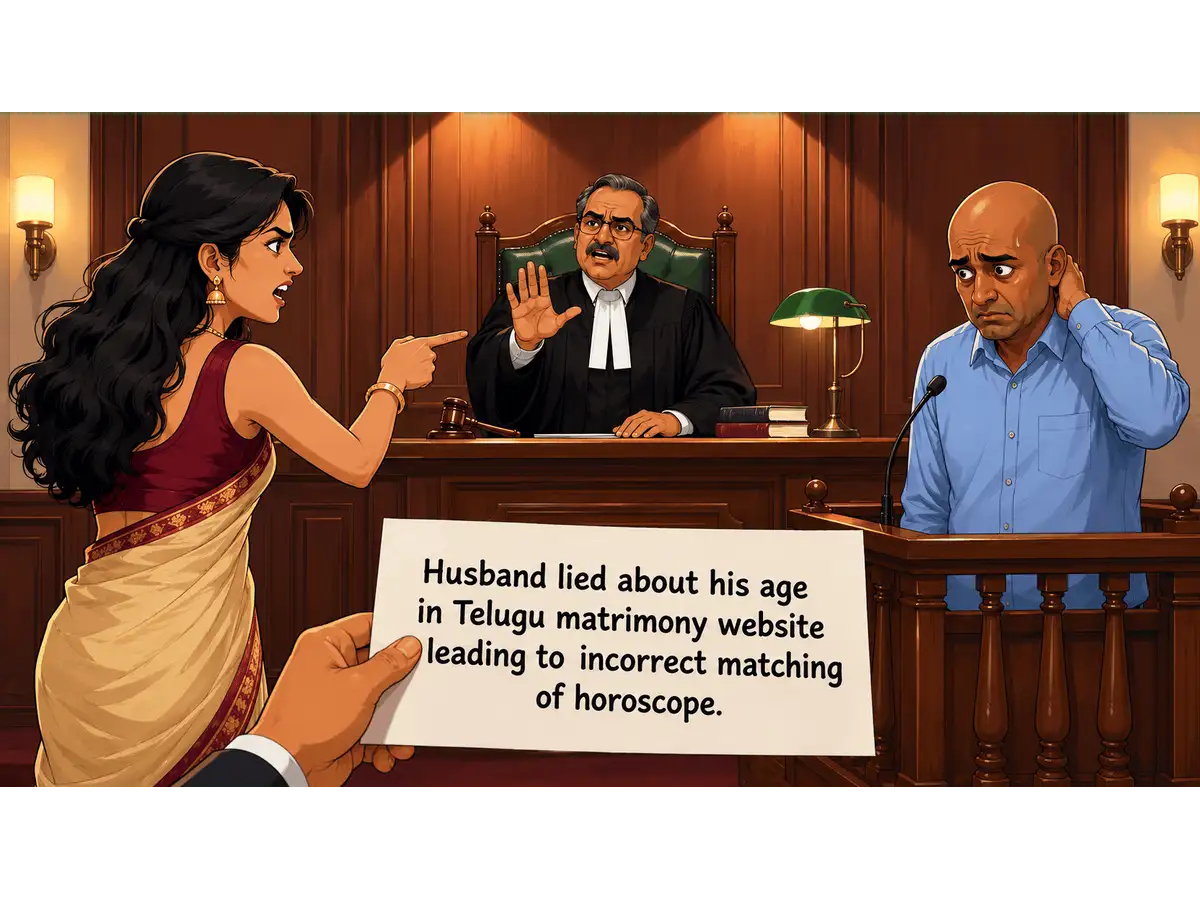
In a recent order, the Telangana High Court granted a wife a divorce after discovering that her husband had lied about his age, which led to her parents incorrectly matching their horoscopes. The high court observed that due to this false information about his date of birth and the horoscope compatibility, she mistakenly thought they were a good match.
After getting married, her dreams of a happy life together were reportedly crashed as she faced harassment and ill-treatment from her husband, his mother and his sister. This eventually pushed her to file domestic violence case against them.

She found about his age deception, when they visited the Sub-Registrar's office in Hyderabad to register their marriage. During the registry process, he disclosed his actual date of birth, thus revealing that he had misrepresented his age on the Telegu matrimonial portal and was about nine years older than her.
At that moment, she realised that the horoscope matching that was done before the marriage had been based on wrong birth details. Consequently, she reported him to the police and filed an FIR against him for cheating and fraud.
However, when the case reached the high court, she expressed her willingness to withdraw the domestic violence as well as the criminal case against the husband (the FIRs) if she was given a fair and reasonable settlement and the return of her gold jewellery.
The husband, however, told the court that he did not have any of her gold jewellery. Instead, he asserted that she had seven tolas of his gold, which he was willing to forgo. He also mentioned that he would agree to have the marriage anulled provided she withdrew the domestic violence and criminal cases pending against him.
The Telangana High Court after hearing their contentions allowed her appeal and dissolved the marriage by granting her a divorce decree. They also gave her the option to file another case for alimony and the return of her alleged gold items.
Regarding permanent alimony, the high court said that since she did not file a separate application under Section 25 of the Hindu Marriage Act, she can't get it now. She would need to file this application and again file another case against him to get permanent alimony.
Both the domestic violence and criminal case against husband (FIR) remain pending in the respective courts. This story is about the divorce judgement (case no. F.C.A. No.226 of 2024, dated May 4, 2026).
Also read: Wife’s MBA degree or past employment with MNCs can’t stop her from demanding maintenance, rules HC
How did this dispute reach court?
On August 24, 2018, an arranged marriage took place between the couple by following all Hindu rites and customs. They both met through an online matrimonial portal i.e., telugumatrimony.com where he had listed his date of birth as February 9, 1981. His actual date of birth was February 9, 1974. She was 36-year-old and it was a late marriage.
She belonged to an orthodox family and her parents believed in matching the horoscopes of the couple. So taking his false date of birth as true, her parents got their horoscope matched and married their daughter with him.
She was under the mistaken belief that both are from the same age group and horoscopes also matched and so all must be well. In hindsight, she told the court, both him and his parents seemed to be in an unusual hurry for the marriage to take place once they were engaged. But at that time she did not suspect anything.
After marriage, she moved to his home in Vijayawada. However, soon he, his mother and sister began to make her life miserable with their constant teasing and sarcasm.
In November 2018, she came with him to Hyderabad to apply for registration of marriage at the office of the Sub-Registrar, Rajendranagar, Hyderabad. When the marriage registrar enquired about his age, she discovered his real date of birth (February 9, 1974) and that he was nine years older than her
This is when she realised that her parents had matched their horoscopes based on the wrong date of birth and she felt deceived by him. Consequently, she decided to seek a declaration to anul the marriage and on the ground of fraud.
He however, denied all allegations. The family court rejected her application and so feeling aggrieved, she filed an appeal in the Telangana High Court.
Telangana High Court order and discussion
A summary of the judgement is as follows:
Both husband and wife does not want to continue with marriage
Both the parties said before the high court that they are not interested in leading a married life. Their respective lawyers also filed affidavits about the same.
In her affidavit, she specifically stated that she is willing to withdraw the domestic violence and criminal case against her husband pending on the file of XIV Additional Metropolitan Magistrate, Rangareddy District at Rajendranagar, provided she received a fair and reasonable settlement and her gold jewellery were returned.
In his affidavit, specifically in paragraph 7, he stated that he will give consent to annul the marriage if she withdraws the cases filed by her (CC No.724 of 2021 and DVC No.41 of 2019).
Husband denies holding any of her gold
His lawyer told the high court that her gold ornaments weighing seven tolas are not with him and she also never brought this up in the earlier cases. On the contrary, his lawyer told the court that she had seven tolas of gold, which he is willing to forgo.
Her lawyer told the court that she is entitled to a fair and reasonable full and final settlement amount and the return of her gold ornaments.
The high court said that the couple was not interested in remaining married and there was no possibility of any reunion. She wanted full and final settlement and her gold, while he wanted her to withdraw the other cases.
Wife needs to make a separate application for permanent alimony
The high court said that under Section 25 of the Hindu Marriage Act, a party seeking permanent alimony has to make a specific application in that regard. In the present case, the appellant has not filed any such application.
Therefore, if she wants permanent alimony, she has to make an application as required under Section 25 of the Hindu Marriage Act before the Family Court. However, she made no such separate application, and so the high court said that they can't grant her permanent alimony.
The high court said that a bare reading of Section 25 clearly indicates that a separate application is required to be made for seeking permanent alimony.
In this regard, reference may be made to the decision rendered by a Division Bench of Madhya Pradesh High Court in the Kuldeep Rai v. Smt.Rita (2024 Supreme (MP) 201) case.
Telangana High Court order
The high court allowed the wife's appeal and dissolved the marriage by granting a decree of divorce.
However, the high court gave the appellant/wife freedom to work out the remedies regarding the return of gold jewelley and also a permanent alimony before the appropriate forum, including in the domestic violence case which she had filed and which was pending in another court.