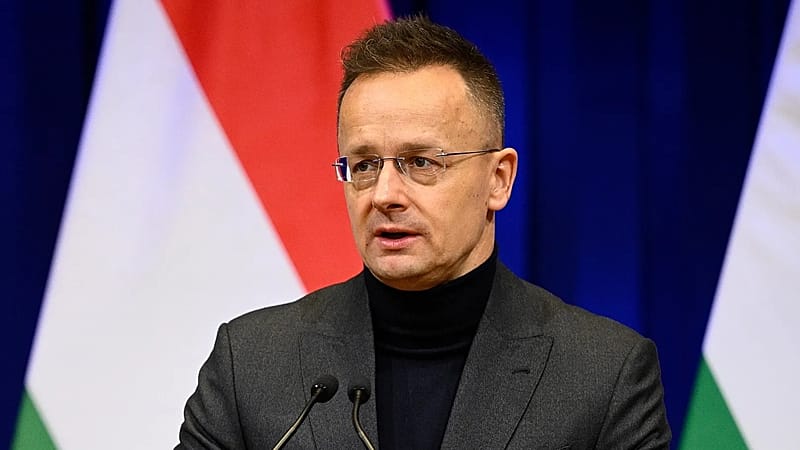
Hungarian Foreign Minister Péter Szijjártó has visted Moscow to hold talks with Russian President Vladimir Putin and secure guarantees on energy imports.
Hungary is one of the last EU member states, along with Slovakia, still importing large volumes of Russian oil and natural gas through pipelines, and the question of energy prices is a hot topic in the Hungarian electoral campaign, where the opposition Tisza party leads opinion polls ahead of Prime Minister Viktor Orbán's Fidesz.
Hungary is locked in a dispute with Ukraine over the Druzhba pipeline, which was damaged in a suspected Russian air strike at the end of January.
Budapest and Bratislava say the pipeline can be made operational, and that Ukraine is blocking repair work for political reasons, but Kyiv says any repair work would be risky and could only proceed under a ceasefire with Russia.
Because of the dispute, Hungary has blocked the implementation the EU's €90 billion loan package to Ukraine.
Hungary warns of international energy crisis
Speaking upon arriving in Moscow on Wednesday, Szijjártó said the war in Iran and the closure of the Strait of Hormuz posed a fresh challenge in the context of the Druzhba situation.
"In this situation, I am here in Moscow to make sure that we still have the oil and natural gas necessary for the security of Hungary's energy supply during the crisis," Szijjártó said.
He added that he was seeking guarantees that Russia would deliver the supplies Hungary needs despite the "global energy crisis".
Kremlin spokesman Dmitry Peskov said both Hungary and Slovakia were suffering from what he called "Ukraine's blackmail." He added that no other European countries had asked to restart energy flows from Russia, despite the escalating situation in Iran.
Szijjártó also said he would raise the issue of two Hungarian prisoners of war held by Russia with Putin, and expressed hope that they would be able to board the return flight to Hungary with him.
European Commission mediates with Kyiv
Earlier, Hungary and Slovakia demanded that Ukraine allow their experts to assess the condition of the pipeline. Kyiv did not respond to the request.
On Tuesday, European Commission President Ursula von der Leyen spoke by phone with Ukrainian President Volodymyr Zelenskyy, during which the pipeline issue was also discussed, according to EU diplomats. The outcome of their conversation is not known.
Hungary had also asked the European Commission and Croatia to allow the import of Russian seaborne oil through the Adria pipeline. Zagreb rejected the request, saying Russian oil is subject to international sanctions.
On Wednesday, the Hungarian Oil Company MOL, together with Slovakia's Slovnaft, filed a formal complaint at the European Commission over the alleged abuse of a monopoly postion by Croatian pipeline operator JANAF.