Get all your news in one place.
100's of premium titles.
One app.
Start reading
The Conversation
The Conversation
Luke Parry, Associate Professor of Palaeobiology, Department of Earth Sciences, University of Oxford

Humans’ closest invertebrate ancestors date back much further than thought – how we discovered the fossils that show this

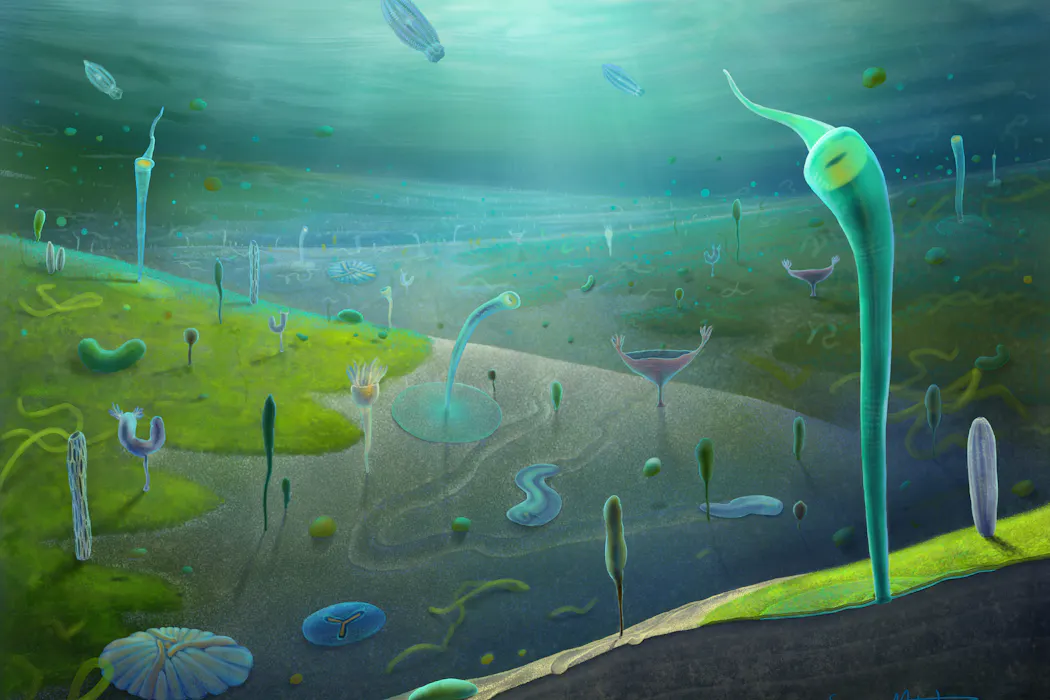
Artist's impression of Earth's earliest complex animals during the late Ediacaran period – before the 'Cambrian explosion'. Xiaodong Wang, CC BY-SA

Animal life is extraordinarily diverse and complex, having colonised almost all environments on Earth – from hostile hydrothermal vents in the deep sea to the skies across our continents.

But the planet was not always teeming with complex animal life. For the first 3.7 billion years after it originated, life was small, simple and largely confined to the oceans. This microbe-dominated world was a tumultuous place, with several major swings in its climate.

Sign up to read this article
Read news from 100's of titles, curated specifically for you.
Already a member? Sign in here
Related Stories
Top stories on inkl right now
One subscription that gives you access to news from hundreds of sites
Already a member? Sign in here
Our Picks
Fourteen days free
Download the app
One app. One membership.
100+ trusted global sources.