Paris-Roubaix has always had a habit of making fools of perfectly good road bikes. Riders can turn up with the fastest, lightest, most wind-cheating machine in the world, and within a few sectors, feel like they have brought a toothpick to a demolition site.
From a tech perspective, the most revealing thing about the race isn’t perhaps who wins – though chapeau to Wout van Aert and Franziska Koch – but how the peloton bends the rules of what a road bike is allowed to be in order to survive it.

This year at the men's race, we saw tyres grow in size again to as big as 35mm. Single chainrings, or 1x drivetrains, are also the firm Roubaix favourite, even if the way teams are achieving them is increasingly archaic. Plus, we spotted plenty of small, telling compromises, some of which look more like damage limitation than optimisation.
35mm tyres

Not long ago, 30mm tyres felt radical. But as frame design has changed to allow more clearance, widths aren't just creeping up, they're maxing out available room in many quarters.
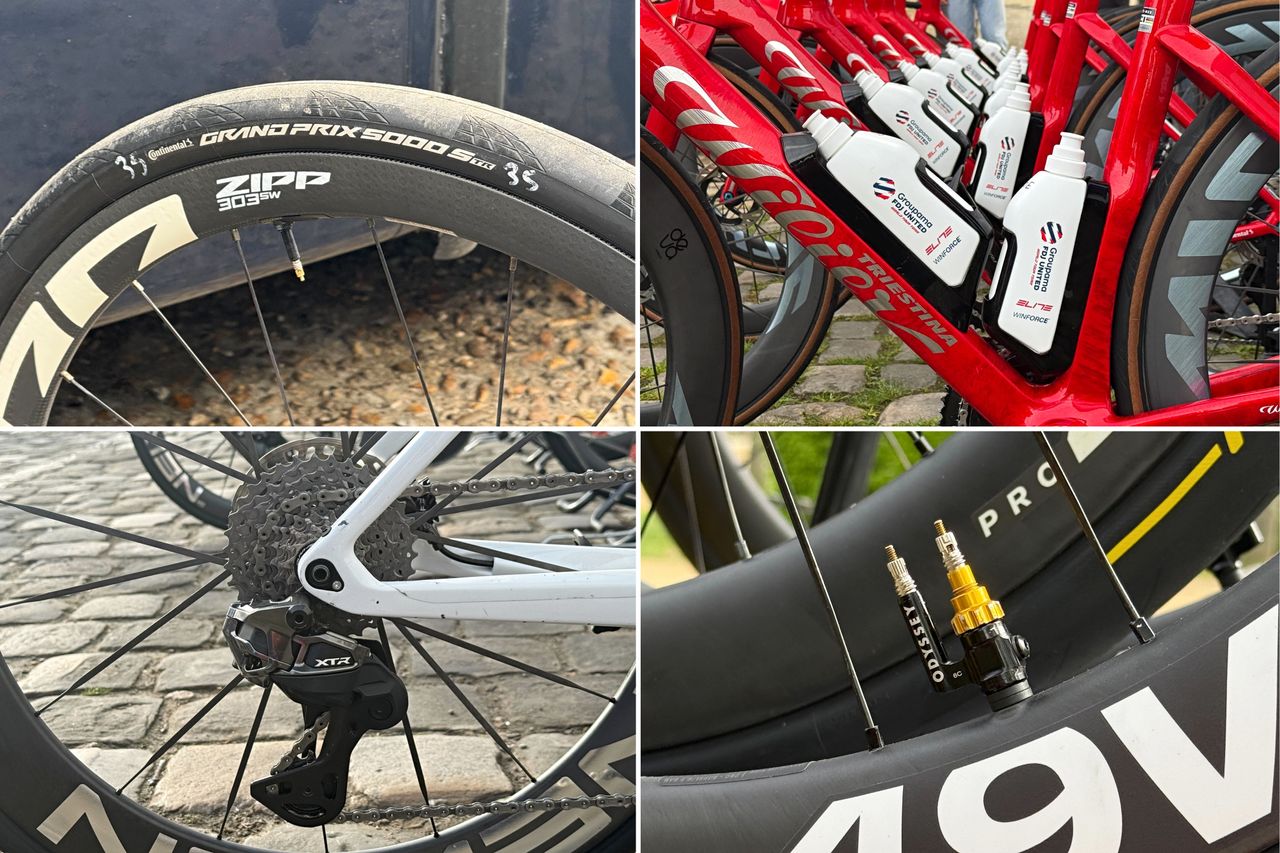
35mm was the clear width of choice for Tadej Pogačar's UAE Team Emirates-XRG, as well as Decathlon CMA CGM and Movistar, with all committed to it this time out, where they could fit it.
Interestingly, both UAE and Decathlon ran mismatched set-ups, with a 35mm tyre at the front, and a 32mm at the back. This may be more about available room than data, but it also seems likely there’s a trade-off some are calculating for here, with the larger volume tyres featuring up front where there’s the most benefit, and least downsides for acceleration, or rotating mass.

The debate on ever wider rubber strategy isn’t final, though. Modern Adventure Pro Cycling (multicoloured forks above), among the majority of the teams, ran 32mm tyres at this year's race, although press information supplied to us in the run-up suggested they’d been cramming in 34mm rubber ahead of the race.
The American ProTeam ran 58mm deep rims, so perhaps there’s some compromises they weren’t prepared to make in terms of the aero package, when the tyre is considered with the rim. This could simply be down to frame clearance, of course.
Groupama-FDJ United (red forks above), meanwhile, appeared to have room to go much wider, but chose not to, sticking with 32mm despite the available space. It seems somewhere in the low thirties remains the sweet spot once rolling resistance, aerodynamics and handling are all factored in – especially when the cobbles are dry and fast.
Double valves

Tubeless anxiety continues to plague plenty in the pro ranks, it seems. While some teams persist with tyre liners, or even glue their tyres on, others have hedged their bets, combining tubeless set-ups with a new two valve system.
Given away by the presence of a two-stem valve, the system Lidl-Trek used at the race is from BMX brand Odyssey, and essentially provides a tyre insert for your standard tubeless set-up, which looks like an extra TPU tube, inside the tubeless system.
Some digging around on the internet revealed that Odyssey claim to have solved the issue of tyre burping, while protecting the rim from impacts. The product also “locks the tyre bead on”, according to the brand, and provides a temporary “run flat” back up – perfect for those unwanted punctures across the cobbles.
1x drivetrains

If tyre width has settled into an uneasy consensus, drivetrains have gone in the opposite direction entirely. 1x set ups are now commonplace, but the routes teams are taking to fit them has become increasingly creative, bordering on rebellious.
SRAM’s XPLR gravel groupsets, first spotted last year on Lidl-Trek's bikes, provide the go-to ready made set-up, and they were in evidence again, unsurprisingly. Modern Adventure, for example, paired a 10-46 cassette with their single ring set-ups – that's gravel gearing, plain and simple.
EF Education-EasyPost, pictured below, also adopted the XPLR.

Shimano-supported teams, however, took a more improvised approach.
At TotalEnergies, the line-up looked less like a unified equipment strategy and more like a pick-and-mix: Anthony Turgis ran a mountain bike XTR rear mech (pictured below) for its chain retention, while Thomas Gachignard was among three TotalEnergies riders who opted for Shimano's GRX, the gravel equivalent. Others on the same team stuck with the standard Dura-Ace road groupset.

It would be easy to frame this as inconsistency, but in reality it’s a clear signal that chain security is worth bending the equipment hierarchies for. The theoretical neatness of a complete drivetrain – that Shimano is said to prefer to see from it’s supported teams – is perhaps growing a little old in events like this one, where good components are clearly available to solve some of the problems presented by the uniquely punishing course.
That's not to say that standard, off-the-shelf set-ups don't still exist at races like Paris-Roubaix. Take Alpecin-Premier Tech's Mathieu van der Poel, for example, who ran his usual double-ringed Dura-Ace groupset that brought him victories in 2023, 2024 and 2025.

Unreleased pedals and wheels

There's evidence to suggest that Shimano may be releasing a batch of new products in the not-so-distant future.
On Alpecin-Premier Tech's bikes at Roubaix, we spotted prototype C60 wheelsets with carbon spokes, which we've seen several times at races now, and give us reason to be excited about what else might be in development.

Alpecin-Premier Tech were also trialling new pedals at the race. In fact, it's been reported that the reason Van der Poel was unable to ride his team-mate's bike after puncturing on the Arenberg sector was because they had different pedals – some on the old, some on the new.
Van Aert keeps it simple

Van Aert, the race winner, offered perhaps the clearest rebuttal to all the hacked groupsets we saw across the team paddock. The Belgian's set-up – a 54-tooth chainring paired with a tight 10-28 cassette and a standard road rear mech – prioritised closely spaced gearing over outright security.
We also saw plenty of 13-speed SRAM rear mechs being used with pins limiting their movement so they could be run on 12-speed road cassettes. It’s not the first time we’ve seen this of course, but it’s another tell that gearing is really critical on flat, fast races like this one.
There’s a clear tension there between survival, and out and out performance, which individual riders are making very different calls on.
Aero is still everything
FDJ had aero bottles on show. So what? Well, it's proof that marginal gains are still really important, and don’t stop mattering just because the road surface is cobbled and uneven.

Deep section wheels were also still present, albeit used more selectively, as well as Tudor Pro Cycling’s choice of DT Swiss GRC 1100 gravel wheels – a choice that sums up the blurred lines this race creates in equipment strategy: aerodynamic gravel wheels being used in a WorldTour race would only be odd at any other race.

Monster chain rings

There were also some massive chainrings on show. King of the ring was Ineos Grenadiers' Josh Tarling once again, claiming the unofficial prize for his whopping 62-tooth dinner plate that looks pretty absurd until you consider the speeds these riders still carry even over the roughest sectors.
Blacked-out kit

For all the polished kit on display, the spirit of Roubaix lived on in the less sanctioned details. Picnic PostNL provided perhaps the most entertaining example this year, appearing to sidestep sponsor obligations by running Vittoria Corsa tyres with logos blacked out in marker pen. The team usually runs sponsor-supplied Michelin rubber.
Ineos Grenadiers, similarly, albeit a bit more tidily, appeared to use black electrical tape to cover the brand of their aftermarket chainrings, which allow gearings combos their specific sponsors couldn’t deliver.

Grip tape galore

Elsewhere, hacks were more practical than political. Grip tape, the kind more commonly found on skateboards, once again found its way inside bottle cages to keep bidons in place over the cobbles.
There were also some cool new contact points; Prologo’s new OctoTouch 3D bar tape made a pretty widespread appearance, and is pictured below on XDS Astana's bikes.

Also from Prologo came Van Aert's new saddle, so-called 'Choice', which is described as an ‘integrated’ saddle. We didn't manage to photograph it at the start in Compiègne, but the best way to describe it is in it having a side skirt, or apron, made in carbon fibre, which extends down from the saddle to encase the rails, out of the wind. It’s got the look of a high-tech Selle Italia Turbo, with extra depth delivered by the carbon apron. We’re told it retails at around £500, so it’s another popular dentist’s saddle in the making, for sure.
Once again, taken in the round, these little hacks, workarounds and clear evidence of some very considered equipment choices prove that Roubaix rewards pragmatism, ingenuity and a willingness to bend both equipment and expectations as far as possible.
The bikes surely do resemble their road-going counterparts at a glance, but as you look a little closer, the truth is clearer. Wider tyres, mixed drivetrains, improvised hacks, and tweaks all point to the same conclusion: a ‘normal’ road bike isn't enough, at least not for this one day in April.