
Get all your news in one place.
100’s of premium titles.
One app.
Start reading
Space
Space
Science
Julian Dossett

Hubble Telescope spies 'wake' of supergiant Beutelgeuse's hidden companion star

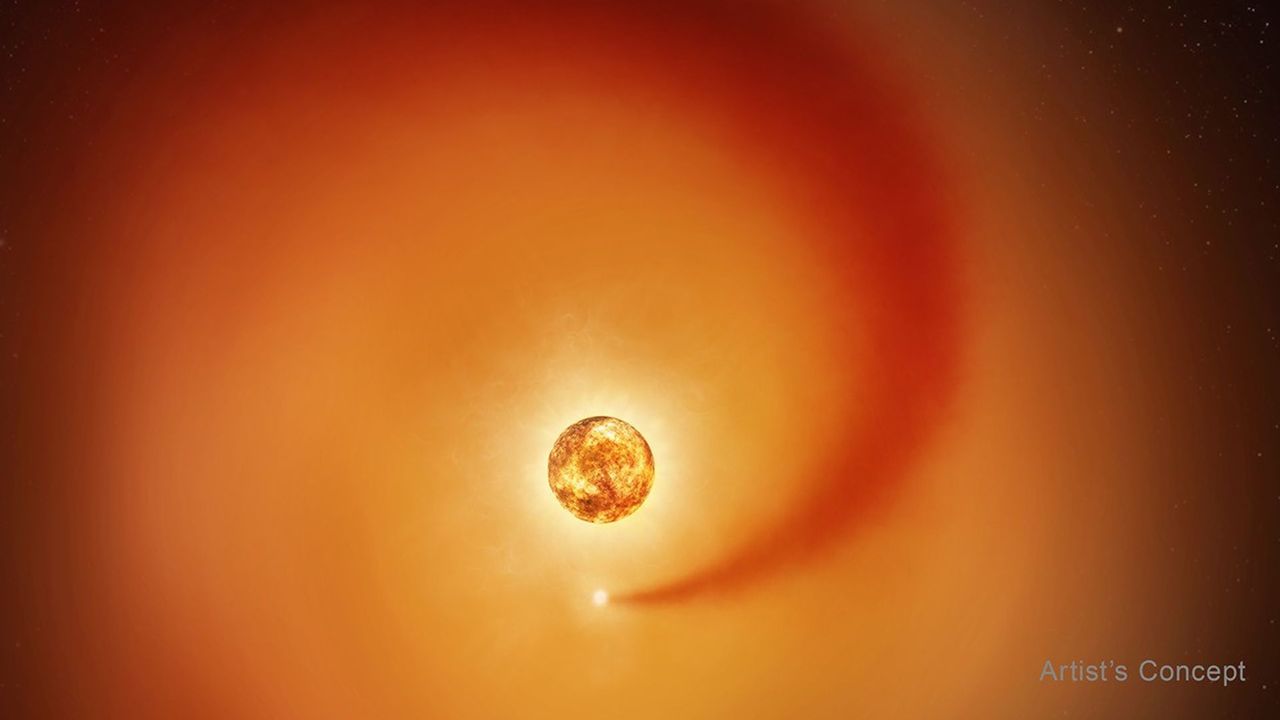
This artist’s concept shows the red supergiant star Betelgeuse and an orbiting companion star. The companion, which is orbiting clockwise from this point of view, generates a dense wake of gas that expands outward. .

Astronomers and scientists love Betelgeuse because it shines so brightly. While most stars appear as tiny points of light, Betelgeuse is large enough, and close enough, that we can study it in much greater detail. But this red supergiant star is strange, often shifting, dimming and brightening in our night sky.

In July 2025, scientists found a companion star in Betelgeuse's outer atmosphere, which could account for the red supergiant star's odd appearance. Now, using new observations from the Hubble Space Telescope, as well as data from observatories here on Earth, scientists have detected the wake of Betelgeuse's companion star, which is named Siwarha. This new study confirms Siwarha's existence.

"The idea that Betelgeuse had an undetected companion has been gaining in popularity for the past several years, but without direct evidence, it was an unproven theory," study lead author Andrea Dupree, an astronomer at the Center for Astrophysics | Harvard & Smithsonian (CfA), said in a NASA statement on Monday (Jan. 5).

"With this new direct evidence, Betelgeuse gives us a front-row seat to watch how a giant star changes over time," she added. "Finding the wake from its companion means we can now understand how stars like this evolve, shed material and eventually explode as supernovae."

With the combined observations of Hubble and telescopes at the Fred Lawrence Whipple Observatory in Arizona and Roque de Los Muchachos Observatory in the Canary Islands, the researchers spotted a "pattern of changes" in Betelgeuse. They could recognize Siwarha's wake, or trail, because it's composed of material that's denser than the outer-atmospheric gases that surround it.

Scientists used NASA’s Hubble Space Telescope to look for evidence of a wake being generated by a companion star orbiting Betelgeuse. The team found a noticeable difference in light shown in the lefthand peak when the companion star was at different points in its orbit. (Image credit: NASA, ESA, Elizabeth Wheatley (STScI); Science: Andrea Dupree (CfA))

Every six years, when Siwarha crosses between Betelgeuse and Earth, the trail becomes visible, and due to its density, it changes the spectrum of colors emitted by the various elements in Betelgeuse's atmosphere.

"It's a bit like a boat moving through water. The companion star creates a ripple effect in Betelgeuse's atmosphere that we can actually see in the data," Dupree said. "For the first time, we're seeing direct signs of this wake, or trail of gas, confirming that Betelgeuse really does have a hidden companion shaping its appearance and behavior."

Siwarha will become visible again in 2027, and researchers are already planning new observations for the event.

The new results on Siwarha's wake were presented Monday at the 247th meeting of the American Astronomical Society in Phoenix, Arizona. The study will appear in The Astrophysical Journal.

Sign up to read this article
Read news from 100’s of titles, curated specifically for you.
Already a member? Sign in here
Related Stories
Top stories on inkl right now
One subscription that gives you access to news from hundreds of sites
Already a member? Sign in here
Our Picks
Fourteen days free
Download the app
One app. One membership.
100+ trusted global sources.