
Get all your news in one place.
100's of premium titles.
One app.
Start reading
Digital Camera World
Alan Palazon

Hubble captures images of an “ethereal” spiral galaxy located 380 million light-years from Earth

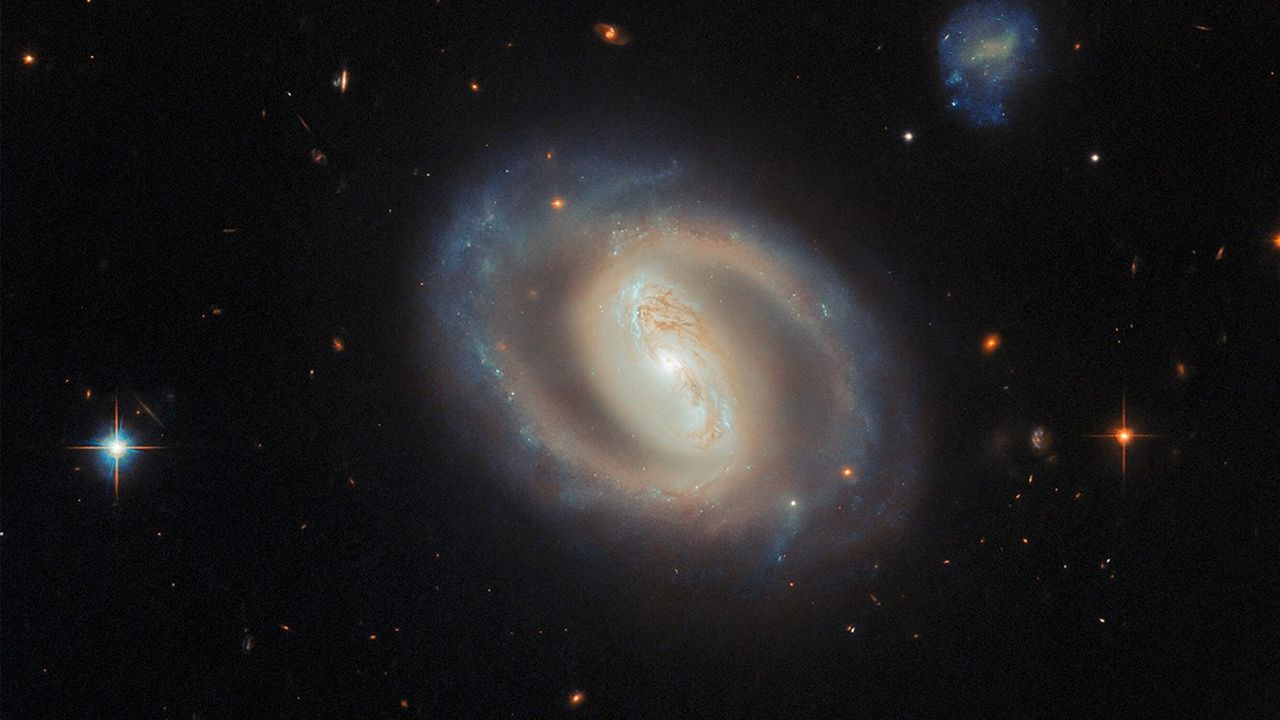
Image of spiral galaxy captured by Hubble Space Telescope.

It’s almost 36 years since the Hubble Space Telescope was launched and NASA continues to blow minds with the unbelievable and often iconic images captured by the device.

The latest of these to be shared by the space agency is of IC 486, a barred spiral galaxy that sits at the edge of the constellation Gemini (the Twins), roughly 380 million light-years from Earth, far beyond any distance the human mind can imagine.

To try to put this into context, it would take a spaceship travelling at the speed of light close to 5 million human lifetimes to reach the galaxy.

NASA has classified IC 486 as a barred spiral galaxy due to the central bar-shaped structure from which its spiral arms stem. Within the centre of the bar lies IC 486’s active galactic nucleus (AGN), which emits a glowing white light NASA has described as “ethereal”.

(Image credit: ESA/Hubble & NASA, M. J. Koss, A. J. Barth)

As if IC 486 wasn’t already mind-boggling enough, powering its AGN is a supermassive black hole more than 100 million times the mass of our Sun.

An accretion disk – a swirling mass of cosmic gas and dust – revolves around the black hole and generates, what NASA describes as “intense radiation”, including X-rays, responsible for the “ethereal” light that outshines the rest of the galaxy.

This latest Hubble image was pieced together using data from two separate observations that survey nearby galaxies to record high-quality images of their central black holes and the stars near their cores.

NASA combined Hubble’s imaging capabilities with the survey data to create “detailed comparisons” of how stars, gas, dust, and black holes interact in galaxy centers.

You might also like

Discover how, during its 34th year of operation, Hubble uncovered an “unusual” spiral galaxy that didn’t quite fit scientific descriptions. Or, take a look at the best cameras for astrophotography.

Sign up to read this article
Read news from 100's of titles, curated specifically for you.
Already a member? Sign in here
Related Stories
Top stories on inkl right now
One subscription that gives you access to news from hundreds of sites
Already a member? Sign in here
Our Picks
Fourteen days free
Download the app
One app. One membership.
100+ trusted global sources.