
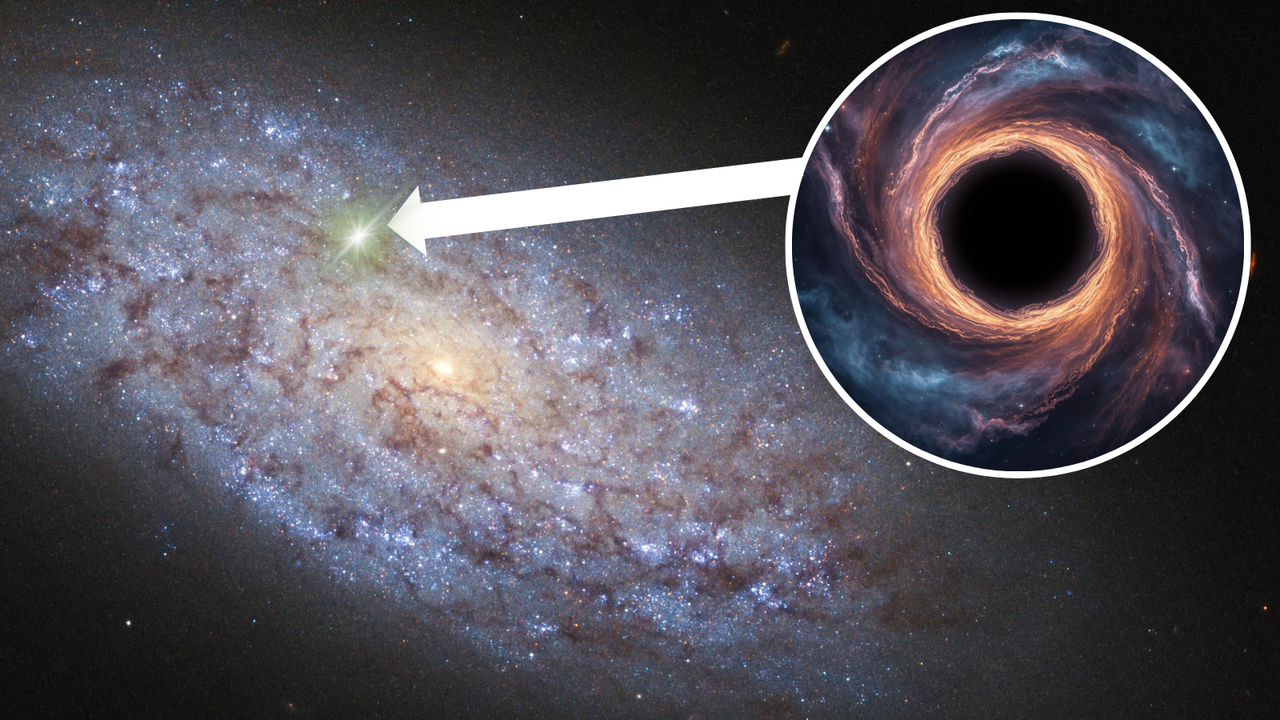
Using NASA's Hubble Space Telescope and Chandra X-ray Observatory, astronomers have hunted for "wandering" black holes drifting through dwarf galaxies. The discovery of these rogue black holes in such small galaxies could provide a "fossil record" that helps to explain how supermassive black holes grew to masses of millions or even billions of times that of the sun.
Supermassive black holes are found at the heart of all large galaxies, and the James Webb Space Telescope (JWST) has increasingly been discovering these cosmic titans already in place when the cosmos was less than 1 billion years old. That is problematic because the merger and feeding processes that are thought to explain supermassive black hole growth should take over 1 billion years to reach fruition. One possible explanation for this is that the process that spawns supermassive black holes may kick off with so-called "black hole seeds" that give a head start to these growth processes. These seeds, classified as either "heavy" or "light," have proved elusive in galaxies in the early universe.