Get all your news in one place.
100's of premium titles.
One app.
Start reading
The Conversation
The Conversation
David Unwin, Reader in Palaeobiology, School of Heritage and Culture, University of Leicester

How we worked out a fossilised ‘pterosaur’ was actually a fish – new research

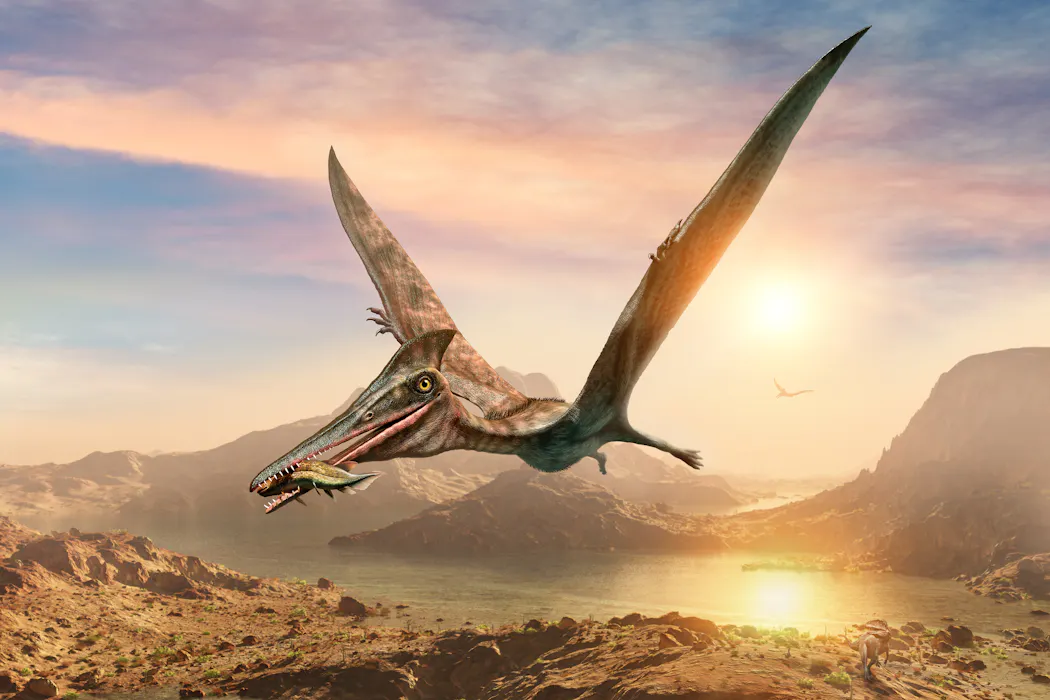
Artist's impression of a pterosaur with a fish in its mouth. Fossils of one have sometimes been mistaken for the other. Warpaint/Shutterstock

Georges Cuvier, the 19th-century French anatomist who first recognised pterodactyls as flying reptiles, wrote that “of all the beings whose ancient existence has been revealed to us, [they are] the most extraordinary”.

Now known as pterosaurs, this extraordinarily diverse, highly successful group lived alongside dinosaurs for more than 150 million years, occupying habitats around rivers, lakes, coasts and even the open ocean. While some species were quite small (no bigger than a pigeon), a few evolved into flying giants with wingspans exceeding ten metres.
Sign up to read this article
Read news from 100's of titles, curated specifically for you.
Already a member? Sign in here
Related Stories
Top stories on inkl right now
One subscription that gives you access to news from hundreds of sites
Already a member? Sign in here
Our Picks
Fourteen days free
Download the app
One app. One membership.
100+ trusted global sources.