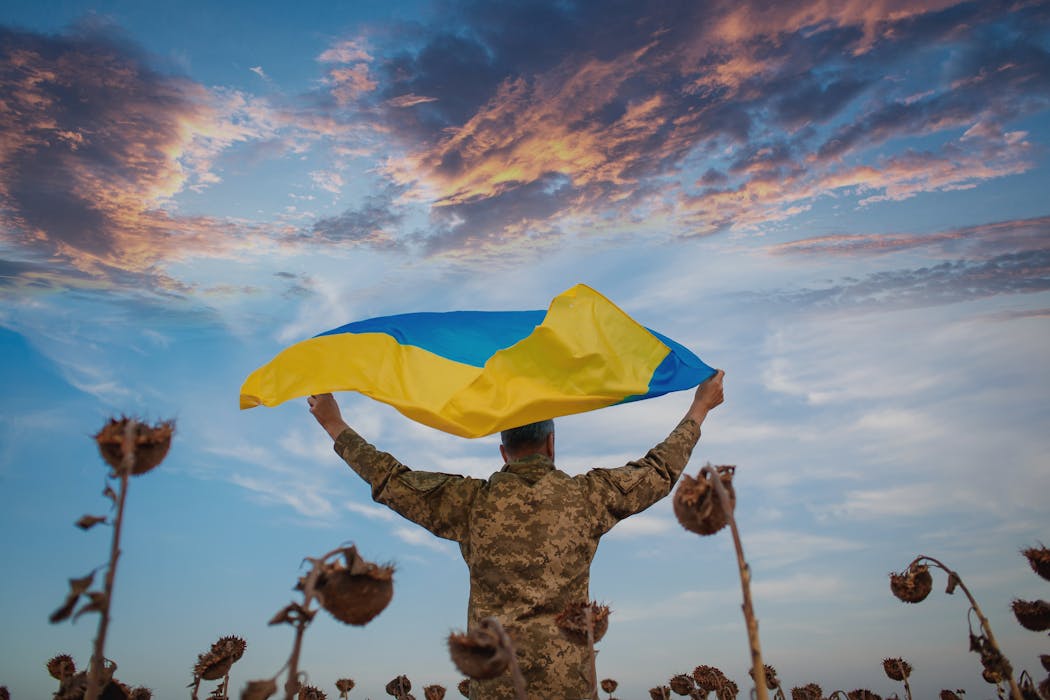
Russia’s war in my home country Ukraine has caused environmental damage on a vast scale. Roughly 2.4 million hectares of agricultural land – an area almost the size of Wales – are now littered with unexploded ordnance. Thousands of oil, chemical and ammunition facilities have also been damaged, releasing toxic substances into rivers, wetlands and the Black Sea.
The 2023 destruction of the Kakhovka dam on the Dnipro River alone flooded 600 sq km of land, destroying entire ecosystems. And total war-related emissions are now estimated to stand at the equivalent of around 230 million tonnes of CO₂. This is comparable to the annual emissions of Austria, Hungary, the Czech Republic and Slovakia combined.

Yet even under this pressure, Ukraine remains able to build a sustainable future. As outlined in a policy brief presented at Cop30 in Brazil by my colleagues from Oxford Net Zero and I, Ukraine has an opportunity to build a carbon market that can support its postwar recovery and strengthen its ability to withstand future conflict.
Wars and climate change are inextricably linked. Climate change can increase the likelihood of violent conflict by intensifying resource scarcity and displacement, while conflict itself accelerates environmental damage. This article is part of a series, War on climate, which explores the relationship between climate issues and global conflicts.
A carbon market allows companies to trade “carbon credits”, each of which represent one tonne of CO₂ reduced or removed from the atmosphere. These credits are generated by projects like reforestation or renewable energy and can be bought by companies to compensate for their own greenhouse gas emissions.
There are two main types of carbon market: a compliance market and a voluntary market. In a compliance market, a government controls the supply of carbon credits. They cap emissions at certain levels and issue tradable permits to companies, with a company that does not use all of its carbon credits able to sell them to one that expects to exceed its limits.
In a voluntary market, companies purchase carbon credits from project developers voluntarily to offset their own emissions. They often do so to enhance their own reputation or to meet demands from investors, with purchasing carbon credits usually a faster way to show climate action than cutting emissions directly.
The global compliance market is far larger than the voluntary market, valued at US$851 billion (£634 billion) in 2021. The voluntary market was valued at only US$2 billion that year. But a functioning voluntary carbon market could still be vital for Ukraine.
According to Morgan Stanley, a global financial services firm, the global voluntary carbon market is expected to grow to about US$100 billion in 2030 and US$250 billion by 2050. A well-designed national market could open access to private capital to support Ukraine’s recovery at a time when the public budget is stretched to breaking point.
Revenue from carbon credits could, for example, help finance more projects to reforest Ukraine’s war-damaged land and restore its degraded agricultural soil. It could also support the development of more decentralised renewable energy in the country.
Various assessments, including one by the World Bank, suggest these are all areas that will require billions of dollars in investment over the coming years. Carbon finance will not replace public funding, but it could complement it at a moment of acute fiscal pressure.
The technology and projects that are commonly financed through voluntary carbon markets, particularly renewable energy, could also make Ukraine better able to withstand the effects of conflict in the future.
Fossil fuel-based infrastructure is extremely vulnerable during war because it depends on centralised facilities, long supply chains and the continuous delivery of fuel. Refineries, pipelines and substations are immobile targets, while fuel convoys are exposed to attack.
Decentralised renewable energy systems reduce these risks. For example, localised solar power systems that operate independently from the national grid can keep hospitals, shelters and communication centres running even when the main electricity network is attacked.
Designing a market
The foundations for Ukraine to design its own national carbon market are already in place. Ukraine’s parliament adopted a law in 2024 that formally mandated the creation of an emissions trading system. The system is set to start in 2026 with a pilot phase, with the aim of establishing a framework for trading carbon credits.
There are also several voluntary nature restoration initiatives emerging in the country. A project called Rewilding Ukraine, for example, has begun restoring around 13,500 hectares of wetlands and grassland in southern Ukraine – an area comparable to the size of the Isle of Wight’s inland forests and farmland combined.
These projects are currently operated independently, while remaining fragmented and generally small in scale. But many are being developed with the expectation that they will eventually be integrated into a carbon market, which would allow them to generate verified carbon credits.
If Ukraine can begin building a credible carbon market under fire, then any country facing instability or crisis can do the same. But countries currently enjoying relative peace and stability should recognise the privilege they hold.
They can restore nature, strengthen resilience to climate change, and cut emissions without living under the constant threat of missiles and blackouts. I hope they choose to act now, before a crisis forces them to.
Ievgeniia Kopytsia does not work for, consult, own shares in or receive funding from any company or organisation that would benefit from this article, and has disclosed no relevant affiliations beyond their academic appointment.
This article was originally published on The Conversation. Read the original article.