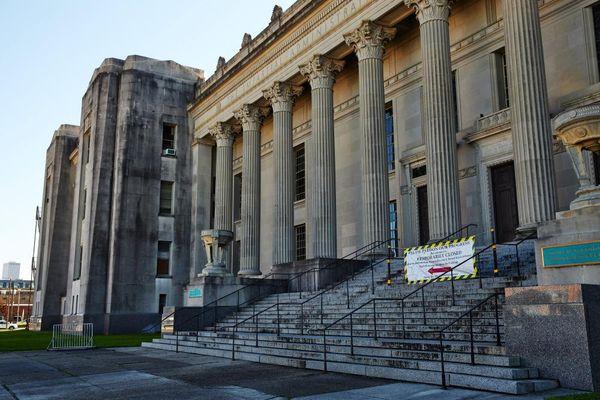
Frigid January weather prompted Donald Trump’s second inauguration to be held in the rotunda of the US Capitol, an iconic room ringed by busts of former presidents that lies at the heart of Congress.
Almost immediately after departing the Capitol, Trump took aim at the legislative branch, moving to siphon from lawmakers the powers to control spending, agencies and declaring war, and take them for himself, experts say.
“What we have seen over the past year represents a real escalation by the executive branch of its intrusion into things that are historically powers of Congress,” said Molly Reynolds, the director of governance studies at the non-partisan Brookings Institution.
“We’ve seen new and different ways that the executive branch has tried to intrude into congressional power, and then Congress, particularly congressional Republicans, not mount a defense of the institution in the way that we might have expected in some previous era.”
At Trump’s orders, leaders of independent agencies intended by Congress to be immune from the whims of presidents have been fired, federal offices whose work the administration disliked were gutted, and the Department of Education was ordered dismantled.
The president has also refused to spend funds appropriated by Congress and cited emergency powers to impose tariffs on US trading partners far and wide. He kept lawmakers in the dark before ordering the raid that captured Venezuela’s president, Nicolás Maduro, to stand trial in the United States.
Most of these policies are facing legal challenges, and several are expected to be addressed by the supreme court, which is dominated by conservative justices who have so far shown deference to the president’s policies.
Experts on Congress warn that the president has spent the past year effectively crowding lawmakers out of areas of governance over which their influence was once unchallenged, with little pushback from the Republicans who control the Senate and House of Representatives.
“Over the decades, the presidency has piled up enormous powers because of the actions of presidents of both parties and congresses of both parties allowing them to do that,” said Philip Wallach, who studies the separation of powers at the center-right American Enterprise Institute.
“I think every everyone involved was comfortable with that amount of power, in part because of unenforceable norms about how the president would behave. And this president has very little respect for those norms, and that allows him to use some of these powers in entirely new ways, that allow him to enrich himself and those around him and allow him to take the government in radically new directions.”
In response to a request for comment, White House spokesperson Kush Desai said: “President Trump is committed to delivering on his promises to the American people with every legal authority granted to him by the constitution and Congress.”
Congress’s authority is spelled out in article one of the constitution, which delegates to lawmakers powers including making war, levying taxes and regulating commerce. Further powers are specified elsewhere in constitutional amendments or through supreme court precedent.
One of Trump’s most potent salvoes against Congress came in the days after he took office, when he fired the leaders of agencies including the National Labor Relations Board, Merit Systems Protection Board and Federal Trade Commission. All had been confirmed by the Senate to roles in which they were intended to remain between presidencies, and operate independently from their policies.
Later in 2025, he tried to fire one of the Federal Reserve’s governors and opened a criminal investigation into its chair, Jerome Powell, amid disagreements over the central bank’s interest rate policy. David Mayhew, a professor emeritus at Yale University and a leading scholar on Congress, called the assault on independent agencies the president’s “most disturbing behavior”.
“It is a violation of statute, norms, and in some cases the constitution, to tamper as Trump sometimes does,” Mayhew said. “The White House isn’t supposed to try to circumvent Congress to impose leaders. In the case of the independent agencies, it isn’t supposed to try to cut terms short, and it certainly shouldn’t engage in prosecutorial harassment as the Trump administration is doing vis-à-vis the Fed right now.”
Compounding those firings has been Trump’s broader quest, begun immediately upon taking office, to thin out the federal workforce through layoffs and incentives for employees to resign, Mayhew said.
“I can’t think of a precedent for firing whole staffs or large shares of them, as Trump has sometimes done. A mission authorized by Congress is supposed to be suitably staffed,” he said.
As for his quest to dismantle the congressionally created Department of Education and parcel out its functions elsewhere in the federal government, Mayhew argued that Trump “doesn’t have the license, at least any such leeway is murky”.
The raid in Venezuela – which came after months of airstrikes targeting boats off its shores that the administration said were ferrying drugs – was carried out without seeking permission from, or giving advance notice to, Congress, prompting howls from Democrats that he had taken the marginalization to a new level.
“It’s very patriotic to say that [Republicans] have abolished the Congress of the United States and have just said to the president: what do you want? Here we are,” Nancy Pelosi, the Democratic former speaker of the House, said after top administration officials briefed lawmakers on the attack.
But the party’s options against Trump are limited, said Jamie Raskin, the top Democrat on the House judiciary committee. “We’re doing everything that that we can to hold the line in committees and subcommittees and on the floor, but being in the minority, obviously, leaves us with fewer legislative tools than we would like,” he said, adding that the caucus has joined in dozens of lawsuits against the administration.
To Republican lawmakers, Trump’s tactics are just a continuation of those adopted by previous Democratic presidents.
Democrats “seemingly had no problem when Joe Biden just with the wave of a wand, eliminated student debt unconstitutionally. They didn’t have any problem when Joe Biden did strikes in Syria, Yemen, they had no problem whatsoever in terms of the White House exerting their executive authority,” said Mike Lawler, a US representative and top target of Democrats in the November midterm elections that could see the opposition take control of the House.
“To me, this is a lot of bunk.” (Some progressive Democrats objected to Biden’s airstrikes against the Middle Eastern countries, while his student debt relief measures were controversial with moderates.)
Trump’s course of action may also be influenced by the fact that despite Republicans holding majorities in the House and Senate, their ability to enact his priorities is limited. Most legislation needs 60 votes to clear the upper chamber, meaning at least seven Democrats have to sign on. The GOP was able to circumvent that by using the budget reconciliation procedure to pass the One Big Beautiful Bill Act, which made permanent tax cuts, funded deportations and downsized federal anti-poverty programs, but many areas on which Trump might like to legislate cannot follow that avenue.
Republicans control the House by no more than three seats, meaning speaker Mike Johnson’s agenda can be upended by the defiance of small groups within his party.
That has pushed Johnson, who almost never breaks with Trump, to take drastic measures against the various rebellions that broke out against the president’s policies. When it appeared that a resolution to overturn Trump’s tariffs may have enough Republican votes to pass, the speaker changed the rules of the House to ensure it went nowhere.
There has been dissent in the Senate, too, such as when five Republican senators broke with Trump to advance a war powers resolution that would have prevented future attacks on Venezuela without first consulting Congress.
Rand Paul, a Republican senator who collaborated with Democrat Tim Kaine to push for that war powers resolution and others, said he was motivated by opposition against “country being run by emergency”, the legal mechanism that Trump has repeatedly used to circumvent Congress on Venezuela and other issues such as tariffs.
Paul posited a scenario where a future Democratic president could declare a “climate emergency” to ban gasoline-powered vehicles. “The reason you argued against [it] isn’t even always for the current president. It’s for the next president,” he said.
The war powers resolution ended up dying after sustained pressure from the administration spurred two Republicans to change their votes. But as the anniversary of his inauguration nears, it has become clear that Trump’s sway over Congress is not absolute.
In the House, Lawler and three other Republicans joined with Democrats to force passage of a measure extending tax credits that lowered costs for Affordable Care Act health plans, which remains under negotiation in the Senate. Four other Republicans pushed through a measure releasing government files from the investigation into disgraced financier Jeffrey Epstein, which Trump went on to grudgingly sign into law.
“When history looks at it, they’ll see the Epstein Transparency Act as a turning point in the Trump presidency, as a time that Congress saw that they could stand up to the president and win,” said the bill’s Democratic sponsor, Ro Khanna.
Whether it’s a sign that congressional Republicans want to regain powers that Trump seized remains to be seen.
“Once set loose in this way, it’s very hard to regather presidential powers gone wild,” Raskin said. “On the other hand, I think that the vast majority of our presidents in the past and the future will have a lot more respect for the rule of law than Donald Trump.”