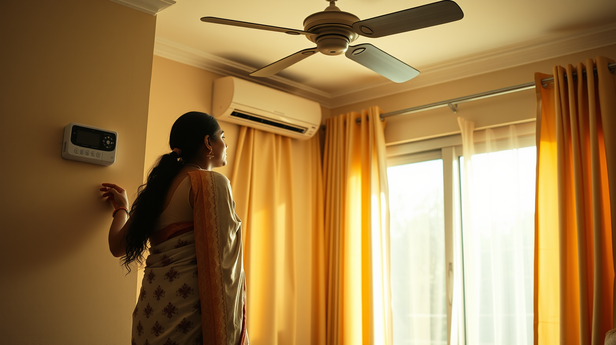
The 24°C Rule That the Bureau of Energy Efficiency Has Been Saying for Years
Every degree below 24°C on your AC thermostat adds roughly 6% to your electricity consumption, according to the Bureau of Energy Efficiency (BEE), which operates under India's Ministry of Power. Most people set their AC to 18°C or 20°C out of habit, not comfort, the room reaches a livable temperature long before it hits those numbers, and the compressor keeps running anyway. Set the thermostat to 24°C. Add a ceiling fan to circulate the air. The combination feels cooler than 24°C still air, and your bill reflects the difference by the end of the month.

Chanakya wrote in the Arthashastra that a kingdom wastes itself not through great disasters but through small, daily leakages that nobody bothers to measure. A thermostat set four degrees lower than necessary is exactly that kind of leakage, invisible on any single day, ruinous across a season.
Inverter AC vs. Fixed-Speed: The Math Your Dealer Skipped
A fixed-speed AC compressor runs at full power until the room hits the target temperature, then shuts off completely. When the temperature drifts up, it starts again at full power. This on-off cycle is where energy bleeds out. An inverter AC adjusts compressor speed continuously, running slower once the room is cool rather than cutting off. The BEE's own star-rating data shows a 5-star inverter AC consuming 30 to 40% less electricity annually than a comparable non-inverter model under Indian summer conditions. The upfront cost of an inverter unit is higher by ₹5,000 to ₹12,000 depending on brand and tonnage. In most Indian cities where summer runs five to six months, that gap closes within two seasons. If you are still running a fixed-speed unit from a decade ago, the savings calculation is not even close.
The Ceiling Fan Trick That Most People Get Backwards
Running a ceiling fan in an AC room feels redundant. It is the opposite. A fan does not lower temperature, it moves air across your skin, which accelerates sweat evaporation and makes you feel cooler at a higher ambient temperature. That means you can raise the AC thermostat by 2°C to 3°C without any change in perceived comfort. A standard ceiling fan draws 70 to 80 watts. A 1.5-ton AC draws 1,200 to 1,500 watts. The arithmetic is straightforward: the fan costs almost nothing to run and allows the AC to run less hard. The one rule, turn the fan off when you leave the room. A fan cools people, not spaces. Running it in an empty room adds to the bill without cooling anything.
Heat Load: What's Making Your AC Work Harder Than It Should
The AC fights everything that brings heat into the room. Direct afternoon sun through west-facing glass is one of the largest sources. Thick curtains or reflective blinds on west and south-facing windows can reduce the heat entering a room by 30 to 50%, which means the compressor reaches the target temperature faster and runs less. Gaps under doors and around window frames are the next problem. A rolled towel at the base of a door is not glamorous, but it keeps the cooled air in and the corridor heat out. In older DDA flats and builder apartments with thin walls, this matters more than in newer constructions with better insulation. The AC's job is to maintain a temperature, not fight a constant inflow of heat. Reduce the inflow and the AC's workload drops proportionally.
The Filter You Haven't Cleaned Since Last Summer
A clogged air filter forces the AC to draw harder to pull air through, which increases power consumption and reduces cooling efficiency at the same time. Cleaning the filter every two to three weeks during peak summer use takes ten minutes and no tools, most split AC filters slide out from behind the front panel. A dirty filter can raise energy consumption by 5 to 15%, according to data from air-conditioning manufacturers including Voltas and Daikin's India service guidelines. Annual servicing, which includes cleaning the evaporator coil and checking refrigerant levels, matters more than most owners realise. A low refrigerant charge makes the compressor work longer for the same output, and that cost shows up on the electricity bill, not on the AC's display panel.
The thermostat setting, the AC type, the fan, the curtains, and the filter are five separate interventions. None of them alone transforms a bill. Together, they attack the same underlying problem: a compressor running longer and harder than the actual cooling demand requires. Reduce the demand, reduce the run time, and the savings follow without any sacrifice in comfort.