
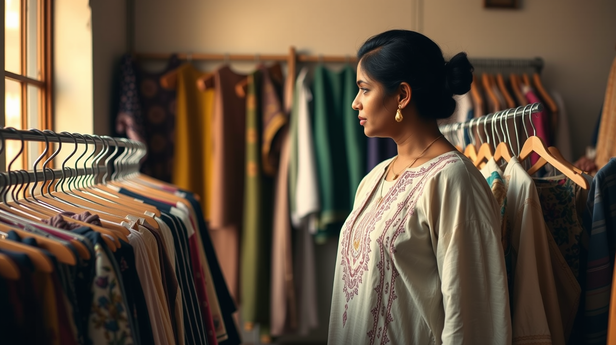
Khadi Was Slow Fashion Before the Term Existed
The Khadi and Village Industries Commission still lists over 7,000 registered khadi institutions across India, producing fabric by hand on charkhas that haven't changed much since the 1920s. That supply chain, short, traceable, low-waste, is the definition of ethical fashion. The problem is that most Indian consumers treat khadi as ceremonial: the kurta pulled out for Gandhi Jayanti, then folded away. Worn regularly, a hand-spun cotton khadi kurta outlasts three seasons of fast-fashion equivalents. The weave gets softer with washing, not thinner. Handloom sarees from Pochampally, Chanderi, or Maheshwar follow the same logic. They cost more upfront than a synthetic duplicate from a mall brand, but the cost-per-wear calculation flips completely by the second year.

What a Capsule Wardrobe Actually Means for an Indian Lifestyle
The capsule wardrobe concept, a small, interchangeable set of pieces that cover most occasions, gets imported from European minimalism and then applied awkwardly to Indian wardrobes that need to move between office meetings, family weddings, temple visits, and monsoon commutes. The adaptation is straightforward once you stop trying to replicate a Pinterest board. A functional Indian capsule wardrobe has three layers: daily wear (three to five cotton kurtas or salwars in neutral tones that mix freely), occasion wear (two to three pieces that can be dressed up with different dupattas or jewellery), and a single statement ethnic piece, a handloom saree, a Kanjivaram silk, a Banarasi, bought once and maintained well. That's it. The sustainable part isn't the number of pieces; it's the decision to stop buying outside that structure. Every impulse purchase that doesn't fit the capsule is, by definition, waste.
Where to Thrift in Indian Cities, and What to Look For
The secondhand market in India is larger than most people in metro cities acknowledge. Chor Bazaar in Mumbai and Janpath in Delhi have sold used and surplus clothing for decades. In Bengaluru, platforms like Relovv and local Facebook groups for pre-owned ethnic wear have built genuine communities around secondhand Indian fashion. Chennai's T. Nagar has tailors who will remake an old silk saree into a blouse and lehenga skirt for a fraction of what new fabric costs. Thrift shopping in India requires a different skill than buying new: you're looking for fabric quality first, not silhouette. A well-made cotton or silk piece in an unflattering cut can be altered. A poorly made piece in a perfect cut cannot be saved. Check seam allowances, generous ones mean the garment was built to last and to be adjusted. Check for natural fibres by feel and, if you're serious, the burn test at home. Synthetics melt. Cotton and silk char cleanly.
Caring for Clothes Is the Actual Sustainable Act
A 2017 study by the Ellen MacArthur Foundation found that extending the active life of a garment by just nine months reduces its carbon, water, and waste footprint by 20 to 30 percent. The most ethical wardrobe decision most Indian households can make costs nothing: stop machine-washing everything on a hot cycle. Cotton kurtas and handloom fabrics last significantly longer when hand-washed or run on a cold, gentle machine cycle and dried in shade rather than direct sun, which breaks down natural fibres faster than washing does. Store silk sarees in muslin, not plastic. Air garments after wearing before folding, body moisture trapped in a folded garment accelerates fabric breakdown. These are habits most Indian grandmothers practised without a sustainability framework attached to them. The framework just gives a name to what already worked.
Buying Ethical Without Buying Expensive
The Indian slow fashion market has grown enough that several independent labels now offer ethically made, handcrafted clothing at prices that sit between fast fashion and luxury. Labels like Anavila, No Nasties, and Doodlage work with natural fibres, surplus fabric, or fair-trade certified artisans. No Nasties, based in Goa, is certified by the Global Organic Textile Standard and prices most pieces under three thousand rupees. Doodlage works entirely with fabric waste from larger manufacturers. These are not niche boutique prices, they're comparable to the mid-range mall brands most urban Indian shoppers already use, with the difference that the garment has a traceable supply chain and is built to survive more than two seasons. The shift required is not a budget increase. It's a decision to buy one piece from a label like this instead of three pieces from a brand that won't exist in five years.
The sustainable wardrobe is not a wardrobe of sacrifice. It's a wardrobe built on the recognition that Indian textile traditions, khadi, handloom, the neighbourhood tailor, the secondhand saree market, already solved the problem that fast fashion created. The capsule approach, the thrift habit, and the care routine are each partial answers. Together, they point at the same thing: that the most ethical piece of clothing you own is the one you haven't thrown away yet.