When a fragile US-Iran ceasefire threatened to collapse this spring, the diplomatic marathon to stitch together an agreement did not end in a dramatic finale that Pakistan had hoped would play out in Islamabad.
Get breaking news anytime, anywhere. Download the TOI app now!
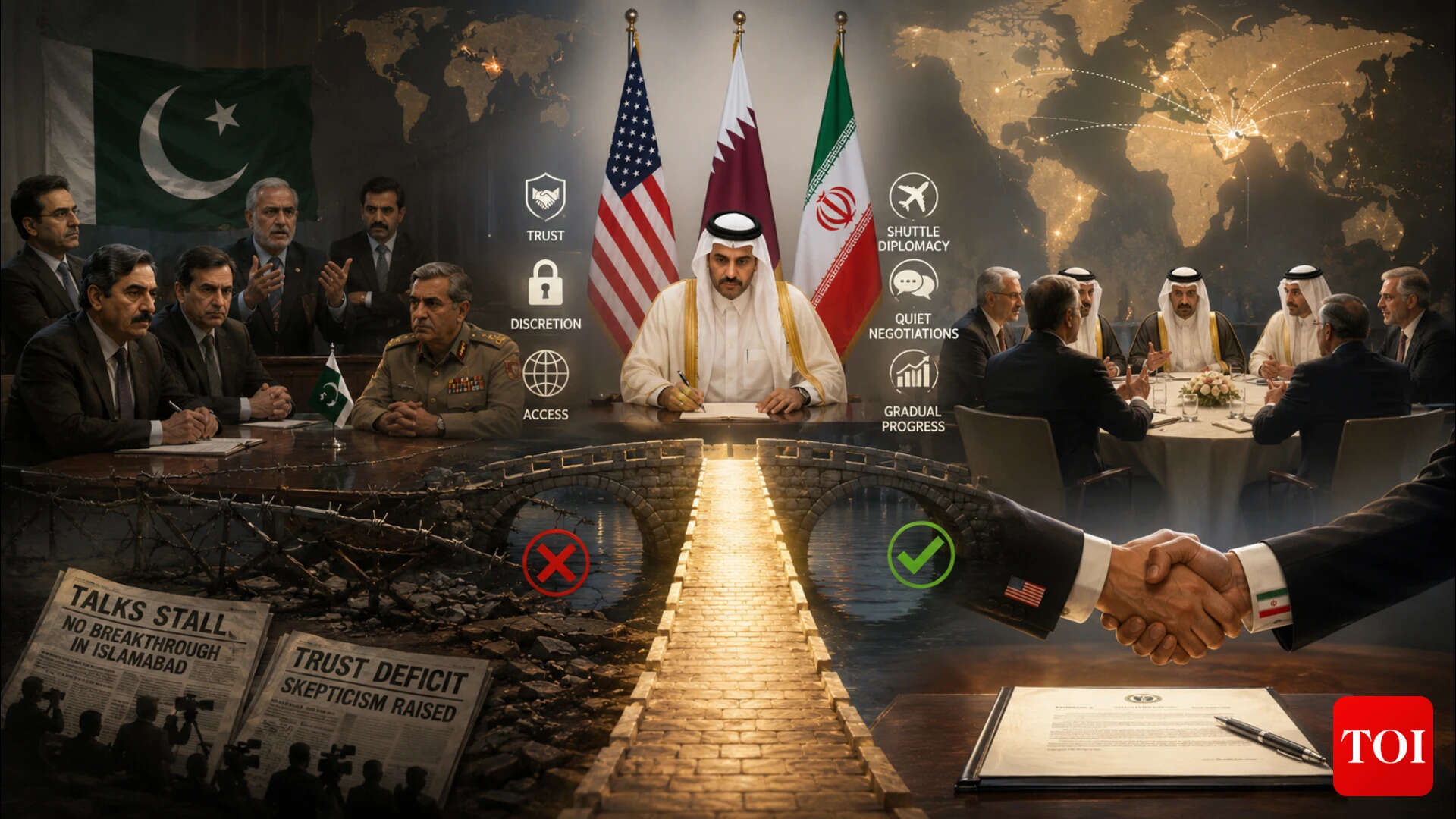
Instead, it quietly folded back into familiar Swiss neutrality — and behind the scenes the real architect was not Pakistan but a low‑profile Qatari mediation effort that outplayed bigger players by blending discretion, access and relentless shuttle diplomacy, according to a report by Financial Times.
Doha’s role was not accidental.
Qatar has spent years cultivating itself as Washington’s preferred conduit to adversaries, honing channels that stretch from Hamas to the Taliban.
In this crisis, that institutional patience and operational subtlety gave it an edge.
Pakistan opened doors — geographically and politically — but it was Qatar that did most of the heavy lifting to turn fitful contacts into a workable framework.
Doha's advantage
Qatar’s mediators arrived with three advantages Pakistan could not match quickly: credibility with Tehran, steady lines into the US policymaking orbit, and diplomatic tradecraft honed in protracted, sensitive negotiations.
- Credibility with Tehran: Qatari envoys operate from a history of quiet engagement across the region. That track record made Iranian negotiators more willing to engage substantively without the suspicion that greeted Pakistan’s overtures.
- Access to Washington: Qatar’s back‑channel access to key Trump aides and envoys allowed negotiators to test US red lines and iterate language rapidly — essential when the US president demanded fast results.
- Quiet, methodical diplomacy: Where the Pakistan effort was visible and political, Qatar’s approach was intentionally low‑profile: secret flights, off‑the‑record consultations, and patient drafting that respected Tehran’s procedural need to sign off word by word.
Those strengths showed up repeatedly.
Qatari delegations, led by veterans such as Ali al‑Thawadi and Hamad al‑Kubaisi, shuttled between Tehran, Doha and Washington, quietly brokering text and building the incremental trust necessary for a deal.
Pakistan’s Field Marshal Asim Munir and other Islamabad actors played a useful role as interlocutors, but the intensive bargaining — the painstaking negotiation of phrasing on nuclear limits, the Strait of Hormuz wording, and the sequencing of sanctions relief — was Qatar’s work.
Diplomacy on deadlines
The negotiations were a study in fragility.
The one‑page, 14‑point memorandum negotiated to extend the April 8 ceasefire, reopen the Hormuz chokepoint and create a framework for nuclear talks — had to bridge half a century of hostility, Israel’s interventions, and President Trump’s impatience for a quick win.
Trump’s timeline compressed the process.
He demanded an Iranian response within days, and repeatedly set public deadlines that risked collapsing the talks.
That pressure made Doha’s steady, iterative method even more valuable.
Qatar’s mediators were prepared to keep talking for weeks; they could absorb setbacks, recalibrate language and press both capitals for restraint in moments of escalation.
That restraint was crucial when kinetic actions threatened the entire enterprise.
A US strike on southern Iran and subsequent Iranian missile and drone responses could have ended any hope of compromise. Instead, Qatar — joined by regional capitals — intervened quietly with phone diplomacy that soothed tensions long enough for negotiators to resume bargaining. Qatar’s ability to coordinate discreet pressure on multiple actors in a single time window is what repeatedly kept the process alive.
What Doha actually negotiated
The package Doha shepherded combined political, military and economic elements:
- An extended ceasefire to halt immediate hostilities.
- A framework for nuclear talks, including Iranian commitments to discuss handling enriched uranium.
- Provisions for reopening the Strait of Hormuz, with sensitive language that allowed both sides to claim tactical success.
- A phased approach to US sanctions relief tied to tangible steps in negotiations.
Iran won concessions in tone and process.
Tehran secured a commitment to discuss the fate of its highly enriched uranium and a timetable for talks, while Washington gained a mechanism to tie sanctions relief to concrete verification steps.
The final product reflected painstaking drafting — the kind of granular bargaining Doha excels at — rather than the headline‑grabbing gestures that had characterised Pakistan’s more public efforts.
Pakistan’s role
Pakistan’s involvement mattered for two reasons: geography and connection.
Islamabad’s early hosting of indirect talks after the war’s outbreak provided an immediate venue and signalled willingness to help.
Pakistan also leveraged personal ties at the highest levels — principally the military chief’s access to US decision‑makers — to keep lines of communication open.
But Pakistani mediation suffered from structural weaknesses.
Islamabad’s public posture, political volatility and deepening ties with Beijing complicated perceptions in Washington and Tehran about its neutrality.
High‑profile sessions in Islamabad were marred by mistrust and public scrutiny, and a marathon 21‑hour negotiation produced no breakthrough.
American sceptics publicly questioned Pakistan’s impartiality; some US lawmakers even raised allegations about Pakistani interactions with Iran’s military assets.
Those factors made Pakistan more useful as an initiator and conduit than as the deal‑closer.
By comparison, Qatar operated with less baggage. Doha’s relationships with regional capitals, its long‑standing discretion and its track record in managing asymmetrical talks allowed it to move beyond opening contacts to resolving core technical disagreements.
The decisive moments
Several episodes crystallised Doha’s ascendancy. In mid‑May, after talks floundered and the ceasefire teetered, Washington explicitly asked Qatar to step up. Qatari envoys flew secretly to Tehran, engaged in hours of detailed bargaining, and returned to brief US counterparts in Washington.
When Trump’s rhetoric threatened to derail progress — calling Iranian offers a “piece of garbage” and setting hard deadlines — Qatar absorbed the diplomatic shock, smoothing language and securing commitments on sensitive issues, including Iran’s willingness to discuss dilution or transfer of its enriched uranium stockpile.
Two episodes demonstrated Qatar’s unique diplomatic muscle.
First, when US strikes and Israeli moves nearly scuppered negotiations, Doha coordinated calls from Gulf leaders to restrain escalation — a regional chorus that bought time.
Second, during the night the Qataris found themselves stranded at Tehran’s tarmac after an American strike, their patience and on‑the‑ground stamina kept the process viable; they returned to the field and continued to negotiate for hours when others might have withdrawn.
Geneva and the power of perception
Why did the talks ultimately migrate to Geneva?
Neutral venues offer secure infrastructure and precedents for complex, multilateral negotiation. But the transition also reflected a less visible judgment: that a deal needed the aura of impartiality Geneva provides to be credible inside both American and Iranian political systems.
Doha’s role was never about theatrics; it was about producing the text and the trust that made a Geneva signing feasible.
In short, Qatar built the bridge; Switzerland provided the neutral port of entry for the last formalities.
Pakistan’s public involvement helped open doors and framed the regional narrative, but it was Doha’s procedure‑driven, multilateral savvy that actually bridged the policy gaps.
Regional implications
Doha’s success recalibrates perceptions across the Gulf and beyond.
Qatar has quietly institutionalised a role as the region’s nimble fixer — a strategic asset for Washington when it wants backchannels that do not carry the political freight of larger capitals. For Gulf monarchies and Tehran alike, Qatar demonstrated it can shepherd even the most sensitive text through the grind of negotiation.
For Pakistan, the episode is less a humiliation than a lesson about realistic ambition.
Islamabad can still play important facilitator roles, but the episode underscores the premium on discretion, coordination and low‑profile tradecraft over public spectacle.
Pakistan’s initial hosting mattered; but in high‑stakes nuclear diplomacy, credibility and procedural finesse win where symbolism alone cannot.
Doha’s durable play
The US–Iran accord that survived months of fits and starts bears the imprint of Qatar’s patient diplomacy: secret flights, persistent shuttle negotiations, regional pressure to pause kinetic escalation, and meticulous drafting.
Pakistan helped open doors, but it was Doha that quietly converted access into agreement.
In the shifting geopolitics of the Middle East, Qatar’s subtle coup — not a flamboyant takeover, but a sustained, methodical accumulation of leverage — may have reshaped who the great powers turn to when they need results without spectacle.