Get all your news in one place.
100's of premium titles.
One app.
Start reading
The Economic Times
The Economic Times
Anshika Jain

How much health insurance cover do you need? Here’s the ideal cover for ₹10 lakh, ₹20 lakh, ₹30 lakh, and ₹50 lakh annual income as per experts

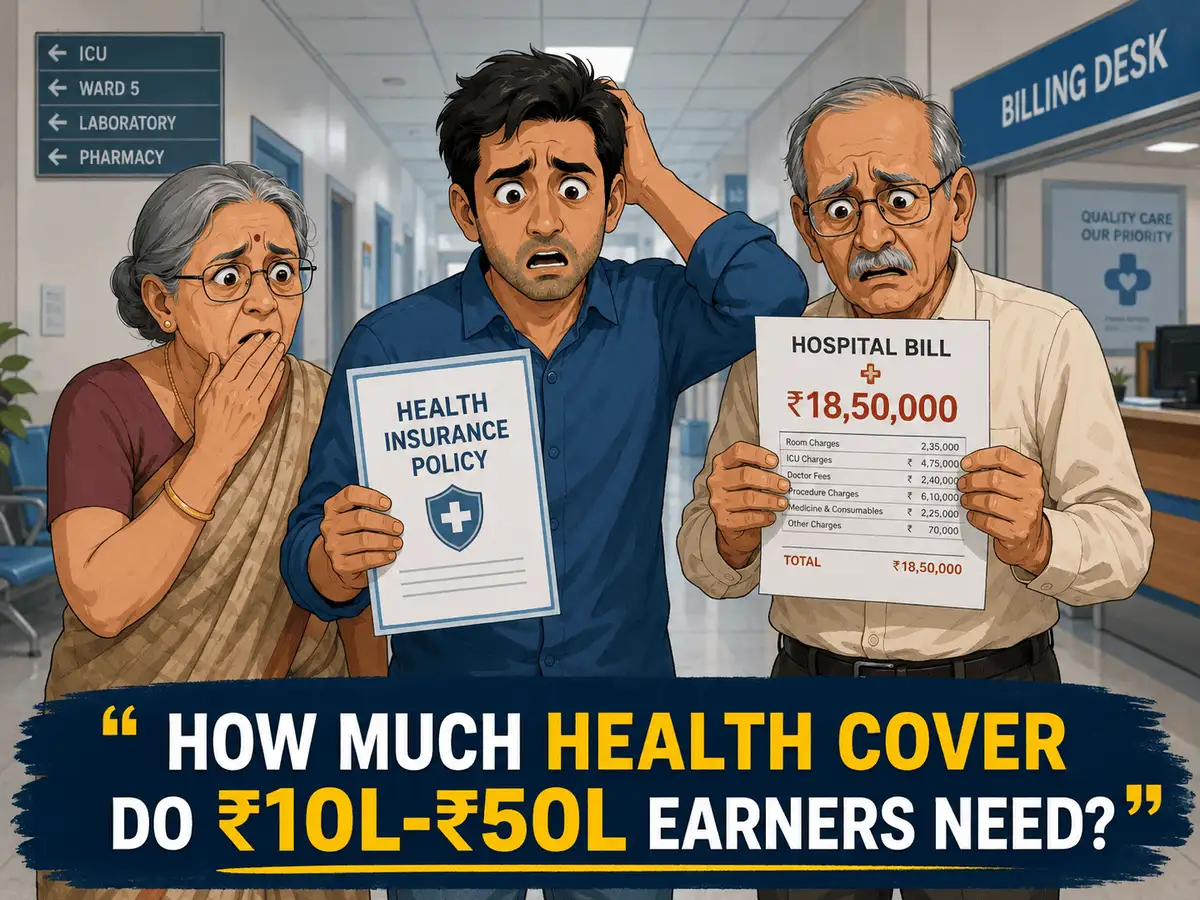
As medical costs keep climbing, just one hospital stay in a metro city can easily cost lakhs of rupees. This really highlights how crucial it is to have the right health insurance coverage.

A recent study by Policybazaar on medical cost trends from 2013 to 2025 shows a worrying trend: Surgery costs have skyrocketed by over 250–300% across the board. Do you think your health insurance is enough? Consider the cost of major surgeries across Tier 1 cities.

Surgery

YOY cost (in lacs)

2022

2023

2024
Cancer 39.4 44.6 50.8
Heart Transplant 26.4 29.9 34
Liver cirrhosis 18.9 21.3 24.3
Kidney Transplant 14.1 15.9 18.2
Source: Policybazaar

The cost of treatment can differ based on the room category. A twin-sharing room typically costs more than a general ward, and related charges such as doctor visits and nursing fees might also be higher.

So, how do you figure out how much health insurance is enough for your needs? The answer hinges on factors such as your income, city of residence, family size, age and medical history.

What is the ideal health insurance cover in India?

There is no universal coverage amount that fits every individual or family, as healthcare needs vary based on age, location, lifestyle, and medical history.

Also read: Ayushman Bharat card: Eligibility, benefits, how to apply online and documents required for PMJAY

“However, given the sharp rise in healthcare costs and medical inflation, an individual should ideally have a minimum health cover of Rs 10–15 lakh, while families should consider coverage of at least Rs 15–25 lakh,” says Kulin Shah, Co-founder & COO, Onsurity.

But don't stop there; factor in your city, age, and whether your employer already gives you some coverage.

“Medical inflation consistently outpaces regular inflation, which means the cover that feels adequate today may fall short five years from now,” says Sarita Joshi, Head of Health and Life Insurance, Probus.

Apart from medical inflation, factors such as family medical history and existing health risks should also influence the coverage amount. For instance, if a family has a history of hereditary medical conditions such as diabetes, they should consider opting for a higher coverage amount compared to others.

“A smart approach is pairing a base policy with a super top-up rather than chasing a single large cover,” she adds.

How should health insurance cover vary by income and city tier?

Your city of residence significantly impacts your health coverage needs as medical costs vary widely. Hospitalisation expenses are generally much higher in Tier-1 cities than in Tier-2 and Tier-3 locations. Individuals living in larger metros often need higher insurance coverage to ensure adequate financial protection.

A smart way to scale this up without overpaying on premiums is by pairing a reasonable base plan with a high-limit super top-up policy. Here is the recommended base and total coverage matrix (in Rs lakhs):

Annual Income

Tier-1 Cities (Metros)

(Base + Top-Up = Total)

Tier-2 Cities

(Base + Top-Up = Total)

Tier-3 Cities

(Base + Top-Up = Total)

₹10 Lakh ₹10L + ₹10L = ₹20 Lakh ₹10L + ₹5L = ₹15 Lakh ₹5L + ₹5L = ₹10 Lakh
₹20 Lakh ₹10L + ₹20L = ₹30 Lakh ₹10L + ₹10L = ₹20 Lakh ₹10L + ₹5L = ₹15 Lakh
₹30 Lakh ₹15L + ₹25L = ₹40 Lakh ₹10L + ₹20L = ₹30 Lakh ₹10L + ₹10L = ₹20 Lakh
₹50 Lakh ₹20L + ₹30L = ₹50 Lakh ₹15L + ₹25L = ₹40 Lakh ₹10L + ₹20L = ₹30 Lakh
Source: Probus

The recommended health insurance coverage increases with both income levels and healthcare costs in different cities. People living in Tier-1 cities typically need higher coverage due to significantly higher hospitalization costs, while those in Tier-2 and Tier-3 cities may require comparatively lower cover. The combination of a base policy and a super top-up plan can help cost-effectively achieve adequate protection.

Also read: Why Rs 1 crore term insurance cover in 2026 may not be enough for many families

What is the ideal health insurance cover for a family?

For a young family with children and no members above 60 years of age, a family floater plan is recommended. It offers a higher coverage amount at a reasonable cost for all family members.

“Considering the rising cost of medical treatment, a family of 4 living in a metro city may consider a floater policy with coverage of Rs 15–25 lakh; the higher the coverage, the better. In non-metro cities, coverage of anywhere between Rs 10–20 lakh may be considered,” says Mr. Gurmeet Singh, Vice President & Head-Health Underwriting, IFFCO TOKIO General Insurance Company Limited.

How much health insurance cover should parents and senior citizens have?

Parents and senior citizens should have a separate health insurance policy rather than being included in a family floater plan. This helps preserve the family's overall sum insured and ensures that a large claim by one member does not exhaust coverage for everyone else.

For seniors, the focus should not be limited to the coverage amount alone. Policy features such as waiting periods for pre-existing diseases, co-payment clauses, and room-rent limits can reduce the effective value of a policy.

“Coverage of Rs 10–15 lakh is a starting minimum, but seniors in metros or those managing chronic conditions should realistically aim for Rs 20 lakh or more,” says Joshi.

The ideal coverage amount should also consider factors such as existing medical conditions, family health history, lifestyle and the city of residence, as healthcare costs can vary significantly across locations.

To build higher coverage without substantially increasing premiums, seniors can consider combining a base health insurance policy with a super top-up plan. This can protect large medical expenses while keeping costs manageable.

“Besides that, having an employer-provided health insurance policy is always beneficial and should be utilised first whenever required,” says Singh.

However, one should also have a personal health insurance policy to ensure there is no break in coverage during a job change or any other such situation.

Sign up to read this article
Read news from 100's of titles, curated specifically for you.
Already a member? Sign in here
Related Stories
Top stories on inkl right now
One subscription that gives you access to news from hundreds of sites
Already a member? Sign in here
Our Picks
Fourteen days free
Download the app
One app. One membership.
100+ trusted global sources.