Get all your news in one place.
100’s of premium titles.
One app.
Start reading
The Conversation
The Conversation
Katrina Raynor, Research associate, The University of Melbourne

How much does it cost to end rough sleeping? An Australian-first study may have just found out

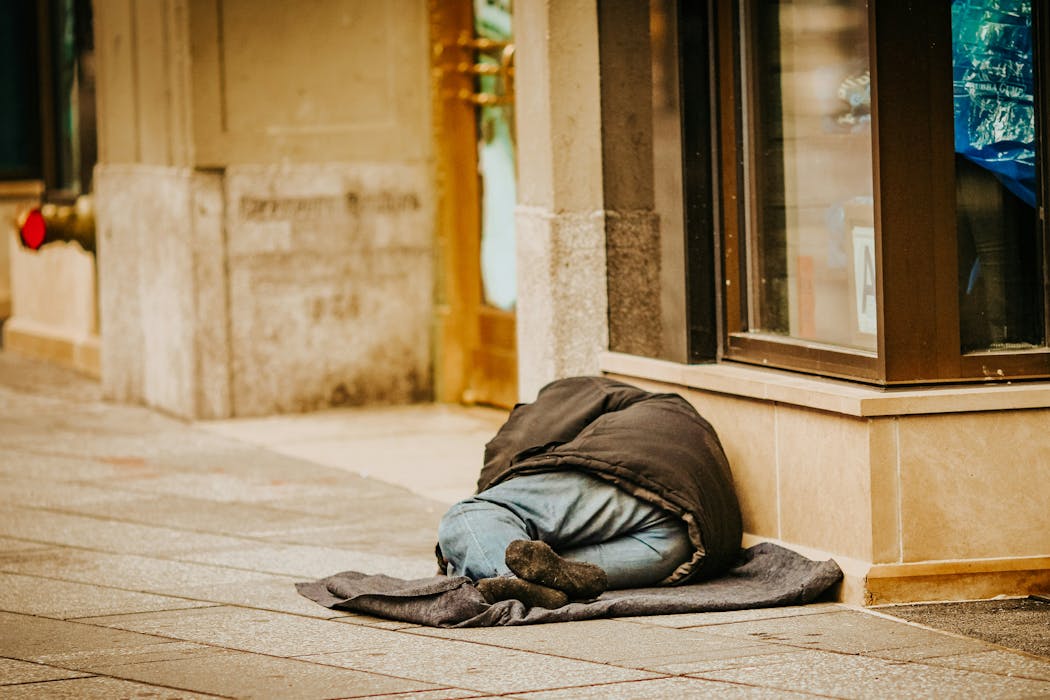
Jon Tyson/Unsplash

Homelessness is a growing issue in Australia.

Data released last week by the Australian Institute for Health and Welfare show 350 requests for support go unmet every day due to a lack of resources. Most of those requests are from women and children fleeing family and domestic violence.
One in three people seeking crisis accommodation do not receive support, highlighting how damaging housing shortages can be.

It’s also a heath issue

Homelessness is also a health crisis.

The median age at death for Australians receiving homelessness services in the past decade was 55 years – 28 years below the Australian average life expectancy.

The figures are even worse for people sleeping rough (people living in improvised dwellings, tents, or sleeping outdoors). A 2024 Guardian investigation found an average age of death for rough sleepers of just 44.

Across Australia, the homelessness system is struggling to keep up.

It’s taking longer for people to receive help, and more are asking for support – including people who in the past would have found housing through the private rental market.

There are a range of reasons for this, including:

How is homelessness tackled in Australia?

Homelessness services are mostly funded through the National Agreement on Social Housing and Homelessness, an agreement between the Australian, state and territory governments.

Homelessness expenditure by the South Australian and Western Australian governments rose by 21% in real (inflation-adjusted) terms over the four years to 2023-24, from $176 million to $213 million. But this has been insufficient to meet rising need.

The lack of available resources means Australia’s homelessness services are locked in “crisis mode” – responding to people only once they are in dire need of help and managing homelessness, rather than reducing or ending it.

Australia is one of many countries that has failed to stem the rise in homelessness in recent decades.

In contrast, the total number of people experiencing long-term homelessness in Finland decreased by 68% between 2008 and 2022.

This success is largely due to Finland’s commitment to “housing first” – a set of principles and a system for housing and supporting people who have experienced long-term and recurring homelessness.

What our research revealed

Our research in South Australia and Western Australia provides an evidence-based argument for “housing first” principles and the development of supportive housing (housing paired with wraparound support services targeted at people with a history of chronic homelessness).

In an Australian first, we estimated the number of homes required to end rough sleeping in Perth and Bunbury in Western Australia, and inner-city Adelaide in South Australia.

We found 1,300 units would be needed in Perth and Bunbury combined and 150 units in inner-city Adelaide. We estimate 90% of homes should be one-bedroom units with the remaining 10% delivered as two or three-bedroom units.

These figures are based on regional databases that allow services to coordinate support and track outcomes for each person.

To build these homes and support tenants with wraparound services, our research estimates it would cost $500 million over five years to build and operate 1,3000 homes in metro Perth and Bunbury, and $50 million to build and operate 156 homes in inner-city Adelaide.

While the Adelaide figures look substantially lower, this is mostly due to a smaller geography and smaller population.

This is a significant but achievable investment. For comparison, the WA and SA governments spent $452 million and $388 million respectively on homelessness services in the four years to 2023-24.

A health and economic boost

Providing housing to people sleeping rough is unsurprisingly highly effective at keeping people stably housed.

One systematic review showed when homeless people are supported by a “housing first” model, their chance of being stably housed 24 months later increases from 37% to 75%.

We also know “housing first” participants are healthier and happier: the same review found participants experience 37% fewer emergency department visits and 24% fewer hospitalisations compared to people without access to supportive housing. They are also more satisfied with their lives overall.

Supportive housing also saves the government money.

We estimated fully funding these programs would save the Western and South Australian governments $130 million over five years in reduced health and criminal justice costs.

In a 60-year time horizon, we estimate every dollar spent on delivering supportive housing would yield social benefits of $1.56 in SA and $1.23 in WA.

More work is needed

Our study needs to be replicated across Australia to better understand national levels of need and the cost of meeting it.

These evidence-based figures can help the homelessness sector be more specific when calling for better funding.

The work doesn’t stop there.

Understanding how much and for whom is important but political will and the dollars that follow it are essential to meaningful change.

Lucas Lewit-Mendes, research associate at Per Capita, contributed to this article.

The Conversation

Katrina Raynor is employed by Per Capita, a progressive think tank. Per Capita was commissioned by the Australian Alliance to End Homelessness to conduct a needs assessment for supportive housing.

This article was originally published on The Conversation. Read the original article.

Sign up to read this article
Read news from 100’s of titles, curated specifically for you.
Already a member? Sign in here
Related Stories
Top stories on inkl right now
One subscription that gives you access to news from hundreds of sites
Already a member? Sign in here
Our Picks
Fourteen days free
Download the app
One app. One membership.
100+ trusted global sources.