
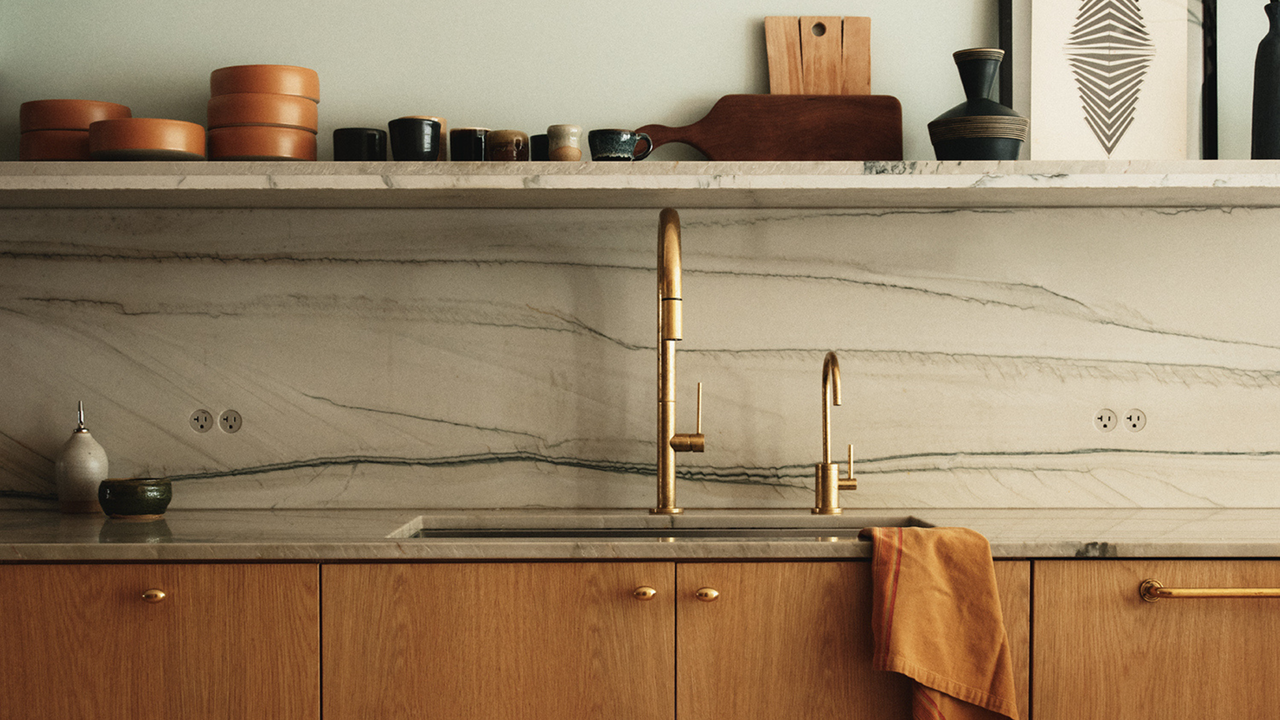
There are the fun parts of designing a kitchen: choosing the marble, the oven, and the light fittings. Then there are the... less fun parts. And I think we all know which category planning your plug sockets falls into.
But, while it may not be the most glamorous part of the process (even if you opt for the more luxurious hidden kitchen socket look), it is nonetheless a highly important one. And, annoyingly, a rather confusing one, too. Not only will you have to figure out how many plug sockets your kitchen should have, but also where to place them, two decisions that can have a pretty major impact on the workflow of your kitchen.

While there are no specific legal guidelines in the UK for the number of plug sockets one needs in the kitchen, Electrical Safety First recommends anywhere between 6-10, depending on the size of your kitchen. But, if this guideline doesn't feel specific enough for you, worry not, as our experts get deep into the nitty-gritty of anything and everything regarding your kitchen's plug socket, from the placement to the height, and even the design. So, if you want a full breakdown on all things plugs, we've got you sorted.
How Many Sockets Does Your Kitchen Need?

The matter of how many sockets your kitchen actually needs is an inherently personal one. As different as each kitchen is, the number of sockets needed will change accordingly. However, there are certain guidelines to follow that will help you make a sensible decision.
Richard Davonport, from Davonports, says, "In the UK, there is no single rule for the exact number of plug sockets a kitchen must have, but the benchmark we work to is simple: the kitchen layout should dictate the quantity."
A seemingly logical approach, but a useful one nonetheless. Adjusting the number of sockets to reflect the layout of your kitchen will be the most risk-free way of planning your design.
Expanding on his method, Richard says, "A kitchen with a generous worktop runs and multiple prep zones will always need more outlets than a compact galley kitchen."
As well as your layout, it can also benefit you to think about how many kitchen appliances you regularly use, and will want permanently plugged in. "Most households benefit from several double sockets along the main counter run, additional points near the hob for small appliances, and dedicated supplies for fixed items such as ovens, extraction, and refrigeration," says Richard. Things like toasters and coffee machines, and any other everyday-use machines, will be worth factoring into your design as well, as you won't want to have to lug them around to the nearest socket daily.
However, it's also important to factor in some additional sockets alongside those needed for these appliances. "Most kitchens benefit from a mix of sockets for everyday appliances plus a few extras for flexible use," recommends Ben Hawkswell, from Roundhouse. "So, somewhere between six and ten in the main prep and cooking areas is usually about right, depending on the size and how you use the space," he says.
Although there are no set rules in the UK, if you need something more concrete to go off of, it can be helpful to consider the approach of those across the pond.
As interior designer Sam Donnelley, from LA-based firm Mercantile and Merchant, explains, "By code, you must have outlets every 4 feet, and within 2 feet of any break in the counter." Alongside these regulatory standards, Sam also suggests, "Islands or peninsulas should have one outlet placed on the side - I like to place this within a cabinet for a cleaner aesthetic look. I think this works pretty well, but I try to be discreet about the exact placement."
Where to Place Plug Sockets in Your Kitchen?

Perhaps of equal importance to the number of sockets is the placement of the sockets, too. In many ways, in fact, the placement may even trump the number.
First, Richard recommends that "Sockets need to sit clear of sinks and hobs, but still close enough to where work naturally happens."
Considering the health and safety risks, as well as the natural workflow of your space, is a smart place to begin your planning. This tends to be the approach taken at Roundhouse, as Ben describes, "We tend to place them where people naturally prep or use small appliances — along worktops, inside appliance garages, and sometimes even inside pan drawers for things like charging devices. Islands often need at least one discreet socket too, as they’re used more than people expect. The goal is to make sure the sockets support how you live, without drawing unnecessary attention."
Achieving this balance of maximum utility, without creating any ugly, visual disturbance, is arguably the trickiest part of this entire process. It might seem appealing to go for a more the merrier approach with your sockets, but this trigger-happy decision will leave your kitchen looking cluttered and far less sleek.
Instead, opt for some more discreet positions for your sockets. Richard suggests, "Corners, the end of an island, and the wall beneath open shelving are often underused but extremely practical positions. In larger kitchens, a pop-up outlet or a discreetly placed socket within an island drawer can support appliances without disrupting surfaces."
He goes on, adding, "You can also build sockets into the back of cupboards, particularly within appliance garages or pantry-style storage. These enclosed zones are designed for everyday equipment, such as toasters or kettles, so adding concealed outlets means the appliances can be used in situ rather than pulled out each time. It keeps the worktops clear, reduces visual noise, and makes the space feel more organised."
Hiding sockets in a pocket door breakfast bar is one of the most-loved tricks amongst designers, as it allows for a super practical and discreet finish. However, it does require some careful planning, as Richard says, "The important thing is to plan ventilation and clearance so heat-generating items operate safely behind closed doors, and to ensure the internal layout gives enough depth for plugs and cables to sit comfortably."
What Height Should Your Kitchen Plug Sockets Be?

Unlike the number of sockets, "Height is guided by Building Regulations." As Richard explains, "Standard socket outlets above a kitchen worktop should sit around 100–150 mm from the surface, which gives enough clearance for plugs while keeping the line visually calm."
Maintaining a constant height will also help create a more cohesive look in your kitchen, as opposed to a scattered array of various sockets across your kitchen walls.
If you're looking for a more specific measurement, Ben says, "Typically around 10–15cm above the worktop works well." Elaborating on this measurement, he says, "It keeps them within easy reach but not so low that they’re awkward to use." Though if you're looking for an even more seamless look, he suggests. "In more contemporary, modern kitchens, especially with beautiful stone splashbacks, we sometimes hide sockets underneath wall cabinets or within pop-up units to keep the walls clean."
The right height for you may also depend on the specifics of your kitchen backsplash, too. Sam says, "If there is a short stone backsplash, then I tend to go around 4 inches above that."
How to Make Your Sockets Look Good

While the best placement can certainly help conceal the look of sockets in your kitchen, for a truly seamless look, our experts have plenty of design tricks for you.
And first and foremost of these tricks is the simple act of color matching. As Ben says, "Color-matching makes a huge difference — sockets in a finish that blends with the cabinetry or wall surface tend to disappear."
A point that is echoed by Richard, who says, "Choosing faceplates in a finish that echoes the cabinetry hardware or blends into the splashback allows the eye to stay on the design rather than the electrics."
Other designers have taken it so far as to hire a muralist to paint the sockets to match the adjoining marble, a high-effort task with high-quality payoff to match. But if you're looking for a slightly more low-maintenance kitchen option, Sam says, "Many manufacturers have a huge range of colors that can help the outlets blend more seamlessly with the tile/wall color. And if you want to splurge, there are some excellent high-end switches and outlets in a range of materials from burnished bronze to low-profile matte black."
Or, if color-matching doesn't appeal, Richard says, "In more contemporary schemes, slimline or flat-plate sockets reduce visual interruption, and placing outlets inside larders or appliance garages keeps the busiest items out of sight. When these details are planned early, sockets become part of the furniture rather than an afterthought."
Shop Chic Sockets
For a classic, but still glam, finish, you can't go wrong with a brushed brass socket. I especially love the practicality of these ones, with the two USB ports.
If you're struggling to find the perfect color match and don't love the look of the metal-finish sockets, you can't go wrong with a simple transparent model. Plus, the aged brass switch adds an extra touch of style to this option.
For maximum power, with minimum visual intrusion, these pop-up sockets are a brilliant option. Push them down to discreetly hide away beneath your counter, and push them up as needed, to reveal a generous number of sockets at your disposal.
If you're looking for some more practical kitchen advice, we've got plenty more to keep you going. How about these kitchen island socket ideas, or these tips for making your kitchen more ergonomic?