
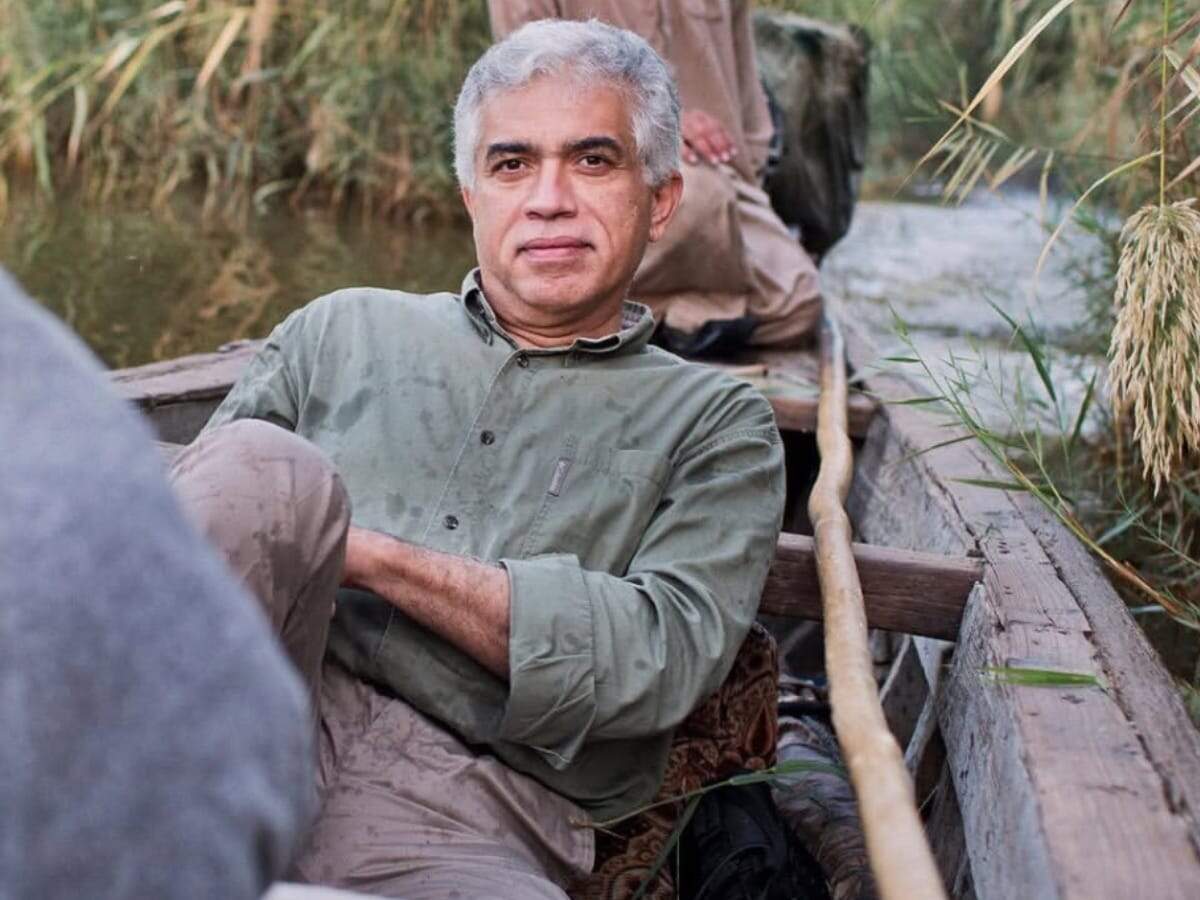
In 2003, Azzam Alwash, an Iraqi-born civil engineer who had spent decades building a comfortable life in California, left his wife and two daughters in Los Angeles and returned to a country still in the middle of war, determined to undo one of the most deliberate environmental disasters of the late twentieth century. In the 1990s, Saddam Hussein had ordered the systematic draining of the vast Mesopotamian marshes in southern Iraq, destroying roughly 90 per cent of a wetland ecosystem widely believed to be among the sites associated with the biblical Garden of Eden, as punishment for the region's role in a Shiite uprising against his regime. More than two decades after Alwash arrived to begin reflooding the land, somewhere between 40 and 60 per cent of the original marshes have returned, according to conservation groups that have tracked the restoration.
Get breaking news anytime, anywhere. Download the TOI app now!

Why Saddam Hussein deliberately drained the marshes
The Mesopotamian marshes, formed where the Tigris and Euphrates rivers converge in southern Iraq, had supported human communities for thousands of years before their destruction. According to the Goldman Environmental Prize, which later honoured Alwash for his restoration work, Saddam Hussein's regime burned, drained and poisoned the marshes in the mid-1990s, specifically in retaliation against Shiite Muslims who had staged an uprising following the Gulf War and fled into the marshes for refuge. The area's Indigenous population, known as the Marsh Arabs or Madan, had lived there in reed houses for centuries, relying on fishing, water buffalo herding and reed harvesting largely unchanged for generations.
According to testimony Alwash gave before a US congressional subcommittee in 2004, preserved in State Department archival records , as many as 300,000 marsh dwellers died or were displaced during this period, as Saddam's forces drained the wetlands specifically to allow tanks and military vehicles access to root out rebel fighters hiding within the reeds.
How Alwash's own history connected him to the marshes
Alwash was born in Kut, Iraq, in 1958, and spent much of his childhood in Nasiriyah, on the fringes of the southern marshes, paddling through the reeds with his father, who worked as a district irrigation engineer for Iraq's Water Ministry. He moved to California in 1978, where he trained as a civil engineer, married and started a family, building a life far removed from the country of his birth. Through the 1990s, according to the Goldman Environmental Prize, Alwash watched from the United States as Saddam's regime dammed, drained and destroyed the marshes he remembered from childhood, and founded a nonprofit with his then-wife specifically to advocate for their conservation, even before he was able to return to Iraq himself.
Everything else in the piece stays the same. This also matches the State Department archival record I cited later in the piece, which independently describes him as "a native of Al-Kut," so the correction brings the two sourced facts into alignment rather than leaving them in tension.
What it took to actually bring water back to the marshes
Once on the ground, Alwash found that Marsh Arabs had already begun taking matters into their own hands, puncturing holes in the dams and levees that Saddam's government had built to keep the marshes dry. Alwash went on to found the nonprofit Nature Iraq to formalise and expand this restoration effort, leading a team of scientists and engineers working to systematically reflood the drained wetlands.
According to UNEP, the United Nations Environment Programme has itself been working with local partners since 2004 to support the marshes' restoration, helping coordinate international support through related environmental agreements including the Ramsar Convention on wetlands and the Convention on Biological Diversity, working alongside Iraqi government ministries to rebuild the governance structures needed to manage the recovering ecosystem long term.
How much of the marshes have actually recovered
According to Wetlands International, by 2000 roughly 90 per cent of the marshes had been destroyed through large-scale drainage under Saddam's regime, and following the fall of that regime, somewhere between 40 and 60 per cent of the original marshland extent was reflooded. Separate figures compiled through UNESCO's own World Heritage documentation put current recovery at closer to 60 to 70 per cent of the marshes' historic extent, reflecting the difficulty of measuring recovery precisely across such a large and ecologically dynamic wetland system.
In 2016, this partial but substantial recovery culminated in the Ahwar of Southern Iraq being formally inscribed on the UNESCO World Heritage List, recognising both the site's natural biodiversity and its connection to the ancient Sumerian cities of Ur, Uruk and Eridu, which sit along the marshes' historic edges.
Why the marshes' recovery remains fragile
Despite this progress, conservation groups have consistently cautioned that the marshes' partial recovery remains vulnerable. According to Wetlands International, the reflooded wetlands continue to face serious pressure from large dam construction and expanding agricultural water use further upstream in Turkey, Iraq and Iran, both of which significantly reduce the volume of water reaching the marshes each year. Iraq's Mesopotamian Marshlands National Park, established on paper in 2013, has struggled to translate that formal designation into consistent on-the-ground management and protection.
More than two decades after Alwash first returned to a war zone to begin this work, the Mesopotamian marshes stand as a rare example of large scale, community driven wetland restoration carried out under some of the most difficult political and security conditions imaginable, a recovery that remains genuinely underway rather than complete, still shaped as much by upstream water politics today as by the deliberate destruction that first drove Alwash back to the country he had left behind.






