
Get all your news in one place.
100's of premium titles.
One app.
Start reading
Times Life
Times Life
Aishwarya Kapoor

How Indian Leopards Have Mastered Different Hunting Strategies Across Forests, Scrublands, and Rocky Terrain

The Biological Toolkit That Makes Terrain Adaptation Possible

The Indian leopard (Panthera pardus fusca) has the broadest prey-weight range of any large felid in Asia. Documented kills in India span from small hares and peafowl to adult sambar stags exceeding 200 kg, a range no other solitary cat on the subcontinent matches. That dietary flexibility is the foundation everything else rests on. Without it, terrain-specific hunting would be impossible, because each terrain offers a completely different prey base.

Physically, the leopard carries several tools that make it unusually adaptable. Its forelimbs are disproportionately powerful relative to its body mass, allowing it to haul kills weighing more than itself up into trees. Its rosette patterning breaks up outline rather than blending into a single background colour, which means it functions as camouflage across multiple habitat types, dappled forest, dry grass, and shadow-broken rock alike. A 2019 study published in Oryx by researchers from the Wildlife Institute of India found that leopard home range size in India correlates strongly with prey density and terrain complexity, confirming that the cat actively reorganises its spatial behaviour around the landscape it occupies.

Dense Forest Hunting in the Western Ghats

In the wet forests of Nagarhole, Kabini, and Bhedaghat, the leopard hunts almost entirely by patience. The canopy is thick enough to suppress ambient light for much of the day, and the understorey is dense with lantana, bamboo, and mixed scrub. Stalking distances here are short. A leopard in Nagarhole will typically close to within 5 to 10 metres of prey before committing to a rush, relying on the forest floor's leaf litter and root structure to absorb the sound of its approach.

Prey selection in these forests skews toward medium-sized ungulates, chital and barking deer, and toward smaller mammals and birds when larger prey is scarce. Leopards here also cache kills in trees with high frequency, because tigers and dholes are present and will steal a ground-level carcass within hours. The tree cache is not instinct alone; it is a learned response to competition. Camera trap data from Nagarhole collected by the Nature Conservation Foundation shows that individual leopards in tiger-dense zones hoist kills significantly more often than those in zones where tiger presence is lower.

Scrubland and Dry Deciduous Terrain: Speed Over Stealth

Move north and east into Rajasthan's Panna Tiger Reserve or the dry deciduous forests of Madhya Pradesh, and the hunting style shifts. Vegetation is lower and more open. Cover is patchier. A leopard cannot close to 5 metres undetected in thorn scrub the way it can in Nagarhole's understorey.

In these habitats, leopards rely more heavily on terrain features, dry riverbeds, rocky outcrops, and the shadow lines of thorn trees, to break their silhouette during the stalk. Prey selection widens to include nilgai calves, wild pig, and peafowl. The rush, when it comes, is longer. Leopards in scrubland have been observed initiating charges from 20 to 30 metres, accepting a lower kill probability in exchange for the only cover the terrain allows.

Crucially, these leopards also hunt more frequently at dawn and dusk than their forest counterparts. The Wildlife Institute of India's long-term camera trap surveys across central Indian reserves show that scrubland leopards have activity peaks that are more sharply bimodal than forest leopards, whose movement is more evenly distributed across the night.

Rocky Highland Hunting: The Ambush From Above

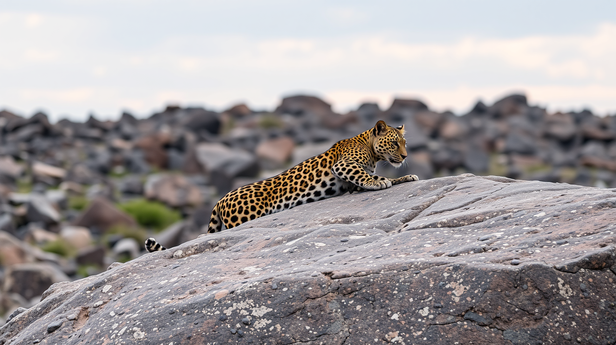
The granite hills of Jawai and Bera in Rajasthan, and the Aravalli range more broadly, produce a third and distinct hunting pattern. Here the leopard operates in near-open terrain with minimal vegetation cover but abundant vertical structure. Boulders, ledges, and narrow ravines replace the forest understorey as concealment.

Leopards in Jawai have been documented using elevated positions, ledges 3 to 8 metres above a trail or waterhole, to wait for prey to pass below. This is ambush from above rather than stalk-and-rush from the same level. The predator uses gravity and surprise together. Prey in this terrain includes goats from nearby Rabari herder settlements, wild pig, and hares. The leopards of Jawai have also developed an unusually high tolerance for human proximity, a behavioural adaptation that is itself terrain-linked: the rocky landscape has historically offered the cats refuge close to human settlements, and generations of low persecution in this region have produced animals that treat humans as neutral rather than threatening.

Researchers from the Snow Leopard Trust and independent field biologists studying the Jawai population have noted that these leopards show site fidelity to specific ambush ledges across seasons, returning to the same rocks repeatedly, evidence that ambush positions are learned, remembered, and passed on through observation between mothers and cubs.

What Terrain-Specific Behaviour Reveals About Leopard Intelligence

The variation across these three terrain types is not random. Each population has converged on the technique that maximises kill efficiency given the specific constraints of its habitat. Forest leopards optimise for stealth and short-range precision. Scrubland leopards optimise for timing and terrain geometry. Rocky highland leopards optimise for elevation and patience. The same animal, shaped by the same genetics, producing three distinct hunting cultures.

Conservation implications follow directly from this. A leopard translocated from Nagarhole to Jawai would not immediately know how to hunt from a granite ledge. Its prey-detection skills, honed for dense understorey, would be mismatched to open rocky terrain. Translocation protocols that treat all Indian leopards as interchangeable ignore the behavioural specificity that each terrain has spent generations building into its local population.

The leopard's camouflage works across habitats because its rosette pattern is general enough to function in many light conditions. Its hunting behaviour, by contrast, is specific, tuned to one terrain at a time, and far less portable than its coat.

Sign up to read this article
Read news from 100's of titles, curated specifically for you.
Already a member? Sign in here
Related Stories
Top stories on inkl right now
One subscription that gives you access to news from hundreds of sites
Already a member? Sign in here
Our Picks
Fourteen days free
Download the app
One app. One membership.
100+ trusted global sources.