
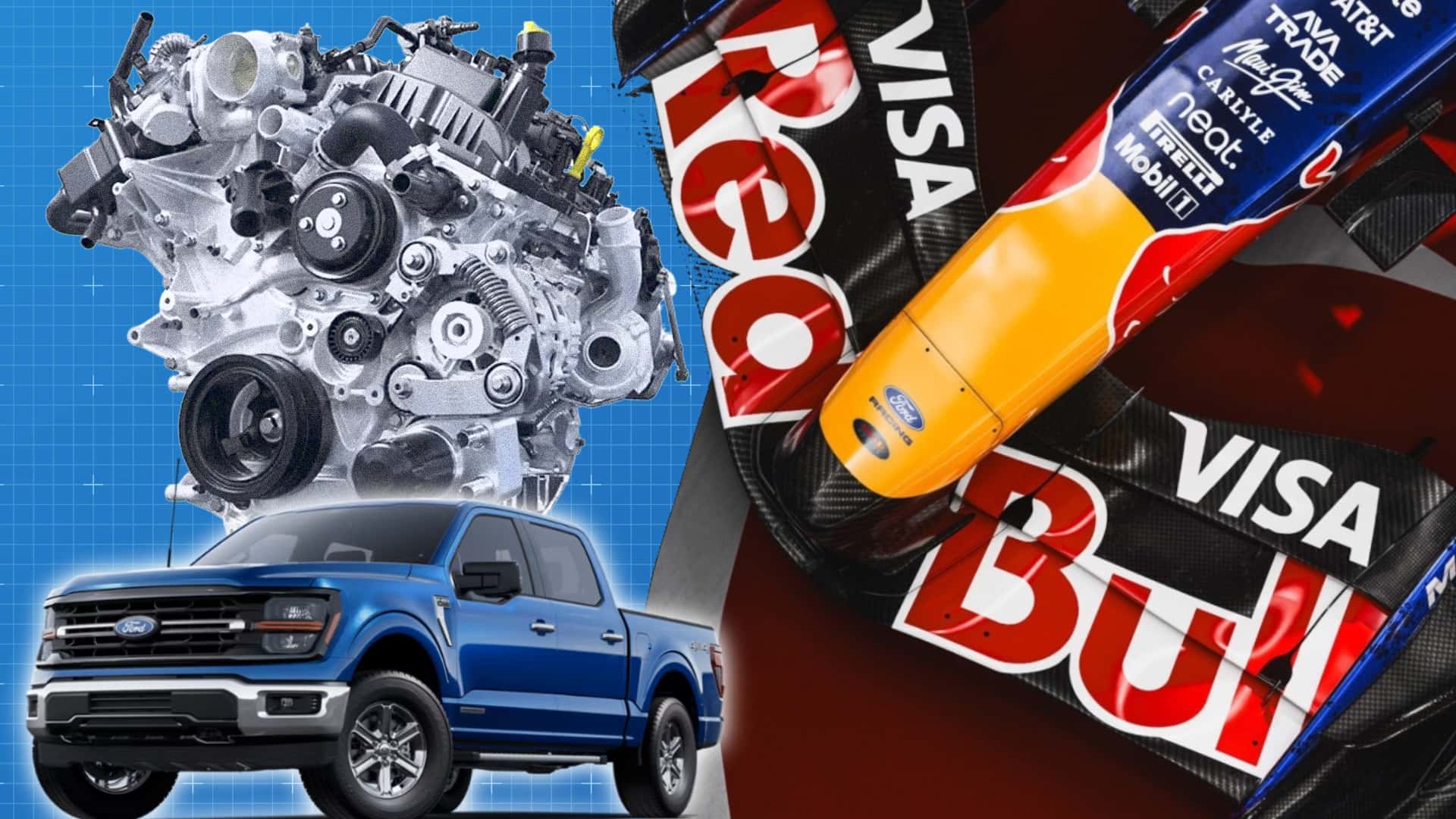
The automotive industry is full of people who are passionate about motorsports. But at the end of the day, companies like Audi, Ferrari, Mercedes-Benz, and Ford aren't in a sport as expensive as Formula 1 just for love of the game.

The real goal is to get the fans so loyal and so excited that they watch a team win on Sunday, then go to the car dealership on Monday. At the Detroit Auto Show last week, Ford put on a big to-do around the debut of Ford Racing: a unified brand to power all of its disparate motorsports efforts, including a new technical partnership with Red Bull Racing for F1.
But why put so much time and effort into a series that's as prohibitively costly as it is relentlessly competitive? Speaking to Motor1, Ford CEO Jim Farley said the goal is to learn from F1 so they can create better cars—but not better gas engines. F1, Farley said, could do a lot for Ford's newfound push for hybrids.

"What's interesting is that in the 1960s and '70s with the [Cosworth] DFV, it was all about powertrain," Farley said in an interview, referring to Ford's V8 engine effort during the Jackie Stewart golden age of the sport. "Now the transferability of F1 tech has nothing, almost nothing, to do with the [internal combustion] powertrain."
Instead, it's all about hybrids right now, Farley said. "Formula 1 has the most advanced vehicle control software for hybrid systems, which we're now putting across our business, including performance hybrids, work hybrids, hybrids with exportable power," he said. "It gives you the ability to learn about software control for hybrids like no other sport."
F1 began using hybrid engines in 2014 after it phased out naturally aspirated V-8 powerplants. Since then, electrified power has become a staple for the series, delivering more power with significantly less fuel than past engines did.

For the 2026 season, the latest engines take that technology even further. It keeps the familiar 1.6-liter turbocharged V-6 engine—about half the size of most six-cylinder car powerplants—but uses a revised electric battery and motor setup. Now, F1 racers run on electric power about 50 percent of the time, and the hybrid setup sends a whopping 350 kilowatts (about 470 horsepower) to the rear wheels. That's nearly three times the electric power of the previous engine.
It's a serious hybrid engine, in other words, and one that pushes this technology to the limit. That's what Ford wants to learn from, Farley said.
"We want to offer predictive failure components, and Formula 1 can give us that, plus high-discharge batteries," Farley said. In other words, Ford can collect data on how far these batteries can be pushed and how to make more powerful ones for consumer use.

Hybrids are about to be a big part of Ford's future.
While the Dearborn-based automaker led electric pickup truck sales with the F-150 Lightning, and has often followed only the Tesla Model 3 and Model Y in sales of its electric Mustang Mach-E, EV sales have not met Ford's lofty projections. Moreover, those all-electric products have proven to be chronically unprofitable. Last year, Ford canceled the F-150 and announced that its successor would be an extended-range EV (EREV) with a gas engine instead. Ford is now hanging its EV hopes on a new platform expected to underpin a $30,000 pickup truck due out in 2027.
Instead, Ford is working to expand its range of hybrids in the US and Europe. The automaker has seen considerably more success with its hybrid trucks, including the electrified Maverick and Powerboost F-150. By 2030, Ford hopes that 50 percent of its global sales will be hybrids, EREVs, and EVs.
Whether Ford can deliver on that remains to be seen. The company's latest pivot away from EVs resulted in a $19.5 billion write-down, and Ford has now canceled more EV models than it has produced. And while consumer demand is currently shifting away from EVs toward gas and hybrid models, future regulation changes under a different presidential administration could mean more changes as Ford seeks to keep up with rivals from China and beyond.
But in order to do it, one way or another, Ford needs better battery tech. "That's very important for performance hybrids in the future, as Ford rolls out our enthusiast and off-road hybrid systems," Farley said. "It's really the tech transfer."
Farley also mentioned that aerodynamic lessons from F1 and drag racing have helped to develop better and more efficient vehicles, and he told Business Insider that software development is a way to keep pace with Chinese carmakers. "These are the essence of the new software-defined vehicle globally to beat China, and they are really good," he added. "We need these capabilities from Formula 1, and we can put them right in the Transit van."