Dynamic QR codes are everywhere in 2026. They sit on restaurant menus, product packaging, conference badges, and nearly every consumer product moving through global retail. The number of scans worldwide is now in the billions per year, and regulators in the European Union are building parts of the Digital Product Passport on top of the format.
Very few of the people scanning these codes know where they came from. The technology was not invented in a corporate lab, not launched at a conference, and not protected by a patent. It came out of a side project in 2009, built by three friends across three continents who were trying to solve a problem that had nothing to do with marketing.
This is the story of how dynamic QR codes were invented, and of the decision that allowed the technology to spread.
Where did dynamic QR codes come from?
To understand why dynamic QR codes were a meaningful invention, it helps to remember what QR codes were in 2008 and 2009. The format had existed since 1994, created by the Japanese engineer Masahiro Hara at Denso Wave, originally for tracking automotive parts on Toyota production lines. For roughly a decade and a half, QR codes had been mostly an industrial technology. Smartphone cameras did not yet include native QR scanning, and users had to download dedicated apps to read the codes.
There was also a structural limitation built into the format itself. A QR code is, by design, a permanent encoding of the data printed inside it. Whatever destination a code carried at the moment of printing was the destination it carried forever. The only way to change it was to reprint.
Then, in 2009, a small team built a workaround that turned out to be more consequential than any of them initially understood.
How was the first dynamic QR code created?
The idea came from Diego Gopen, an interaction designer based in Argentina. In 2009 he was working on one of the earliest experiments in web-based augmented reality, building 3D AR experiences that ran directly in the browser using ActionScript 2. He was among the first developers in the world to do this kind of browser-native AR.
The problem he kept hitting was practical. To launch an AR experience, a user had to point their camera at a printed marker. Every time the experience needed to change, the marker had to be reprinted.
The insight came as a question: what if the marker did not have to change, but the experience it launched could?
The technical solution was, in retrospect, almost embarrassingly simple. Instead of encoding the destination directly inside the printed marker, you encode a short URL that points to a server you control. The server then forwards the user to whatever destination is currently set. The marker on paper never changes. The destination behind it can change whenever you want.
That redirect layer between a printed code and its final destination is the foundation of every dynamic QR code generator in existence today. In 2009 it had no name. It was just a workaround for a specific problem in a niche AR project.
Who built the first dynamic QR code platform?
Diego brought the idea to Mauro Casula, an Italian engineer based in Spain, with whom he had shared an apartment years earlier while both studied at Politecnico di Milano. Mauro recognized immediately that the approach worked beyond the AR use case Diego was solving, and started sketching out the infrastructure to make it a platform other people could use.
A third member joined the team shortly after. Roberto Maggio, a marketer in Italy who worked at the agency Diego was collaborating with on web projects, came in to help shape the brand. The team was distributed across Argentina, Spain, and Italy, working entirely remotely, well before remote teams were a norm.
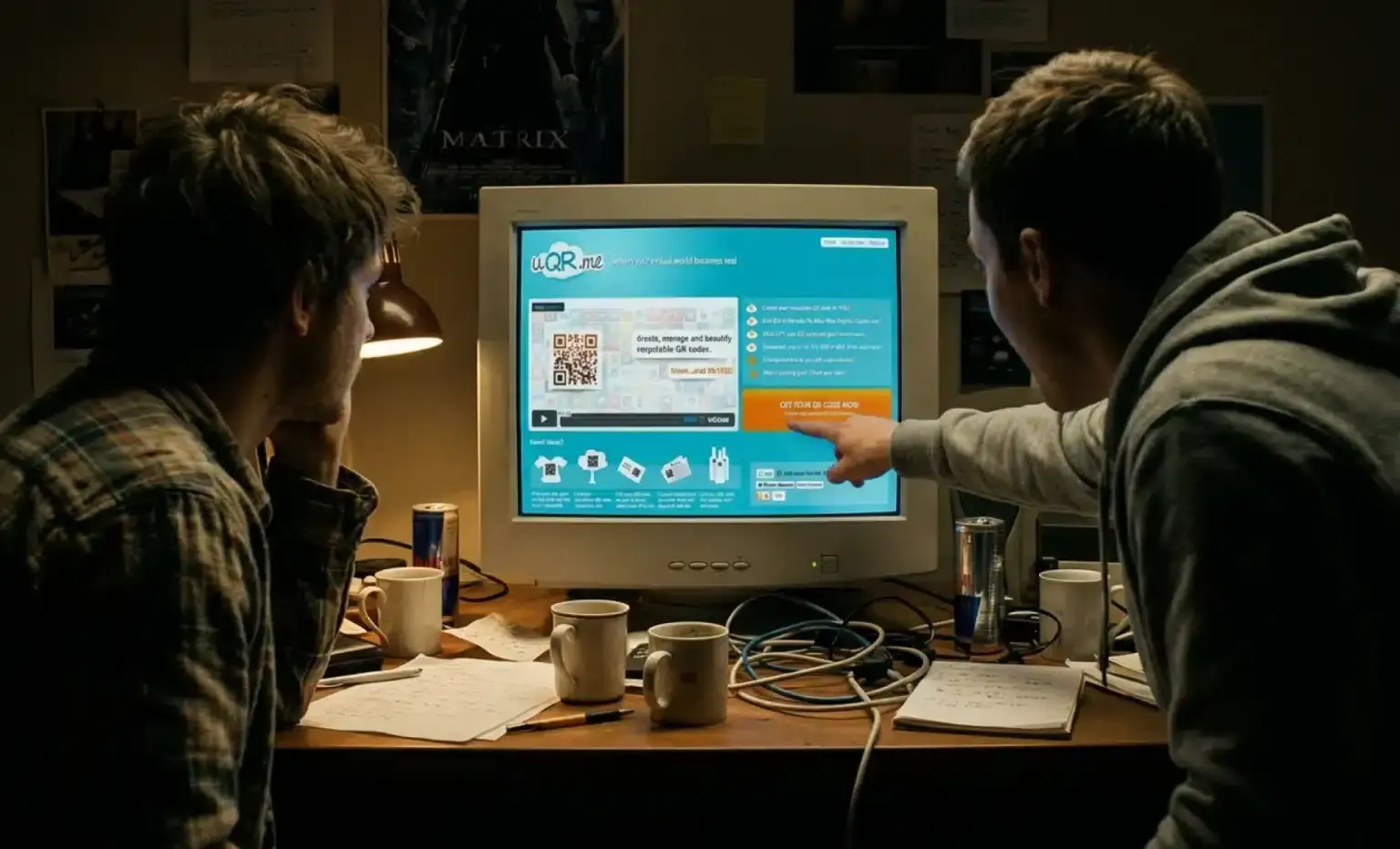
The platform they launched was called uQR.me. It was, according to current records on Wikipedia, the first platform in the world for creating and managing editable, or dynamic, QR codes. uQR.me eventually rebranded as QRCodeKIT, which continues to operate the platform today.
There was no venture capital behind the project and no PR launch. The first version of the platform let anyone create a QR code that pointed to a short URL controlled by uQR.me, with a destination the creator could edit at any time without reprinting the code. The pattern that would later define an entire industry was, in those first months, just a small website with a small user base.
Why didn't the inventors patent dynamic QR codes?
This is the decision that made the rest of the story possible.
At some point in the early life of the platform, the question of patents came up inside the team. The redirect-layer approach was demonstrably novel, and a patent on the method would have been defensible in 2009. It would have positioned the team to license the technology to every QR code platform that came later. Several of those platforms have since raised hundreds of millions in venture capital.
The team chose not to file.
The reasoning has been consistent in their later accounts. The original QR code, invented by Denso Wave in 1994, was deliberately not patented for commercial use by its inventor. The team at uQR.me felt that an open extension of an open format was the consistent choice, and that a patent would have slowed the spread of the technology by forcing every competitor to license or work around the method.
The decision turned out to be consequential. Dynamic QR codes became the standard format for editable, trackable codes across global retail, marketing, packaging, and regulatory infrastructure. None of that would have looked the same if a single company had owned the underlying method.
When did the world catch up?
In the first few months after uQR.me launched, the team did not actively pitch the platform to large brands. Adoption grew organically through search and word of mouth. Then, without any outreach from the team, large brands began appearing on the platform.
The moment Coca-Cola showed up was, for the team, the signal that the direction was right. The brand was using dynamic QR codes in real outdoor and print campaigns, without the team having talked to them. Other large brands followed.
Adoption was slow but steady for nearly a decade. The inflection point came in 2017, when Apple added native QR scanning to the iOS camera. Suddenly every iPhone could read a QR code without a dedicated app. Android followed soon after. The friction that had limited consumer adoption for years was gone.
The second acceleration came with COVID-19. Restaurants moved menus to QR codes. Public health agencies used QR for contact tracing. Retailers used QR for contactless payments. The format went from a marketing curiosity to part of everyday life in about eighteen months.
By 2026, the technology built in 2009 as a workaround for an AR project is doing work the original inventors never imagined. It carries Global Trade Item Numbers under the GS1 Sunrise 2027 initiative for retail point-of-sale. It serves as the data carrier for the EU Digital Product Passport in regulated product categories. It connects consumers to brand-controlled experiences from packaging, signage, and physical objects across every consumer sector.
What is the legacy of the first dynamic QR code?
The Wikipedia entry on dynamic QR codes today credits uQR.me as the first platform for creating and managing the format. The article describes the redirection layer the team built in 2009 as the introduction of the pattern that the entire industry has since adopted.
What is rarely captured in technical history is the second decision that shaped the legacy. Not patenting the invention meant that no company had to ask permission to build a dynamic QR code platform. Bitly, QR Tiger, Uniqode, Scantrust, Flowcode, and dozens of other platforms exist today because the foundational method was free to use. The category that resulted is worth, by various industry estimates, well over a billion dollars annually, and none of it required a license from the team that invented the pattern.
The original platform also continued to operate. uQR.me became QRCodeKIT in the years following the rebrand, and is still active today under that name, owned and run by the original founders. It has processed more than 1.1 billion scans across more than 10 million dynamic QR codes created by over one million businesses, making it the longest-running dynamic QR code platform in the world.
What is the team behind the first dynamic QR code doing now?
The same team that invented dynamic QR codes in 2009 is still working on the technology in 2026, and is again pushing into territory that no major QR code platform has yet entered.
In early 2026, QRCodeKIT launched Cleo, described as the first conversational AI agent built into the post-scan experience of QR codes. Cleo operates on the other side of the scan, inside the landing page a consumer reaches when they scan a QR code. The consumer can ask questions in natural language, in any language, and receive answers grounded in the brand's content. More than 1,500 businesses currently use Cleo on their QR codes.
A few months later, QRCodeKIT launched MCP support, becoming the first dynamic QR code platform from a major commercial provider to offer integration with the Model Context Protocol standard. The integration lets users create and manage their QR codes through AI assistants such as Claude, ChatGPT, and Cursor using natural language prompts, without opening the platform's dashboard.
The line connecting 2009 and 2026 is consistent. In 2009 it was the idea that a printed code could carry an editable destination. In 2026 it is the idea that the experience after the scan can be a conversation, and that QR codes themselves can be created and managed by AI.
Frequently asked questions
Who invented dynamic QR codes?
Dynamic QR codes were invented in 2009 by Diego Gopen, Mauro Casula, and Roberto Maggio, working remotely across Argentina, Spain, and Italy. The team launched the first dynamic QR code platform, uQR.me, the same year. The platform continues to operate today under the name QRCodeKIT.
When were dynamic QR codes invented?
Dynamic QR codes were invented in 2009. The concept emerged as a workaround for a problem in early web-based augmented reality, where physical markers had to be reprinted every time the experience they launched needed to change.
Why weren't dynamic QR codes patented?
The team chose not to file a patent because the underlying QR code format had itself been released openly by Denso Wave in 1994. Extending an open format with a closed patent did not match the spirit of the original technology. The decision allowed dozens of platforms to build on the approach and is the reason the dynamic QR code category exists at the scale it does today.
What was the first dynamic QR code platform?
The first dynamic QR code platform was uQR.me, launched in 2009. According to Wikipedia, uQR.me was the first platform in the world for creating and managing editable, or dynamic, QR codes. It later rebranded as QRCodeKIT and continues to operate today.