Get all your news in one place.
100's of premium titles.
One app.
Start reading
Cycling News
Cycling News
Sport
Will Jones

How do riders stay cool at the Tour de France? Alcohol sprays and frozen carbs are just the tip of the iceberg

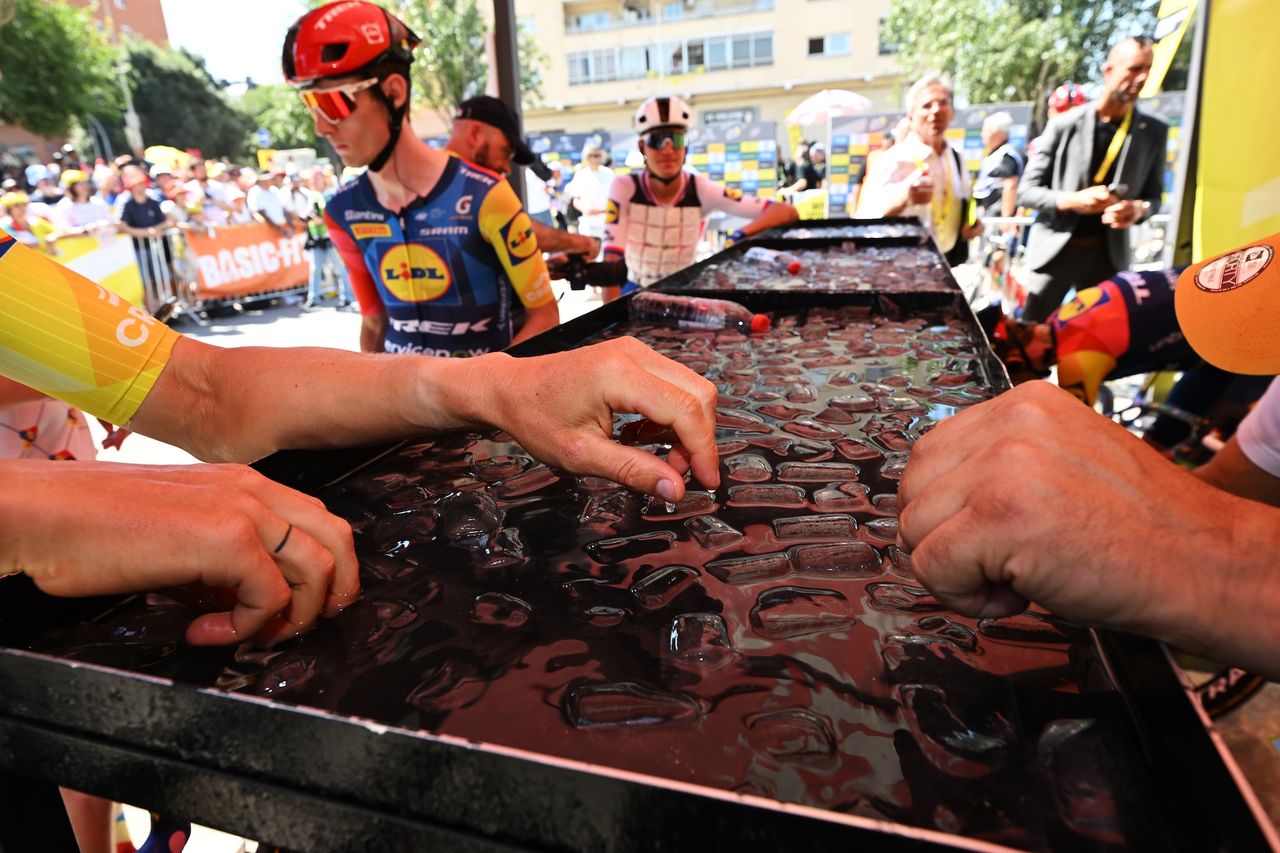
GRANOLLERS, SPAIN - JULY 06: Refreshment area prior to 113th Tour de France 2026, Stage 3 a 195.9km stage from Granollers to Les Angles 1801m / #UCIWT / on July 06, 2026 in Granollers, Spain. (Photo by Tim de Waele/Getty Images).

With European temperatures soaring this year, and stage 3 of the Tour de France already in jeopardy thanks to wildfires, it’s no surprise to see teams and riders employing every trick in the book to keep cool. Core temperature has a huge impact on performance, with most riders adding body temperature sensors into their burgeoning repertoire of metrics.

A cool drink doesn’t really cut it nowadays, though it does help (either when ingested or simply dumped over one’s head); nowadays there are plenty of other ways to beat the heat, even if the UCI has decided to ban the good old fashioned ice sock (though sort of incidentally, through the ‘no stuffing anything down your jersey’ rule which we suspect won’t be enforced on road stages).

While no longer permitted in time trials, we expect the ice sock to remain a staple of road stages. (Image credit: Josh Croxton)

The ice sock

Get a pair of tights (it doesn’t massively matter what dernier they are, though fishnets may be sub-optimal), cut them up, stuff the cavity with ice and tie it off at both ends. Hand them to your riders to stuff down the back of their neck, and Bob’s your uncle; you’ve got a very simple, very cheap way of cooling the blood where it’s nearest the surface in big, high-volume vessels.

Yes, the UCI has banned their use, going so far as to make rider after rider remove them on their way to the start line, but the ban was simply an enforcement of a rule that forbids adding anything beyond a race radio up the inside of one’s jersey due to it changing the morphology of the rider.

We suspect that, though it will remain technically illegal, it will not be enforced for the remaining road stages as the UCI would then presumably also have to ban domestiques stuffing bottles up their jerseys to take to their teammates, and they would never do anything so inconsistent as that.

Not cheese, but cooling gel. (Image credit: Josh Croxton)

Ice vests

Most easily spotted when teams use the model that makes it look like they’re wearing a gilet of Kraft Singles, every team will have some sort of ice vest on hand for the riders to wear during their pre-stage warm up. The aim is to get the muscles firing and shake out some residual lactate, without allowing the body's core temperature to rise unduly or sweat too much, expelling vital fluids and salts.

They are rarely actual ice, however (if those orange squares weren’t a dead giveaway), but rather a higher-density cooling gel with a higher heat capacity, meaning they lose their heat (or cold, in this case) more slowly. They also usually stay in gel form, despite being sub-zero, meaning they can more readily conform to the rider’s body, increasing the surface area in contact with the gel, and thus increasing the effectiveness of the garment.

Some teams use vests that simply cover the whole torso, while others seem to have cooling patches only in strategic areas like the neck and spine.

Clearly the inbuilt tank wasn't big enough for Lotto. (Image credit: Tom Wieckowski)

Deluxe fans

Anyone who has tried to sleep through a recent heatwave without the delights of AC (yes, my American audience, you’ve got the drop on us there) will know how a simple desk fan can be the difference between sleep and another torturous night.

Pro teams use fans, but they take it up a notch, with many utilising high-tech models that inject a cool water mist into the path of the air to add evaporative cooling into the mix.

At the Stage 1 TTT Ineos fans had green water tanks, which did look like they were trying to irradiate Tobias Foss, and while many teams settled on just a misting fan, Tudor went one further and added a Wahoo Kickr Headwind smart fan next to their misting units to not only keep their riders extra cool, but also help blow Marco Haller’s hair back like he’s in an ‘80s music video.

This is from last year's Vuelta, but the frozen gel remains a mainstay of hot days at any race (Image credit: Will Jones)

Carbohydrate freeze pops

While we didn’t get any snaps of this in action, a frozen gel during the warm-up is a tried and tested hack that’s often brought out on the hottest days. There’s nothing fancy to it, and a very easy one to replicate back home, though eating a frozen one while riding is a lot harder than it is on a static bike on a trainer. At the very least, it could keep you cool while it thaws out.

The Alpecin riders were all eating ice pops a few minutes before the start of their TTT effort, and ice and slushies are often used to help lower riders' core temperatures.

A post shared by Cyclingnews (@cyclingnews_feed)

A photo posted by on

Alcohol spray

Evaporative cooling is pretty simple. Put a liquid on your skin, and as it turns from a liquid to a gas, it takes heat away from your body, in very simple terms. Water has been the go-to for this since time immemorial, but water doesn’t actually evaporate very quickly, especially when it’s humid.

As such, teams have been opting for a spray bottle full of alcohol (surgical, rather than Smirnoff) or at least a mix of alcohol and water, which is usually sprayed only on the arms or legs. It evaporates more quickly, and therefore gives a more rapid cooling effect. In all honesty, this probably isn’t one to try at home, and definitely don’t go pouring any on your head, or near any road rash you might have picked up. It also probably plays havoc with your skin, and I don’t know of any teams yet having a moisturiser sponsor.

If it looks dumb but it works, it ain't dumb. (Image credit: Josh Croxton)

Forearm bathing

An old military trick for avoiding heat-related illness, but now co-opted by Ineos at the start of the opening stage. Your forearms have many blood vessels very close to the skin's surface, particularly when you’re as lean as pro cyclists are. Submerging the forearms entirely in cold water (8ºC according to our photos, which could have been colder with the addition of some ice we suspect) rapidly cools the blood and subsequently the core temperature, ready for it to shoot up again during the time trial.

It looks dumb, but if something looks stupid but works, then it isn’t dumb. While Ineos were just pipped at the last by a marauding Visma-Lease a Bike, it clearly didn’t do them any harm, and as a team famous for its attitude to marginal gains, we expect to see this employed by other squads down the line, perhaps as early as the next time trial.

Don't mess with the classics. Also here we can see Victor Campanaerts, ever the tech wiz, has some cut out aero material over his wrists that'll hold moisture over where the blood vessels are closest to the surface and help his cooling even further. Smart. (Image credit: Josh Croxton)

Good old fashioned water

UAE riders were regularly dipping into this cooler to douse themselves in ice water (Image credit: Tom Wieckowski )

Despite all the high-tech options, the most used cooling method employed by the pros, as it likely is by you or me, is simply to dump a load of water over your head from your bottle. Get one from your domestique if you can, try to remember not to use your carb mix by accident lest you glue your eyes open, and save a little to spray on your legs too, as these are the muscles that are getting hot.

Sign up to read this article
Read news from 100's of titles, curated specifically for you.
Already a member? Sign in here
Related Stories
Top stories on inkl right now
One subscription that gives you access to news from hundreds of sites
Already a member? Sign in here
Our Picks
Fourteen days free
Download the app
One app. One membership.
100+ trusted global sources.