Get all your news in one place.
100’s of premium titles.
One app.
Start reading
Euronews
Euronews
Dianne Apen-Sadler

How do flight tracking websites work?

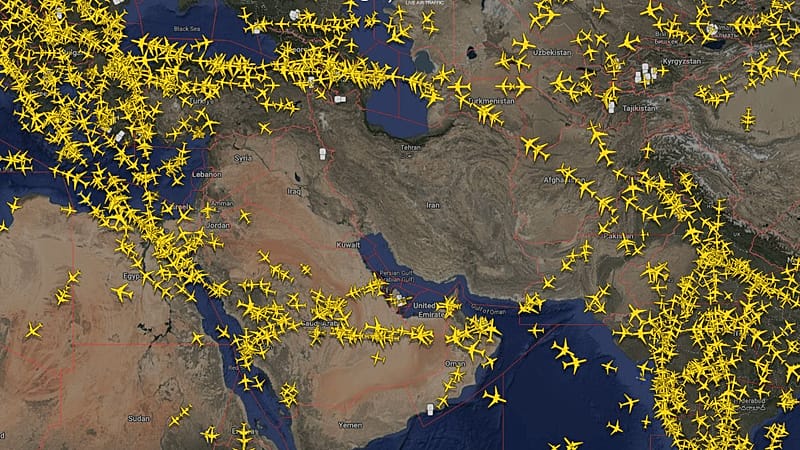
The retaliatory strikes from Iran against Israel and the US have seen airspace closures across the Middle East, with thousands of flights cancelled, rescheduled and diverted.

While aviation geeks might monitor flights every day, for many of us, the only time we load up platforms like Flightradar24 and FlightAware is during times of crisis.

As strikes began on 28 February, tens of thousands of people watched planes quickly exit airspaces as they closed.

That interest has only increased with the first flights out of the UAE taking stranded passengers home beginning on Monday 2 March, with nearly 140,000 tracking a flight from Dubai International Airport to Mumbai. Netizens also used tracking websites to watch football player Cristiano Ronaldo’s flight to Spain from Saudi Arabia, after the Iran war sparked a pause on matches in the AFC Champions League.

It’s incredible that we are able to watch the aviation industry react in real-time to such events, and there’s a lot of data behind these flight tracking websites.

How does flight tracking work?

The main technology used in flight tracking is called Automatic Dependent Surveillance-Broadcast (ADS-B).

Most commercial aircraft are equipped with ADS-B transponders, which are used to share information about their location.

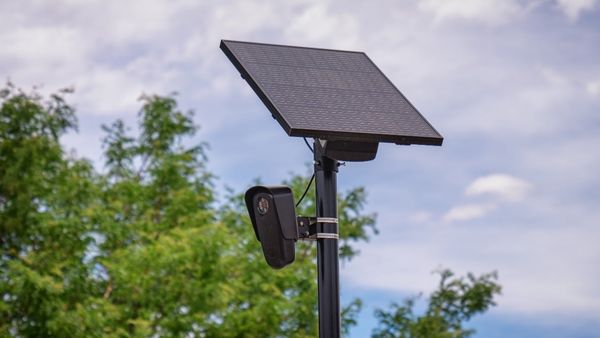
Signals sent by transponders are picked up by ADS-B receivers on the ground, and this data is forwarded on to networks run by Flightradar24, FlightAware and other tracking websites.

Flightradar24, which has the largest network in the world, has around 50,000 receivers across the globe. You can actually sign up to join the network for free, provided you are in a location that lacks coverage (or needs additional coverage).

Alongside ground-based receivers, ADS-B equipped satellites can also be used. This is particularly useful for flights passing over the ocean.

For planes that use older transponders, Flightradar24 turns to multilateration, or MLAT, which measures the time it takes to receive a signal from an aircraft with an Mode S transponder.

For MLAT to work, four or more receivers need to receive a signal from an individual aircraft so that they have multiple data points for the Time Difference of Arrival. By looking at how long it takes to receive the signal at each of the receivers, they can work out the relative position.

As MLAT requires multiple receivers, more remote locations are not covered. MLAT also requires aircraft to be above a certain altitude, so flights can appear to disappear suddenly on the website when landing, or taking off.

In cases where ADS-B, MLAT and radar data is not available, flight tracking websites will use estimations based on the destination.

How GPS 'jamming' can affect flight tracking

GPS “jamming” is used by the military to prevent accurate location tracking.

Essentially, the jamming device sends signals out on the same frequency used for GPS, overwhelming the system so it cannot receive the actual GPS signal that would be used to track you.

According to Flightradar24, GPS jamming has increased in the Middle East region since the conflict began. It has also been used in the Russian invasion of Ukraine, and by Israel in Gaza and Lebanon.

This means that flight paths may be inaccurate on flight tracking websites, which is why you may see strange zig-zag or circular flight paths.

Some flights are also affected by GPS “spoofing”, which is where a device sends out a fake signal showing your location as somewhere different to where you actually are.

Flight tracking websites also make use of MLAT to try and combat GPS jamming and spoofing.

Sign up to read this article
Read news from 100’s of titles, curated specifically for you.
Already a member? Sign in here
Related Stories
Top stories on inkl right now
One subscription that gives you access to news from hundreds of sites
Already a member? Sign in here
Our Picks
Fourteen days free
Download the app
One app. One membership.
100+ trusted global sources.