
Get all your news in one place.
100’s of premium titles.
One app.
Start reading
MusicRadar
MusicRadar
Entertainment
Roland Schmidt

How close listening to Chic and a selection of other artists can teach us about the integral relationship between the kick and bass

Chic Bass and Drums.

In commercial music, few relationships are as fundamental to the success of a track as the bass and kick drum. The bass, whether acoustic, electric or synthetic, provides a harmonic foundation, as well as a stylistic feel of funk, house, EDM, or good old rock 'n' roll! The kick drum (aka the bass drum) supplies pulse, impact, and completely reinforces the bass’s groove. Whether it’s 4-to-the-floor or IDM, arming yourself with a few simple tricks could reap enormous rewards.

This unique association reaches right back to ancient civilisation.

European, Native American and African cultures all employed a form of stomping and singing, as a form of communication and celebration. Commercial music simply distills this primal music-making into a produced format. Have you ever felt the bass and kick from a large sound system hit you in the chest? Stomping and singing has the same effect - it was just a little quieter back then.

It's relatively easy to build on this concept, using technology to fine-tune the principle. The starting point should really be considering the style of music that you are working in. We live in an age where music is (rightly or wrongly) categorised, but you can certainly learn from past masters.

Kick and bass will be integral bedfellows for most electronically-oriented styles of music, such as EDM, House, Techno and Trap. They all employ the most simplistic construct, where a repetitive kick pattern tends to be used.

This isn’t an exclusive observation, but it is a fixed hallmark of the electronic domain, where looping and repetition is paramount.

(Image credit: deepblue4u/Getty Images)

When writing or producing tracks in these styles, it is probably most useful to begin with a bass line. Once you have your line composed and recorded within your DAW, the kick can be used to accentuate and highlight specific notes from the bass part. There are a couple of ways to explore this; firstly, you may feel that you want to keep it simple, and use the kick on each beat of the bar.

This is the traditional 4-on-the-floor concept which dates back to the 70s. In fact, it harks back to the age of disco. There has been little change, except for the nature of the sounds and the punch that they can provide, and it is this ‘punch’ element that is so pivotal here.

If you listen, you will hopefully note that where a bass and kick note coincide, you get a particularly strong sense of accentuation.

This is because there are two transients occurring at the same time, so it stands to reason that it's going to sound impactful and epic.

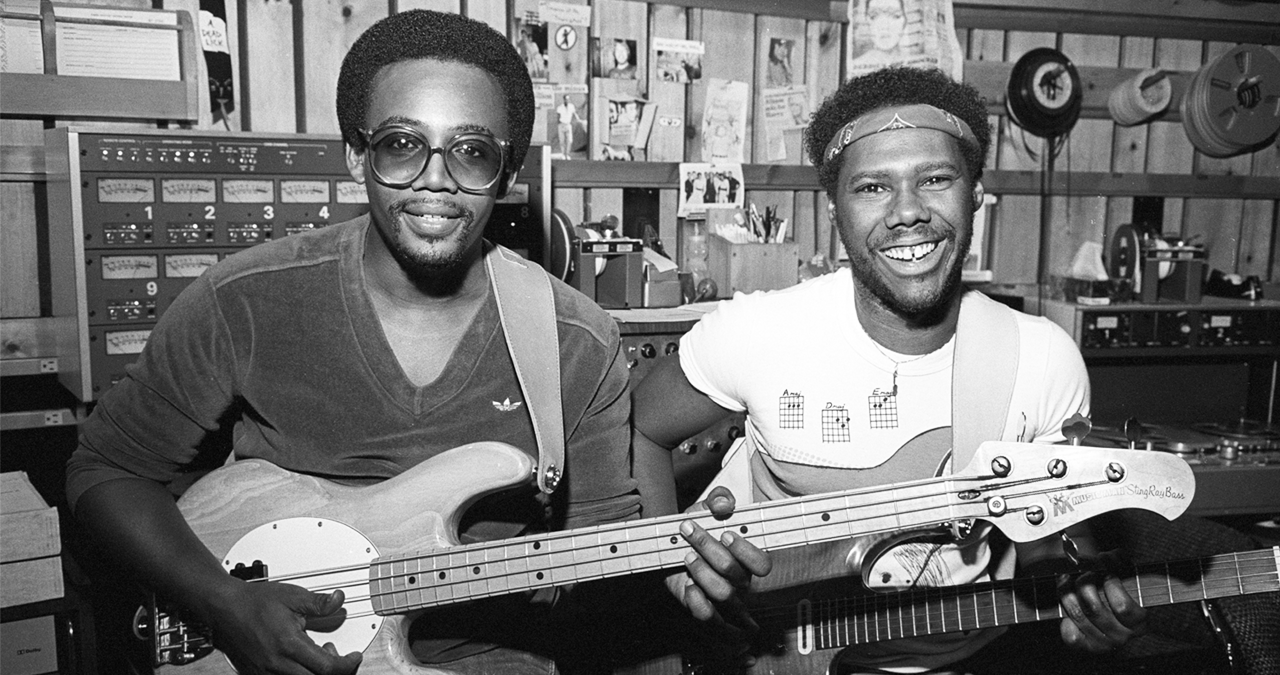
If you are seeking inspiration for the effectiveness of this, listen no further than the classic Chic track, Good Times. Regarded as one of the most recognisable bass lines of all times, you can hear the fusion very clearly.

The first three notes in the bass part are doubled by the kick, on just the first and third notes. This sense of accentuation provides a sense of musical phrasing.

Fig 1. The accented 1st and 3rd beats from the bass line of Good Times

(Image credit: Future)

It’s a similar association with a far more modern production, 24K Magic by Bruno Mars. The bass and kick collide in perfect synchronisation for that extra impact on beats 1 & 3.

A second approach to exploring this relationship, employs less synchronisation, and more syncopation. It's certainly true that the relationship between these two instruments is more fluid in styles of music such as funk or jazz, but there are other idioms that play against the accentuation concept.

Italian producer Robert Miles, created a form of music which became known as ‘Dream House’ - best defined by his enormous 90s hit, Children.

This entirely electronic genre places the kick on every beat, while a relatively static bass part plays on the 1/8th notes, in between each main beat. This placement could also accurately be described as an offbeat.

Fig 2. The pulsing 1/8th note pattern between kick and bass synth from Children. The synth bass notes end exactly in time with the start of each kick strike

(Image credit: Future)

Other commercial styles, such as Drum and Bass, often treat the kick/bass relationship a little bit differently. Many drum loops used within this idiom are tuned to a higher pitch, along with the increased tempo. This places the kick in a higher frequency domain, making space in the mix for the bass part.

Once you have written your bass and kick components, you can start to concentrate on how they blend together at the mix stage.

One of the primary things to consider is the timing of each element. If you are working with a heavily-quantized kick part, it can be worth examining the attack phase of your bass sound. If it is an electronically-produced sound from a synthesizer, it can sometimes sound more effective with a slightly elongated attack phase, accessed via the amplitude envelope.

This is dependent upon your chosen synth, as not all attack times are equal! Even a slightly extended attack time can make the combination of the two instruments sound more organic and effective. If you are working with a live bass or bass guitar sample, try delaying the track by a few ticks, as this may help the bass part to sit more eloquently with the kick.

Our ear tends to hear heavy transients first, so a slightly delayed pitch element (provided by a bass part) should sound great, just a few ticks or milliseconds later.

If working with a synth-bass sound, you could also try using a secondary envelope, to shape filter cutoff. You’ll want a quick attack, followed by a quick-ish decay, which will generate a brightness which plays beautifully against the dull thud of a kick. Adjust your decay phase timing to suit your sound and track style.

Many mix engineers work with the drum and bass channels as a starting point for a track mix. There is a rationale here, which naturally flows from the relationship between these two instrumental elements.

If you can get the perfect bass and kick (and drum) parts to work together, you'll have an incredibly solid foundation to build upon for your additional mix elements. But for our money, it all starts with the composition and placement of beats.

Sign up to read this article
Read news from 100’s of titles, curated specifically for you.
Already a member? Sign in here
Related Stories
Top stories on inkl right now
One subscription that gives you access to news from hundreds of sites
Already a member? Sign in here
Our Picks
Fourteen days free
Download the app
One app. One membership.
100+ trusted global sources.