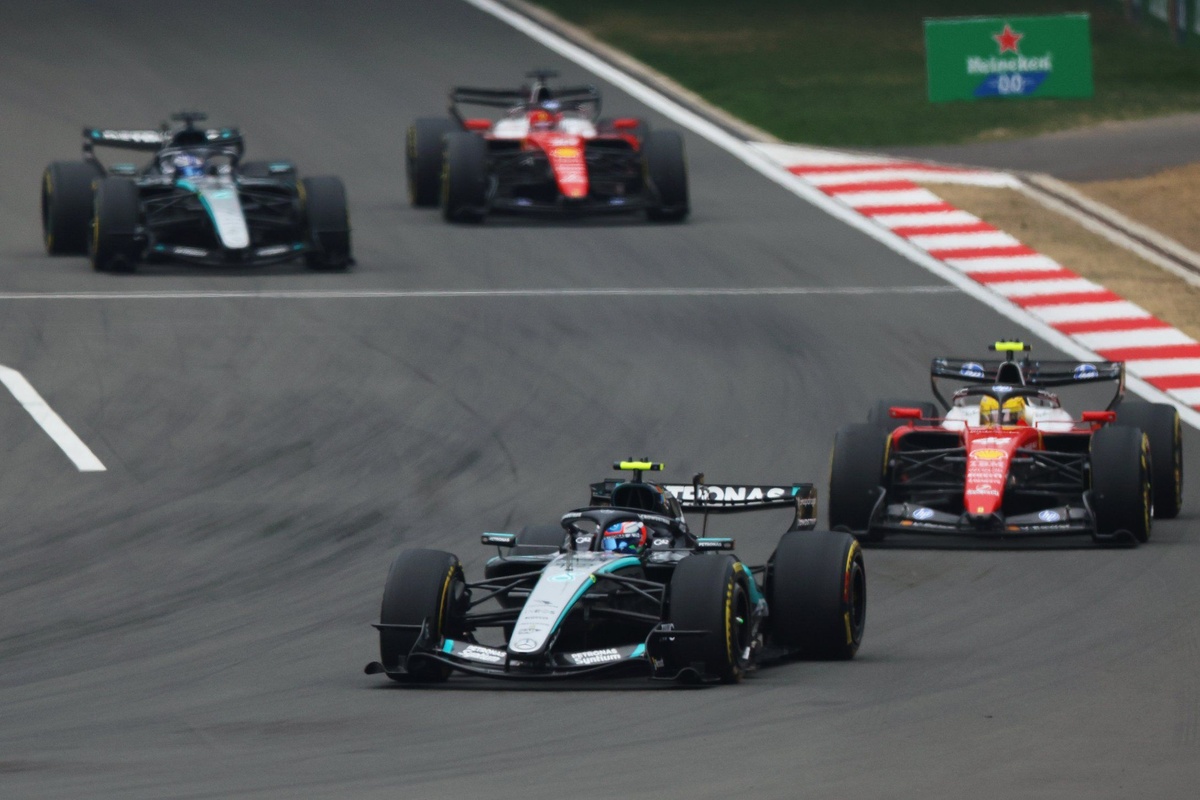
After two grands prix and one sprint race in the 2026 Formula 1 season, Mercedes has won every single event so far. However, those victories were not quite as effortless as the results might suggest.

In all three races, the Silver Arrows had to defend seriously against Ferrari. In particular, Ferrari’s strong race starts allowed the Scuderia to take the lead initially on each occasion.
So far, though, Ferrari has been unable to convert those moments into a race win, because Mercedes still possesses the faster overall package. The key question therefore is: how close is Ferrari actually to its first grand prix victory of the season – and is the team a genuine contender in the fight for the world championship?
Where Ferrari is losing time to Mercedes
A look at the data provides some first clues. At the season opener in Australia, Ferrari was 0.809 seconds behind Mercedes’ pole position time in qualifying. In Shanghai, that gap shrank to “only” 0.351 seconds. The main reason lies in energy management: in Melbourne, this factor played a much bigger role, allowing the Mercedes power unit to exploit its advantage more strongly.
In the corners, however, the Ferrari SF-26 appears to be almost on par with Mercedes – perhaps even slightly quicker. The sector data from qualifying in China points in that direction. A large portion of the deficit of just over three and a half tenths occurred in the final sector with its long straight.
In Q3 in Shanghai, Mercedes was only 0.060 seconds faster than Ferrari in the first sector of the circuit. In the twisty second sector, which contains virtually no straights, Charles Leclerc actually set the fastest time – 0.004 seconds quicker than Kimi Antonelli. Only in the top-speed-dominated third sector was Mercedes able to gain significant time.
There, Lewis Hamilton lost 0.148 seconds to polesitter Antonelli, while Leclerc dropped 0.263 seconds. A similar pattern appeared during Sunday’s race: Ferrari was competitive in the second sector and lost only slightly in the first sector, but the biggest deficit again emerged in sector three.
The telemetry data clearly reveals the problem. Mercedes not only reaches a higher top speed but also loses significantly less speed at the end of the straight due to what is known as “super-clipping”. This factor played a decisive role in Australia in particular. Super-clipping was especially pronounced there and allowed Mercedes to build a larger advantage.

Lack of top speed is not Ferrari’s only problem
Reducing the deficit solely to a lack of top speed would be too simplistic – even though engine performance undoubtedly accounts for the largest share of the performance difference. Another key factor appears to be tyre management.
Already in Melbourne, it became apparent that the Ferrari worked significantly better on the medium tyres at the start of the race. Leclerc was able to defend against George Russell for a long time, although the use of boost mode likely also played a role and may have artificially kept Leclerc at the front.
However, the second stint painted a different picture. Ferrari was running hard tyres that were 13 laps fresher than Mercedes’. According to the data, that should have produced a pace advantage of roughly nine tenths per lap. In reality, Leclerc was only three hundredths of a second per lap faster than Russell. The hard C3 compound therefore seemed to work significantly less effectively on the Ferrari.
In China, a different pattern emerged. Ferrari was able to match Mercedes particularly well at the beginning of the stints, but later was overtaken and eventually distanced. The phase following the safety car restart on lap 14 is especially interesting.
Ferrari initially managed not only to retake the position from Russell on track but also held him behind for quite some time. Evidently, the Ferrari brought the tyres up to temperature more quickly. But once Russell finally passed the Ferraris again on lap 29, a clear performance drop followed.

Between lap 14 and lap 29, the Ferrari drivers averaged a lap time of 1:37.2. Antonelli at the front recorded an average lap time of 1:36.9 over the same period – only three tenths faster. And this is despite the fact that the Ferraris were constantly battling each other and Russell during that phase.
However, if the period from lap 30 to lap 56 is considered, the picture changes dramatically. Mercedes averaged 1:35.8 per lap, while Ferrari managed only 1:36.5. The deficit therefore suddenly increased to seven tenths per lap – even though the intense wheel-to-wheel battles had largely ended by then.
Data suggests Mercedes holds the advantage in tyre management
A closer look at the tyre degradation data provides a possible explanation. Overall tyre wear in Shanghai was relatively low, making a one-stop strategy entirely feasible. Even so, differences between the teams became visible.
Over the full race distance, Mercedes lost an average of 0.021 seconds per lap due to tyre degradation. Ferrari, by contrast, lost 0.037 seconds per lap.
After the first two races, a potential pattern is beginning to emerge: Mercedes apparently takes a little longer to bring the tyres into the optimal operating window, but can keep them there for significantly longer. The Mercedes therefore suffers less degradation than the Ferrari, especially towards the end of stints.
However, it is still too early in the season for a definitive conclusion.

Ferrari further from the front than in 2025
A particularly sobering perspective emerges when comparing race pace. In Australia, Ferrari was 0.64 seconds per lap slower than Mercedes – after correcting for strategy differences. In China, the gap was 0.58 seconds per lap. This results in a current season average deficit of 0.61 seconds per lap.
With such a gap, Ferrari would even have struggled to reach Q3 last year. However, the new regulations have stretched the field further apart overall. In 2025, Ferrari was only the fourth-fastest car in the field, but over the course of the season it was still on average “only” 0.55 seconds per lap behind McLaren in race pace.
The qualifying deficit was also smaller back then. In 2025, Ferrari was on average about 0.44 seconds behind the championship-winning team. In the current 2026 season, after just two races, the gap to Mercedes already stands at 0.58 seconds. Statistically speaking, Ferrari is therefore further away from the front than it was last year.
Mercedes dominance: Ferrari far from a title challenge
In other words, Mercedes currently appears extremely dominant – to an extent not seen since the beginning of the hybrid era. The current advantage even exceeds McLaren’s dominance in 2025 (0.31 seconds), as well as Red Bull’s dominance in 2023 (0.57 seconds), when Max Verstappen won 19 of the 22 races.
Even in 2020 – the year of the famous DAS system and 13 wins from 17 races – Mercedes was statistically less dominant. At that time the average advantage over Red Bull was 0.55 seconds. Comparable dominance was last seen between 2014 and 2016 – again by Mercedes.

Given these figures, Ferrari’s chances in the fight for the world championship appear questionable. A rule of thumb in Formula 1 suggests that teams typically find about eight tenths of a second in lap time through development over the course of a year, including the winter break.
Applying that rule to the current situation, Ferrari is currently almost an entire development year behind Mercedes. At the same time, it must be assumed that the Silver Arrows will also continue improving their car. However, development rates could currently be higher than usual, as the new regulations are still in an early phase.
One thing is certain: Ferrari is still clearly far away from having a car capable of fighting for victories on pure pace. The strong starts and numerous – often artificially created through battery deployment – battles with Mercedes can therefore easily create a misleading impression.
The reality at the moment is clear: Mercedes is dominant. More dominant than ever. And Ferrari still has a lot of work ahead.