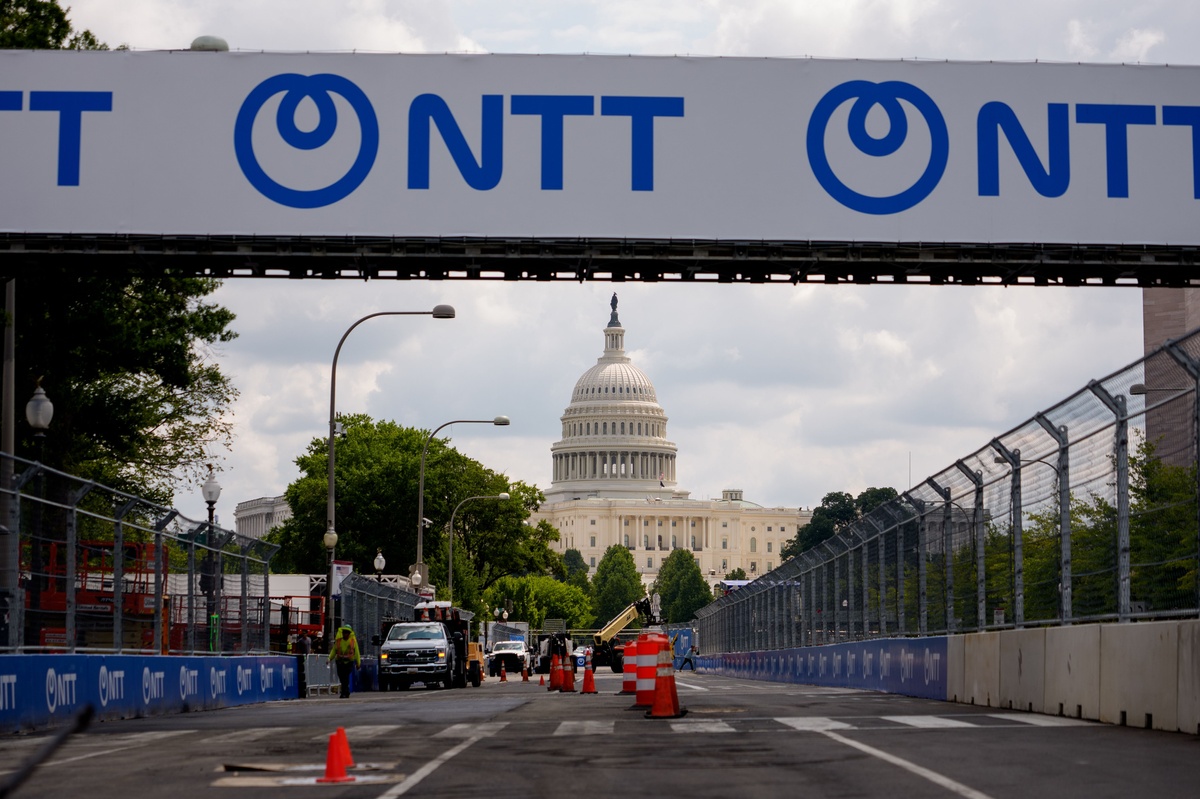
On Thursday, commuters on Washington D.C.’s Metro were greeted by an unprecedented sight: an official IndyCar show car attached directly to one of the trains traveling through the city. Behind the spectacle was a core team of just 13 people, 1,350 pages of permits and demand that produced 288,000 ticket requests.
It was a striking sign that the inaugural Freedom 250 Grand Prix of Washington, D.C. had finally arrived, and for Bud Denker, president of Penske Corporation and chairman of the event, the culmination of a massive project that once seemed unlikely to happen.
For over a year, Denker had envisioned turning the nation's capital into a venue stage for open-wheel racing.
“Yeah, (FOX Sports CEO) Eric Shanks’ and my dream, but it's been my baby since I came here last June and designed the original racetrack and then came back and designed the second racetrack on January 24th,” Denker told Motorsport.com. “So I don't think there were many people that said this could ever be done.” The plan called for a 1.7-mile street circuit carved directly around the National Mall and historic D.C. streets, flanked by more than 70 hospitality suites. Even within his own ranks, the feasibility of building a racetrack in the political center of the United States seemed dubious.
Welcome to DC .. right at the Metro station at the airport. #Freedom250 #IndyCar pic.twitter.com/dqx4s3e8nF
— Joey Barnes (@JoeyBarnes85) August 20, 2026
“I'm not sure if you asked Roger Penske, my boss, who has a lot of confidence in me, could it be done? And I'm not sure sometimes, as I hit my head against the wall a few times, that it could be done,” Denker said. “But I never, ever lost sight of the objective of bringing the patriotism we see at Indy to here and multiplying it times 100.”
That vision captured the public’s imagination on a massive scale. Demand for free general-admission tickets reached 288,000 requests for 150,000 available places allocated through a lottery. The layout allocates 70,000 fans to the “Stars” sector and another 70,000 to the “Stripes” sector along the National Mall, with the remaining spectators filling premier corporate suites.
The event has been organised by a remarkably small core team. Alongside Michael Montri, vice president of Penske Entertainment, Denker has spent most of his time in Washington, D.C. spearheading the event. The duo – who also oversee the construction, setup, and teardown of the Detroit Grand Prix and play key roles in the new-for-this-year Grand Prix of Arlington, among others – brought in a small operational team.
“The dream has always been big,” Denker said. “Some people dream of other things, I've dreamt of having this race here, and it's been a part of my soul. It truly is a part of me. And on Monday (the day after the race), it's going to be a tough morning when I wake up and – the level of activity that I'm experiencing with probably 80 texts in my back pocket, can't even get to my emails, I'm afraid of who I've missed because the people have been asking for tickets and passes left and right – but on Monday, it's going to be a tough day. I'm preparing myself for that, some PTSD. Because what it's taken to get here and the team I have to help me do it, I mean, my team is like 13 people that put this on and no one's living here. They're all from Detroit. They're from my Grand Prix team and my Texas Arlington team.”
The project also brought Denker into parts of Washington he had never expected to access when he was growing up in Northern Michigan.
“For me, it's the culmination of a lot of chapters in the book of meetings,” he said. “And the best byproduct for me of the event, for me personally, are the people I've met. I would have never had a chance to meet Bernie Moreno (United States Senator from Ohio), Speaker of the House (Mike Johnson), Sergeant at Arms of the House (William McFarland), Sergeant at Arms of the Senate (Jennifer Hemingway), Architect of the Capitol (Thomas Austin), go to meet Andrew Ferguson, chair of the Federal Trade Commission; I'm using his building for our Race Control. All the people in the Smithsonian. I've been to the White House now three times. Small-town boy from Sault Ste. Marie, Michigan, that's a pretty big deal for me.”
Denker said the event's organization had also drawn praise from local officials.
“I think if you talk to the mayor's office or anybody here, and she said this (Wednesday) night at a reception, they've had a lot of events come to their city, thousands come to their city," he said. "She’ll tell you the most organized event that she's seen in her 12 years is this event.”
For Penske Corporation, the D.C. event, which is likely a one-off—in this current iteration, at least—isn't a vanity project; Denker framed the D.C. event as part of Penske’s broader strategy to elevate IndyCar through major showcase events.
“Yeah, no doubt about it,” Denker said. “I think you mentioned Arlington. People went down there and were overwhelmed by it; just by how it looked, how it felt, and how it came together. Year Two is going to even be better. We've broken the ice there now and people have a cadence there now. Look at the investment in Long Beach this year. Long Beach has all new double-decker suites we invested in. A lot of infrastructure we invested in there too. We're going to continue doing that in Long Beach. So we're here for the long term. Roger keeps saying we didn't buy this thing to sell it. We're here to invest in it.”
The demand for tickets in Washington reinforces Penske’s belief that major temporary street races can attract new audiences.
“We need big events like this to continue to propel our sport,” Denker said. “I'll be curious as hell to see what the ratings are going to be out of this event. I'll be curious as hell to understand what the people think that are leaving here because, remember, 288,000 tickets were requested. How many of those are new fans? I bet you a lot of them are. A lot of those people were not in our IndyCar database. These kinds of tentpole events are what we need in our sport. My job, Mark Miles (IndyCar CEO and Penske Entertainment), Doug Boles (IndyCar President), Jonathan Gibson ( Executive Vice President of Marketing and Business Development), that's our job to keep doing that.”
There has also been plenty of learning in tackling this venture for Denker, and through it there have been key lessons that can be applied to future events.
“I think the single biggest one is we can't rely upon ourselves to do everything,” Denker said. “An example there is I don't have one employee living here. I relied on Monumental Sports to help me sell sponsorships.”
To navigate Washington’s complex permitting requirements, Denker partnered with local production company Harbinger.
“A company called Harbinger,” he said. “I relied on Harbinger, who puts on big events here. They did all my permits, 1,350 pages of permits. Imagine if I had to hire a staff just to do permits. We didn't know who these people were. We didn't know their rules. We didn't know the rules of one side of the road to the next.
"So oftentimes, I had to learn that curb is NPS. That curb is city. That curb over there is the National Art Gallery. That curb over there is the Smithsonian. Seriously, that's how it works here in this city. Everything requires a permit. Harbinger knows all that. Every fence that was laid around this track is Harbinger. Every tent put up is Harbinger. The security people you're going to see on Friday and Saturday are Harbinger. The security you're going to see on Sunday is Secret Service. But we rely on outside partners that are really damn good. And that's a new model I think we need to continue to look at. Perhaps versus sinking people into a marketplace that don't know the market. Monumental can call anybody in this city. And they did. And they sold about 50% of our suites, and we sold the other 50% based on our partnerships. But look what we have. We have Delta Airlines here. We have General Dynamics. We have Boeing. Starlink. Bitdeer. Bitdeer was brought in by Monumental. That's a big one.”
For Denker, proving that an out-of-town crew could pair up with local stakeholders to build a major event on the National Mall gave Penske a model it believes could be applied to future IndyCar events.
“I think the model we've taken away from this is that if you find good partners in a marketplace you can rely on, it can take away a lot of the issues of operationally but also sales.”