Get all your news in one place.
100’s of premium titles.
One app.
Start reading
Creative Bloq
Creative Bloq
Technology
Joe Foley

How a photo of an insect inspired this surprising retrofuturistic cityscape

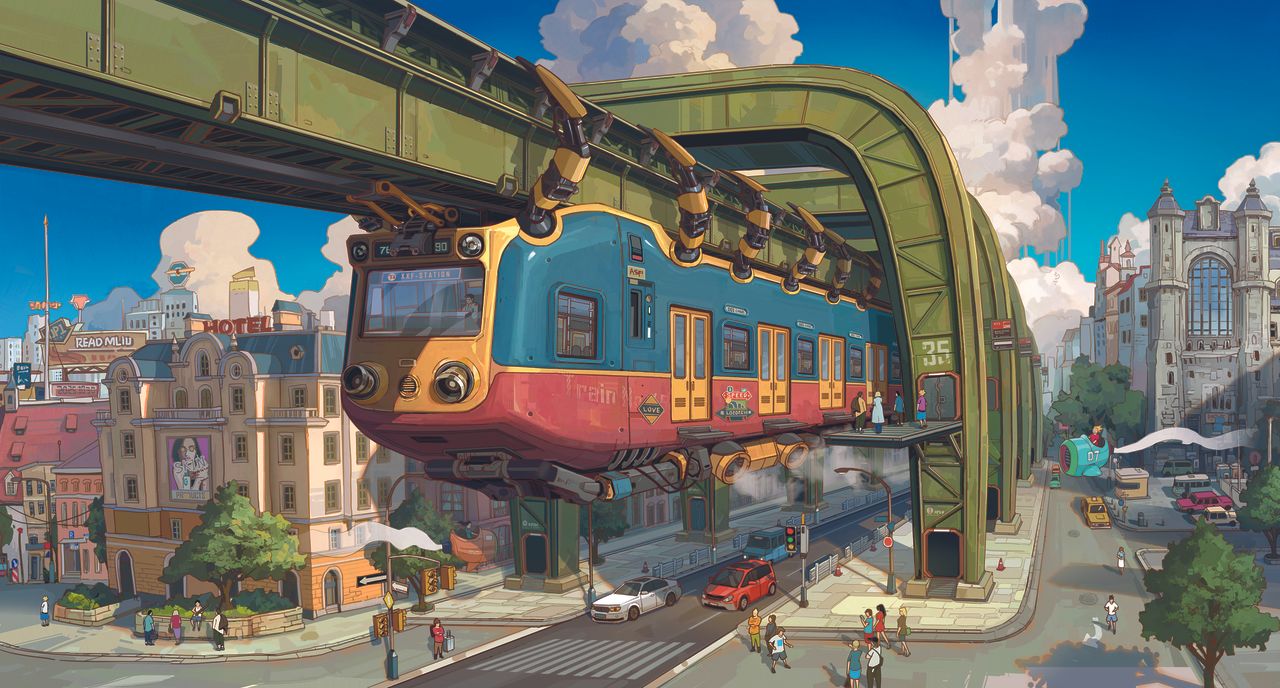
Concept art showing a retrofuturistic urban scene with a hanging monotrail.

We've seen lots of examples of how concept artists can find inspiration in the most unlikely of places. Sail Lin turns vegetables into weapons, and Max Froer combines insects with retro tech for his hybrid insect machine characters.

The Chinese concept artist and illustrator Xie Xufeng works for major studios in the gaming industry. His inspiration for the personal retrofuturistic scene above came from a photograph of a grasshopper.
He was captivated by the insects pose as it hung upside down from a branch, and the photograph reminded him of the streetcars that he takes every day in his commute.

“I tried to blend these two very different elements together when creating this piece,” he explains. “In the midst of the bustling city streets, a train with countless mechanical legs slowly crawls into the station, while people wait patiently on the platform”.

“This scene, I hope, adds a touch of whimsy and delight to the otherwise monotonous routine of daily commuting,” he adds.

Below, Xie talks us through his process for making the piece. If you need the tools for your own work, see our guides to the best drawing tablets and the best digital art software.

01. Laying down the initial sketch

“I begin the artwork by outlining my ideas and composition of the unusual-looking commuter train pulling into a station in monochrome line art. This approach makes it possible for me to quickly visualise the desired shapes and design concepts without becoming distracted by other visual elements.

“Focusing solely on structural clarity at this stage helps to solidify the foundation before moving on to complex rendering.”

02. Value blocking

I add greyscale value layers to establish foreground/background relationships.

Each object is on a separate layer for organisational efficiency, creating a clear roadmap for colour application later on.

03. Applying colour

I start with flat base colours (local colours), initially avoiding complex colour mixing to maintain clean hue relationships.

Once this colour framework is established, I move on to refinement and detailing, ensuring colour harmony remains intact throughout the polishing process.

You can see more of Xie's work on his ArtStation profile.

For more inspiration, see our feature what is concept art?

This article originally appeared in ImagineFX. Subscribe to ImagineFX to never miss an issue. Print and digital subscriptions are available.

Sign up to read this article
Read news from 100’s of titles, curated specifically for you.
Already a member? Sign in here
Related Stories
Top stories on inkl right now
One subscription that gives you access to news from hundreds of sites
Already a member? Sign in here
Our Picks
Fourteen days free
Download the app
One app. One membership.
100+ trusted global sources.