
Get all your news in one place.
100's of premium titles.
One app.
Start reading
Tom’s Hardware
Tom’s Hardware
Technology
Mark Tyson

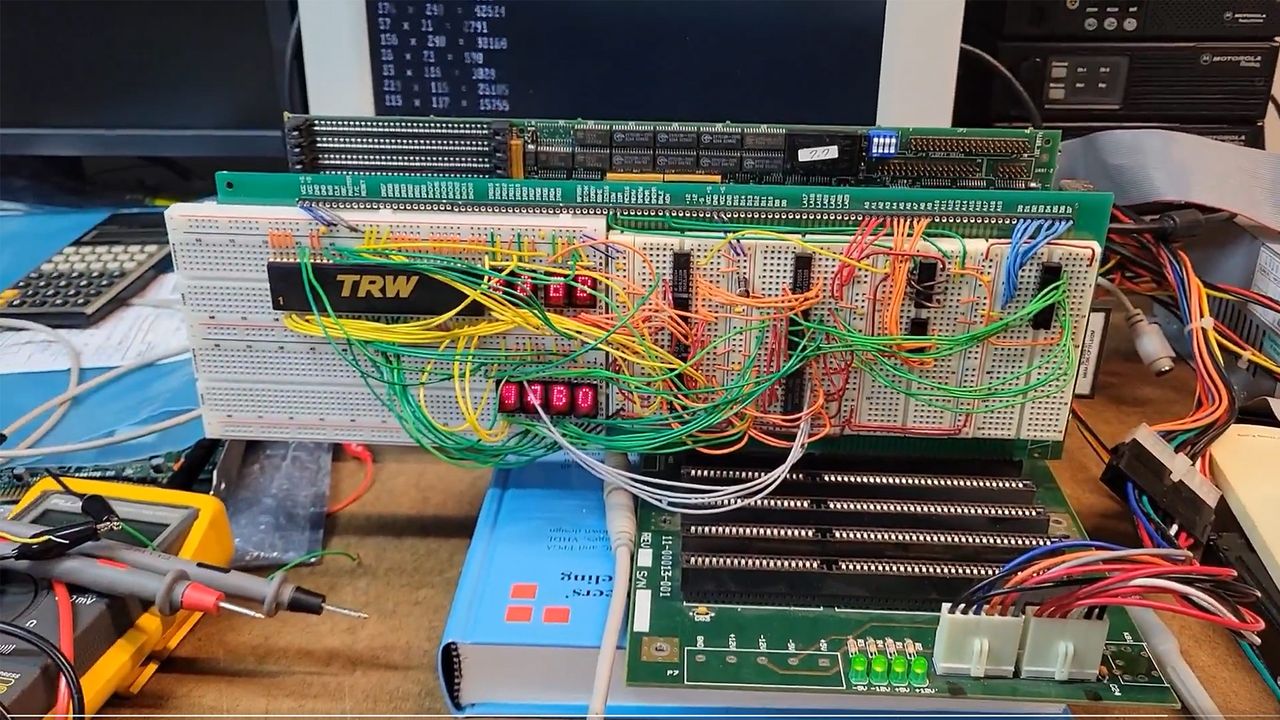
Hobbyist builds a homebrew Intel 8086 ISA accelerator card — maker’s project improves integer multiplication on these retro systems by 250%

Intel 8086 and 8088 ISA accelerator card .

50-year-old hardware is slow, but rest assured, there are hobbyists out there trying to speed things up by building new era-appropriate accelerator cards. A prime example is @bradthx (Brad) on X, a computer scientist and lover of boating who has recently showcased their hardware multiplication ISA card accelerator for Intel 8086 and Intel 8088 PC systems.

A new homebrew ISA card fitted with a TRW MPY12HJ parallel multiplier chip “makes integer multiplication about 2.5× faster on early x86 systems,” says project maker Brad.

According to our searches, this multiplier chip was actually around in the late 70s and early 80s. Thus, it may have been possible for an engineer at the time to implement something similar for the iconic IBM PC Model 5150 with an Intel 8088 CPU. This open-architecture computer from IBM would come to define the PC, and famously debuted ISA slots back in 1981.

The major reason for Brad to create this accelerator was how early Intel x86 chips handled the MUL instruction. “On the original 8088/8086, multiplication was implemented as an iterative shift/add algorithm controlled by microcode,” explains the computer scientist. “It basically calculates it the same way you would solve it on paper in binary.” In essence, this meant multiplication handling by the old Intel CPUs would take “a crazy long time.”

Hello TRW MPY12HJ

Brad’s ISA card is built around the capabilities of the TRW MPY12HJ chip. This is a “12×12 parallel multiplier designed specifically for high-speed arithmetic operations,” says the maker. It works in an asynchronous fashion, without a clock, running as fast as the bits can propagate through the silicon. This is actually “orders of magnitude faster than the CPU’s microcoded multiply loop,” underlines Brad.

Because the TRW multiplier is so fast, it can calculate intercepted MUL instructions between two consecutive bus cycles. Therefore, having it on an ISA card isn’t a killer performance penalty, as is explained by the computer scientist. Overall, the card achieves performance “about 2.5× faster than the CPU’s built-in multiplier.”

Click 'See more' to watch the accelerator in action.

Existing compiled code not accelerated

As cool as the Intel 8086 ISA accelerator card project is, it won’t work its magic on the classic old apps you might already have in your library – unless you wrote them or have access to the source code.

Brad explains to other X users that “for anything that I build, I can use my own subroutine that uses this hardware multiplier instead of the internal x86 MUL instruction.” But when it comes to pre-compiled apps, they aren’t aware of, and will not make use of, the ISA accelerator card.

Sign up to read this article
Read news from 100's of titles, curated specifically for you.
Already a member? Sign in here
Related Stories
Top stories on inkl right now
Our Picks
Fourteen days free
Download the app
One app. One membership.
100+ trusted global sources.