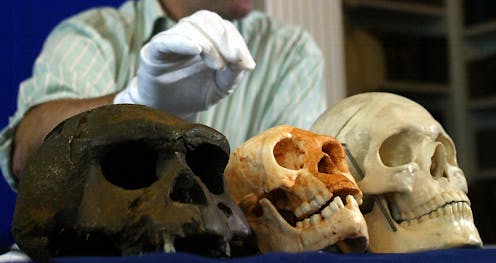
Until Homo floresiensis was discovered, scientists assumed that the evolution of the human lineage was defined by bigger and bigger brains. Via a process called encephalization, human brains evolved to be relatively more massive than would be expected based on corresponding body size.
This proportionally bigger brain is what anthropologists argued enabled us and our relatives to perform more complex tasks such as using fire, forging and wielding tools, making art and domesticating animals.