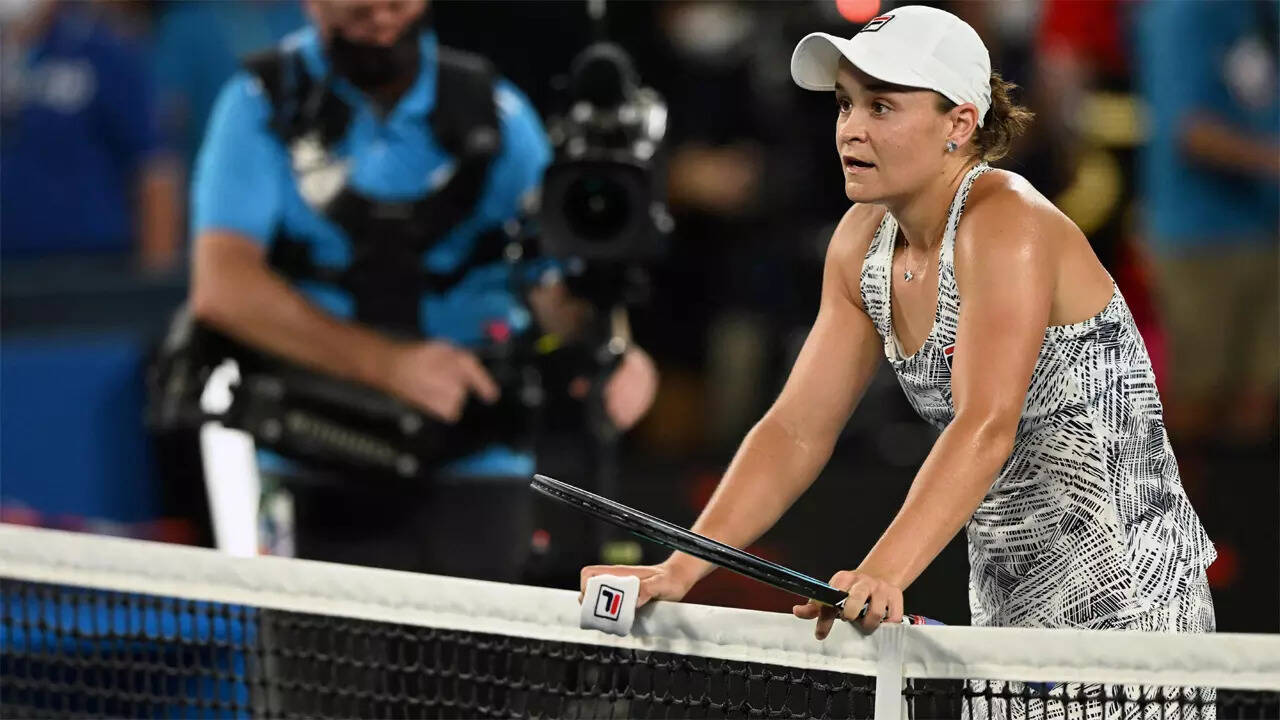
Knowing Ash Barty, it shouldn’t come as a surprise how she wishes she could play on the historic grass courts of the Kooyong stadium.
World No. 1 Barty moved within one win of adding another chapter to her already brilliant career on Friday when she beat American Madison Keys 6-1, 6-3 to reach the women’s singles final of the Australian Open.
She faces another American, Danielle Collins, in the summit clash and should she win the title, Barty will become the first Australian to hold the Daphne Ackhurst trophy since Chris O’Neil held it aloft in 1978.
The last time an Australian woman reached the final was in 1980 when Wendy Turnbull lost to Hana Mandlikova.
Back then, though, the Australian Open was held at the Kooyong stadium, not far from Melbourne Park where the championship has been held since 1988 on hard courts.
“I love Kooyong. I'm a Kooyong girl. I love it. That's my club down here in Melbourne, I love the grass there,” Barty, a keen student of the game’s history and considers Aussie legend Evonne Goolagong as her inspiration and mentor, gushed at the post-match press conference.
Seldom does a modern tennis player venture into the realms of past era, but that is exactly what sets Barty from the rest.
“I'm yet to be able to really enjoy a full grass court season at the Kooyong courts. I can just imagine what it would have been like, the way that the stadium is set up.
“I've said a couple of times I wish I was maybe born in a different era and I got to experience playing on grass courts all year long. It would have been incredible.”
Barty has the French Open title from 2019 and the Wimbledon’s Venus Rosewater dish from 2021 in her cabinet.
Adding the Australian Open title, played on the hard court, would truly set her apart from the rest on the women’s tour, which is transitioning from the Williams era and has had a variety of winners in the last five years.
As to what sets her apart from the rest on the court, it couldn’t have been said better than her vanquished opponent.
“I think the tough thing is that she kind of makes you overthink a little bit, and you start pressing a little bit, you feel like you have to do too much at times,” said Keys after the match.
“I think I was overthinking a little bit at the beginning, trying to do things that weren't really happening for me or really actually (not) an option, just because she kind of puts that pressure on you.
“Once that happens and when she starts feeling like she can play downhill, then she just gets that confidence and momentum and it's really hard to get that back from her.”
The 26-year-old should know, having now gone 1-3 in head-to-head against Barty, who also beat her on the way to her title at Roland Garros, where they met last.
“I think everything has just improved a little bit,” Keys said of the improvement in Barty’s game in the last couple of years.
“I think she's got a little bit more precise on her serve. I think her forehand, she's doing a really good job at mixing up paces and spins, as well. It feels like you can't really get in a rhythm off of that forehand side.
“Then on her backhand side, I mean, everything is coming in at your shoelaces on the baseline. So, it's not like you can really do anything with that.”
The Aussie herself articulated it succinctly when asked whether she focussed on her own game or changed her plan according to the opponent.
“Oh, I'm still very much focused on myself. I know if I do the right things on my part, it will make my opponent uncomfortable,” the 25-year-old from Ipswich, near Brisbane, said.
“I think it's a little bit of a double-edged sword in a way. Sometimes it's really nice to be able to focus internally and just focus on what you need to do and then other times it's nice to look up the other end of the court and see how your opponent is reacting.
“Without a doubt I've done that in various stages in my career, and sometimes it is nice to take the focus away from your feelings and focus on them a little bit more. It just opens your eyes and changes the perspective of how you view the match.
“I think being able to use a little bit of both is something that I like to do. Everyone is different, everyone is unique, and I found that doing a little bit of both really sharpens me up and makes me see the court in different ways.”
Barty said she would do her best to enjoy playing the final on home soil instead of being overwhelmed by the occasion.
“Absolutely embrace it. You have to. It's fun,” she said.
“It's brilliant to be playing in the business end of your home slam. I'm not gonna lie about that. It's amazing.
“I think being able to experience it multiple times has been incredible, but Saturday's going to be a new experience for me.
“So, I go out there and embrace it, smile, try and do the best that I can and whatever happens, happens.”
She has a day’s rest before the final, and she won’t be changing her routine.
“Same old. I'm a creature of habit,” she said.
“Not a lot will change for us. The preparation stays the same, process is the same.
“I'm able to switch off when I'm not here on-site and that makes the time when we are on-site more enjoyable, more special, and then we switch on and get ready to go.”