Get all your news in one place.
100's of premium titles.
One app.
Start reading
The Economic Times
The Economic Times
Piyush Shukla

History's most famous Halley's comet may need a new name, and the real discoverer was a monk nobody ever heard of

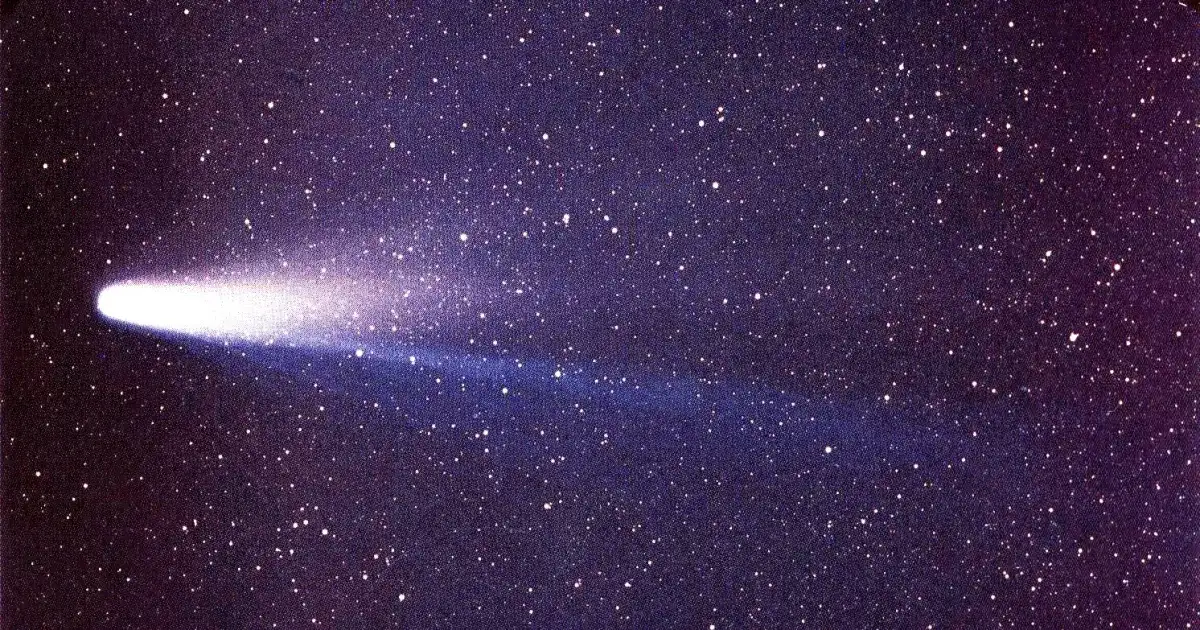
For centuries, Halley’s Comet has carried the name of English astronomer Edmond Halley. His work transformed astronomy by proving that the bright comet appearing every few decades was not a random celestial visitor, but the same object returning repeatedly through Earth’s skies. Yet a new historical study now suggests that one of astronomy’s greatest recognitions may have happened nearly 700 years earlier. Researchers from Leiden University argue that a medieval monk named Eilmer of Malmesbury may have already understood that the comet seen in 1066 was the same one he had witnessed decades earlier in 989.

The new findings have stirred historians, astronomers, and medieval scholars alike because the debate reaches beyond simple naming traditions. It challenges how scientific credit is remembered across centuries.

Researchers say the overlooked evidence comes from writings preserved by the 12th-century historian William of Malmesbury. His records describe how Eilmer recognized the returning comet after seeing it earlier in life. According to the study, the monk understood that the blazing object crossing England’s skies in 1066 was not entirely new. That insight, if accepted, would mean the periodic nature of Halley’s Comet was recognized centuries before Edmond Halley’s celebrated calculations in the 17th century.

Why the Halley’s Comet name debate is gaining attention again

The modern story of Halley’s Comet began with Edmond Halley in the late 1600s. By studying historical observations from 1531, 1607, and 1682, Halley concluded the comet was returning roughly every 76 years. That prediction later proved correct when the comet reappeared in 1758, years after his death. The successful forecast became one of the greatest triumphs in astronomy history. Eventually, the object officially became known as Halley’s Comet, or 1P/Halley.

Yet the new research argues that Eilmer of Malmesbury had already grasped the comet’s repeating pattern centuries earlier, even without advanced mathematics. Researchers believe this distinction matters because scientific discovery is not always limited to equations and calculations. Observation itself can represent profound understanding. In medieval Europe, where comets were viewed as terrifying omens from God, recognizing a repeating celestial cycle required unusual curiosity and memory.

The debate also exposes how history often favors later scholars over earlier observers. Halley mathematically demonstrated the comet’s orbit using Newtonian physics, which undeniably changed astronomy forever. But Eilmer’s observations suggest that human beings had already begun recognizing cosmic patterns long before modern science formalized them. That possibility gives the story emotional and philosophical weight. It reminds readers that scientific thought did not suddenly appear during the Enlightenment. Fragments of it existed across monasteries, oral traditions, and ancient civilizations for centuries.

How Halley’s Comet terrified medieval Europe during 1066

The appearance of Halley’s Comet in 1066 became one of the most dramatic celestial events in European history. The comet arrived during a year already filled with political tension, war, and uncertainty. England was under the rule of King Harold Godwinson, whose reign lasted only months before the Norman conquest transformed the nation forever.

At the time, medieval societies viewed comets as warnings of disaster. Across Europe and Asia, blazing objects in the sky were associated with famine, plague, royal deaths, and divine punishment. Ordinary people believed the heavens reflected God’s anger toward humanity. Kings feared that celestial signs predicted political collapse. In that environment, Halley’s Comet became more than an astronomical event. It became a psychological force shaping public fear and political storytelling.

The comet’s connection to the Norman conquest gave it legendary status. It famously appears in the Bayeux Tapestry, one of history’s most important medieval artworks. The tapestry shows frightened witnesses staring at the comet while King Harold faces mounting anxiety. Historians believe the image reinforced the idea that Harold’s downfall had been foretold by heaven itself.

Researchers say Eilmer of Malmesbury likely recognized the comet because he had witnessed a similar celestial event in 989. By 1066, he was probably elderly. Yet according to surviving accounts, he reportedly realized the returning object was the same comet from his youth. That realization is extraordinary because medieval people usually interpreted comets symbolically rather than scientifically. Eilmer’s recognition suggests careful observation survived even within an age dominated by superstition.

Could Halley’s Comet eventually receive a different name?

The question of renaming Halley’s Comet may sound symbolic, but naming conventions in science carry enormous historical influence. Names shape public memory. They decide whose contributions survive across generations. Researchers involved in the new study argue that Eilmer’s observations deserve far more recognition than they have received.

Still, changing the comet’s name would face major resistance. Edmond Halley’s contribution remains foundational because he mathematically proved periodic cometary motion. His work transformed astronomy from observational speculation into predictive science. Without Halley’s calculations, humanity may never have understood comets as orbiting objects bound to the solar system.

At the same time, the debate reflects a broader movement within science history. Modern historians increasingly revisit overlooked contributors whose discoveries were ignored due to social status, geography, or historical circumstance. Medieval scholars, women scientists, Indigenous astronomers, and non-European observers are receiving renewed attention as historians reconsider how knowledge evolved across cultures.

The Halley’s Comet discussion therefore becomes larger than astronomy itself. It asks whether scientific recognition should belong only to those who formally prove theories, or also to those who first perceive important truths. Eilmer lacked telescopes, advanced mathematics, and modern scientific frameworks. Yet he may still have recognized a repeating cosmic phenomenon centuries before the scientific revolution began.

The renewed fascination with Halley’s Comet is not simply about correcting historical records. It reveals something deeper about human nature. Across civilizations, people have always searched the skies for meaning. Ancient observers tracked stars, eclipses, and planetary movements long before formal science existed. Even in periods shaped by fear and religious belief, curiosity survived.

The story of Eilmer of Malmesbury shows how observation can quietly preserve knowledge across generations. A monk living in medieval England, surrounded by superstition and political chaos, may have recognized a cosmic cycle that modern astronomy later confirmed scientifically.

FAQs:

Q1. Could Halley’s Comet really be named after the wrong person?

New research from Leiden University suggests medieval monk Eilmer of Malmesbury may have recognized Halley’s Comet as a repeating object nearly 700 years before Edmond Halley. Researchers say Eilmer connected the comet he saw in 1066 with another appearance in 989, making historians rethink who first understood the comet’s recurring journey through Earth’s skies.

Q2. Why is Halley’s Comet still linked to Edmond Halley despite the medieval discovery?

Although Eilmer may have noticed the comet’s return earlier, Edmond Halley became famous because he mathematically proved its periodic orbit using scientific calculations and historical records. His prediction that the comet would return in 1758 changed astronomy forever, which is why Halley’s Comet still officially carries his name despite the growing historical debate.

Sign up to read this article
Read news from 100's of titles, curated specifically for you.
Already a member? Sign in here
Related Stories
Top stories on inkl right now
One subscription that gives you access to news from hundreds of sites
Already a member? Sign in here
Our Picks
Fourteen days free
Download the app
One app. One membership.
100+ trusted global sources.