
Which Passes Are Actually Restricted, and Why
Not every high-altitude crossing in the Himalayas requires a special permit, but the ones that do tend to be the ones worth crossing. Passes that run along India's international borders, or through ecologically sensitive zones designated under the Wildlife Protection Act, fall under restricted or protected area status. Rohtang Pass in Himachal Pradesh requires a daily entry permit capped at 1,200 vehicles. The Niti Pass and Lipulekh Pass in Uttarakhand sit in Inner Line zones. In Sikkim, the Nathu La Pass to the Tibet border requires both an Inner Line Permit and a separate border permit. Ladakh's Khardung La, once freely accessible, now requires registration at the District Collector's office in Leh for certain onward routes.

The restriction is not arbitrary gatekeeping. The Rohtang cap exists because unchecked vehicle traffic was measurably degrading the Beas and Chandra river basins. The Inner Line system, inherited from a 1873 colonial regulation and still enforced by the Ministry of Home Affairs, exists to manage movement near international boundaries. Knowing why a pass is restricted tells you which government body controls it, and that is the first practical piece of information you need.
The Permit Types You Will Actually Encounter
Three categories of permits cover most restricted Himalayan trekking and driving routes in India.
The Inner Line Permit (ILP) applies to travel in Ladakh, Arunachal Pradesh, Manipur, Mizoram, and Nagaland, and to border-adjacent zones in Uttarakhand and Sikkim. Indian nationals can obtain ILPs online through state government portals or at designated district offices. Foreign nationals face a separate and more involved process, often requiring a Protected Area Permit (PAP) applied for through the Ministry of Home Affairs or through a registered tour operator.
The Protected Area Permit (PAP) covers zones like North Sikkim and parts of the Andaman and Nicobar Islands. Foreign nationals trekking to passes in North Sikkim, including the Gurudongmar area, must apply through a registered tour operator who submits the application to the Foreigners Registration Office. Solo foreign trekking in these zones is not permitted.
The Rohtang Permit is a standalone category managed by the National Green Tribunal's directives. Apply online at the Himachal Pradesh government's official portal. Slots open at 10 PM for travel two days out and fill within minutes for weekends. Set a reminder. Diesel vehicles have a separate, lower daily cap.
The Application Process, Step by Step
The process varies by pass and by whether you are an Indian or foreign national. These are the consistent steps that apply across most restricted Himalayan routes.
1. Identify the controlling authority. For Ladakh ILPs, the DC Office in Leh. For Sikkim PAPs, the Foreigners Registration Office in Gangtok or Delhi. For Rohtang, the HP government portal. For Arunachal Pradesh ILPs, the state's e-ILP portal at arunachalilp.com.
2. Gather your documents before you travel. Indian nationals need: a valid photo ID (Aadhaar or passport), two passport-size photographs, and a filled application form. Foreign nationals need: passport copies, visa copies, two photographs, and in many cases a tour operator's letter of guarantee.
3. Apply with enough lead time. Rohtang permits open 48 hours in advance. Sikkim PAPs for foreign nationals can take 10 to 15 working days if applied through Delhi. Arunachal Pradesh ILPs for Indian nationals are often processed same-day online, but the physical permit may need collection in person at a district office.
4. Carry physical copies. Every checkpoint on a restricted route will ask for a printed copy of the permit. A screenshot on your phone has been rejected at multiple checkpoints on the Leh-Manali highway. Print two copies.
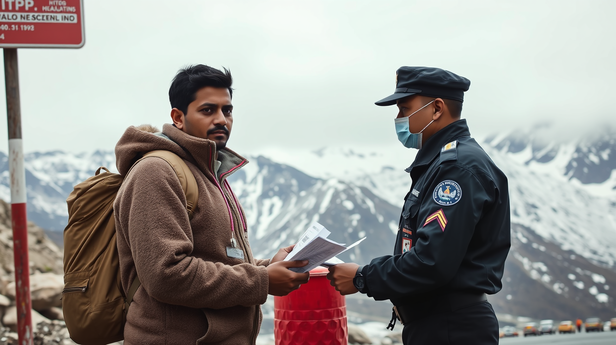
5. Register at checkpoints. Many passes require you to sign a register at the ITBP (Indo-Tibetan Border Police) post, regardless of whether your permit is already stamped. This is not redundant, it is a safety log. If weather closes the pass behind you, the ITBP knows you are on the other side.
What Nobody Tells You About the Offices
District Collector offices in Leh, Gangtok, and Tawang operate on government hours: typically 10 AM to 4 PM, Monday to Friday, with extended Saturday hours in peak trekking season. They close for gazetted holidays, which in Ladakh include both national holidays and local Buddhist festival days. The Hemis festival closure, for instance, catches trekkers every year.
The people at the permit counters have seen every version of incomplete paperwork. Bring one extra copy of everything. If your Aadhaar address does not match your current city of residence, carry a secondary address proof. If your tour operator's letter has a spelling error in your name, the permit will be issued with that error, and a checkpoint officer may flag it against your ID. Check every document before you leave the counter.
Online portals for Arunachal Pradesh and Himachal Pradesh are functional but not always stable during peak season. Apply on a weekday morning. If the portal times out, try again in the early morning the following day. The Rohtang portal in particular is best accessed between 10 PM and 10:30 PM when slots release.
One practical note on altitude: the Leh DC office sits at 3,500 metres. If you have flown in from a low-altitude city, your first full day in Leh should be acclimatisation, not paperwork. Plan to reach Leh two days before you need the permit in hand.
The bureaucracy around restricted passes is not a system designed to frustrate trekkers. It is a system designed for other purposes, border security, ecological management, revenue collection, that trekkers must work within. The passes where the paperwork is heaviest are almost always the passes where the trail is emptiest. The Niti Valley above Malari village in Uttarakhand, accessible only with an ILP, sees fewer than a few hundred trekkers a year. Gurudongmar Lake in North Sikkim, locked behind a PAP, remains one of the highest lakes in the world with no permanent commercial infrastructure on its banks. The permit counter is the toll booth on the road to somewhere most people never reach.