
Japan’s climate spans extremes, from punishing summer sun and monsoon humidity to some of the heaviest snowfalls on earth. These conditions demanded a sophisticated relationship with light long before modern glazing. Enter hikari (光).
In Japanese design, hikari (光) refers to natural light. Be it sunlight, directional, or the light of the world. But there is a second word, akari (明かり), for the warm, intimate glow of a lantern or candle.

Where English distinguishes natural from artificial light, Japanese draws a deeper line: between the light that connects us to the world outside and the light we create within. Hikari is the first of these, and in Japanese aesthetics, it's inseparable from shadow. Here's why it's one of the tenets that rule my design story.
What Is Hikari?
In Northern Europe, natural light is limited by high latitude. Traditionally, houses had small windows to retain heat, further restricting daylight. But with advances in insulation and glazing came a shift toward larger openings and more glass — assuming more is always better.
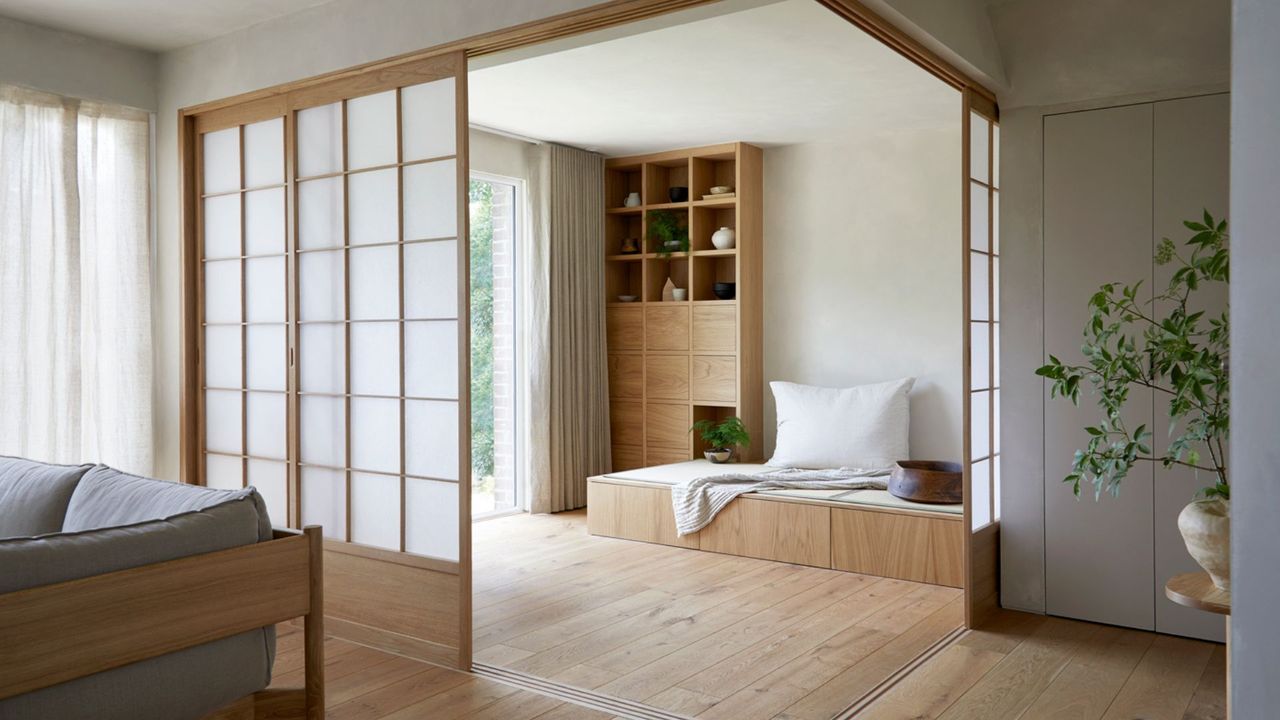
The Japanese tradition takes a different view. Rather than flooding rooms with brightness, homes are designed to receive light indirectly, filter it, and allow shadow to give a space depth.
This begins with Japanese gardens. Traditional houses are oriented around the garden first. It is the primary source of light, not just a view. Deep eaves and engawa (veranda) soften sunlight before it reaches the room. Inside, shoji screens, translucent washi paper on timber frames, diffuse it further, transforming harsh sun into a soft luminosity that shifts with the hours and seasons.
In the chashitsu (tea room), a space considered the highest expression of Japanese architecture, where every material, proportion, and gesture is distilled to its essence — windows are deliberately small. Not to darken the room, but to heighten presence.
Clay plaster walls bounce light gently. Lacquered objects catch a shimmer visible only in indirect light. Japanese has an everyday word, komorebi (木漏れ日), for dappled light filtering through a tree canopy, showing how finely this culture attends to light.
What Makes Hikari a Staple in Japanese Design?
Essentially, light that changes is light that connects us to the world outside. A room where the quality of light shifts between morning and afternoon, summer and winter, keeps its inhabitants attuned to time and season.
Shadow is not a problem to solve — it is a quality to orchestrate. The tokonoma (alcove), where a single scroll or ikebana is displayed, gains its depth precisely because of the shadows around it. Remove them, and the alcove reverts to mere void.
This matters more now than ever. Now, light and shadow are embraced as dynamic characters. After years of artificial perfection, people crave what is real, and real light moves and casts shadows. It is time to pay attention to hikari for wellbeing.
How to Design a Home Around Hikari
I start with orientation and the garden. Where will morning light fall? Where will evening shadow gather? These decisions come first as they shape the entire experience of a home.
I embrace darkness where it serves. Dark bedrooms transform sleep quality, while early morning light that bounced around a white room now stays as a subtle stream, not a disturbance. Dark hallways create drama and welcome, while transition spaces benefit from bold, enveloping finishes.
I choose materials that respond to light. Think plaster, natural timber, stone. These surfaces shift character through the day, unlike reflective finishes that look identical at noon and midnight.
And when it comes to windows, bigger is not always better. Size, proportion, and orientation need careful consideration. A well-placed opening that frames a view and controls how light enters does more than an oversized window that floods it indiscriminately. This is where hikari meets nagame (眺め), our principle of the framed view — light and view designed together.
Decor to Compliment Hikari


Light is the first thing we experience in a space. Hikari teaches us to treat it not as a commodity to maximize but as a presence to be shaped — one that, like the seasons, should be allowed to change.
If your home is particularly devoid of windows, learning how to maximize natural light through artificial lighting will do your interiors a world of good. And for more design ideas to make your house feel more in tune, sign up for the Livingetc newsletter.