Get all your news in one place.
100's of premium titles.
One app.
Start reading
The Times of India
The Times of India
World
TOI World Desk

Hidden in 18 New York City restaurants, air pollution in kitchen spaces reached a median PM2.5 level of 79.6 micrograms per cubic meter, and scientists say some spikes climbed into the thousands, raising new questions about what restaurant workers breathe all shift

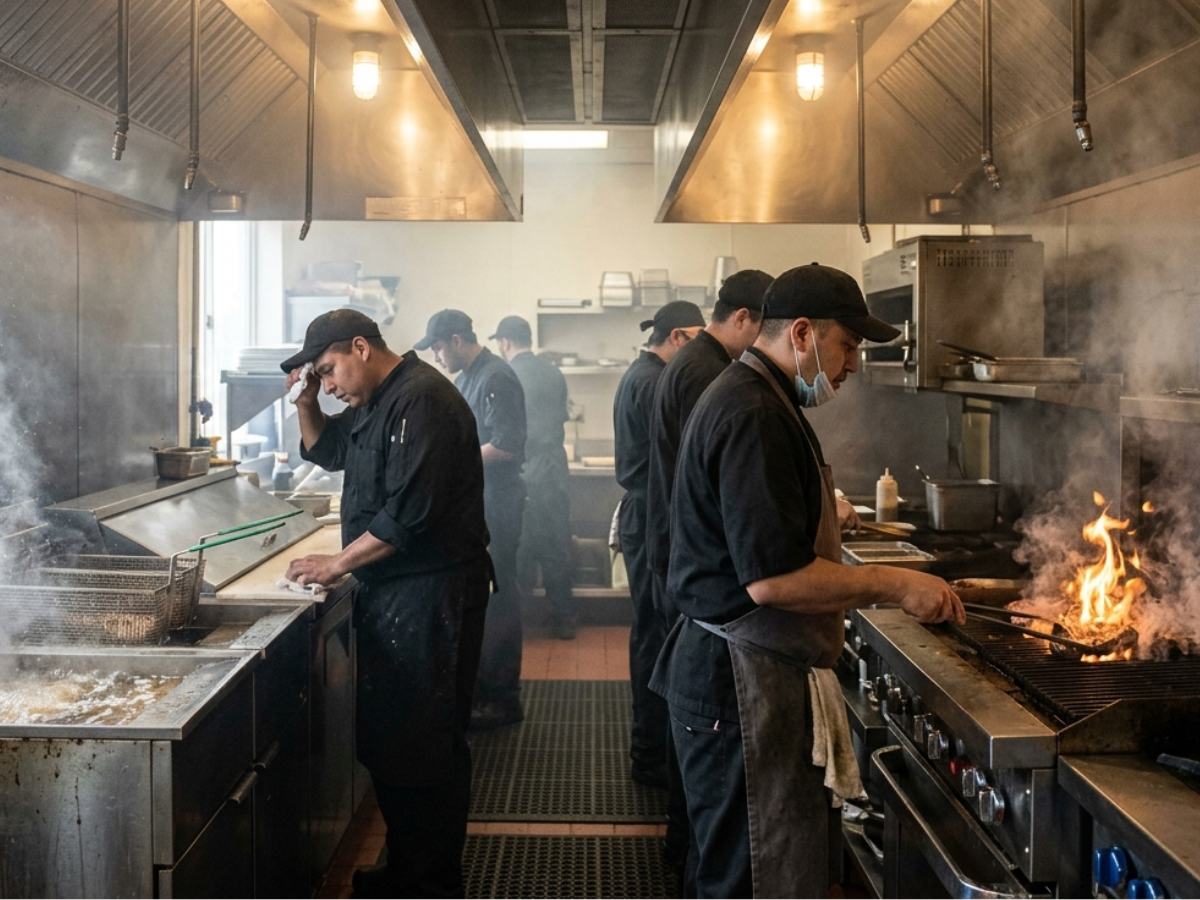
Restaurant kitchens tend to be known for their hot environment, as well as their noisy operations. However, what many people don't see is the air that workers have to breathe over long shifts. There has been another addition to the growing research, which indicates that the air inside commercial kitchens contains excessive amounts of fine particulate pollution at times well above outdoor safety standards.

Get breaking news anytime, anywhere. Download the TOI app now!

According to a peer-reviewed study indexed on PubMed , measurements of fine particulate matter or PM2.5 were carried out inside 18 restaurants in New York City. There was a median value of 79.6 micrograms per cubic meter reported in kitchen environments. There were also short-term peaks reported that had extreme values during intensive cooking periods, reaching hundreds and even more than 1000 micrograms per cubic meter.

This research shows just how fast the air quality in such enclosed environments may deteriorate during frying, grilling, and heating operations.

Measures taken by the New York study

The study entailed measuring the PM2.5 concentration in real time, in actual operational restaurant kitchens. In this context, PM2.5 stands for particulate matter smaller than 2.5 micrometres, and these particles can settle deep in the lungs.

As reported in the PubMed -indexed study, the median value of 79.6 µg/m³ reflects ongoing exposure during active cooking. There were also short-term peak values recorded in relation to the level of cooking activity, use of equipment, and the ventilation conditions.

As per the World Health Organization guidelines, the annual average concentration of PM2.5 should not go beyond 5 µg/m³. In contrast, the levels recorded in the kitchen are several times greater than this figure.

Reasons why kitchen air is highly contaminated with particulates

Kitchen activities are one of the sources of indoor particulate matter emissions. Emissions can arise from the high temperatures of oil used, frying, grilling, and combustion of gas.

The presence of multiple cooking points in a kitchen where emissions are produced in large amounts can result in a rapid accumulation of these emissions. In this case, exposure levels increase when the time of peak services is reached.

Ventilation is another method that is used to control such an accumulation of particulates. However, in many kitchens, there are ventilation systems that do not capture all emissions at the source.

Implications for health risk

There has been extensive research done on PM2.5 in the field of environmental health. As the size of the particles is very small, they can go deep into the respiratory system and even into the bloodstream.

As stated by the US Environmental Protection Agency , high levels of exposure to PM2.5 cause irritation of the respiratory system, aggravation of asthma, decreased lung function, and even cardiovascular problems.

Although air pollution outdoors gets more attention, exposure at the workplace in the kitchen is more intensive and prolonged. People working in restaurants are exposed to such air pollutants for many hours a day.

Why this research is relevant

One of the major lessons learned in this New York research study is the issue of variability. The levels of air pollution were not constant but rather varied greatly in response to cooking activities and ventilation systems.

This means workers’ exposure was uneven across a shift, with some periods involving much higher inhalation of fine particles than others.

These findings have added to the existing literature on occupational safety, which shows that there are many sources of pollution in the indoor workplace environment, such as combustion.

Implications for other urban kitchens, including those in the UK

While the study was carried out in New York, similar cooking procedures are adopted in commercial kitchens all over the world, including cities like London, Manchester, and Birmingham in the UK.

Workplace guidelines in the UK acknowledge that cooking emissions in commercial kitchens are potentially hazardous and need to be appropriately controlled. However, exposure could be affected by the design of the kitchen, ventilation effectiveness, and maintenance.

While the New York results cannot directly be applied to conditions in the UK, there are larger questions raised about the consistency of ventilation system effectiveness in controlling particulates in busy hospitality settings.

Can exposure be minimised?

Ventilation is typically regarded as the most effective means of control. Properly designed extraction systems installed near the cooking area can minimize the accumulation of airborne particulates. Cleaning and maintenance are also necessary because any buildup of grease will eventually decrease efficiency.

Changes in operational practices can also assist in minimising exposure peaks. These include more efficient kitchen design and placement of extraction hoods, and also, wherever possible, modification of cooking techniques that minimize emission production.

There is some evidence from studies that minimization of dependence on gas cooking can decrease the level of certain pollutants, but practical difficulties often prevent this in restaurants.

An unseen exposure in the workplace

Though this study doesn’t reveal any impending danger, it reveals the often-neglected facet of restaurant employment. Kitchen air quality may be highly variable and exceed outdoor levels significantly.

For hospitality workers, this indicates that exposure to fine particulate matter is not confined to the outdoors but rather is an occupational hazard determined by the nature of their job and the design of the kitchen.

Sign up to read this article
Read news from 100's of titles, curated specifically for you.
Already a member? Sign in here
Related Stories
Top stories on inkl right now
One subscription that gives you access to news from hundreds of sites
Already a member? Sign in here
Our Picks
Fourteen days free
Download the app
One app. One membership.
100+ trusted global sources.