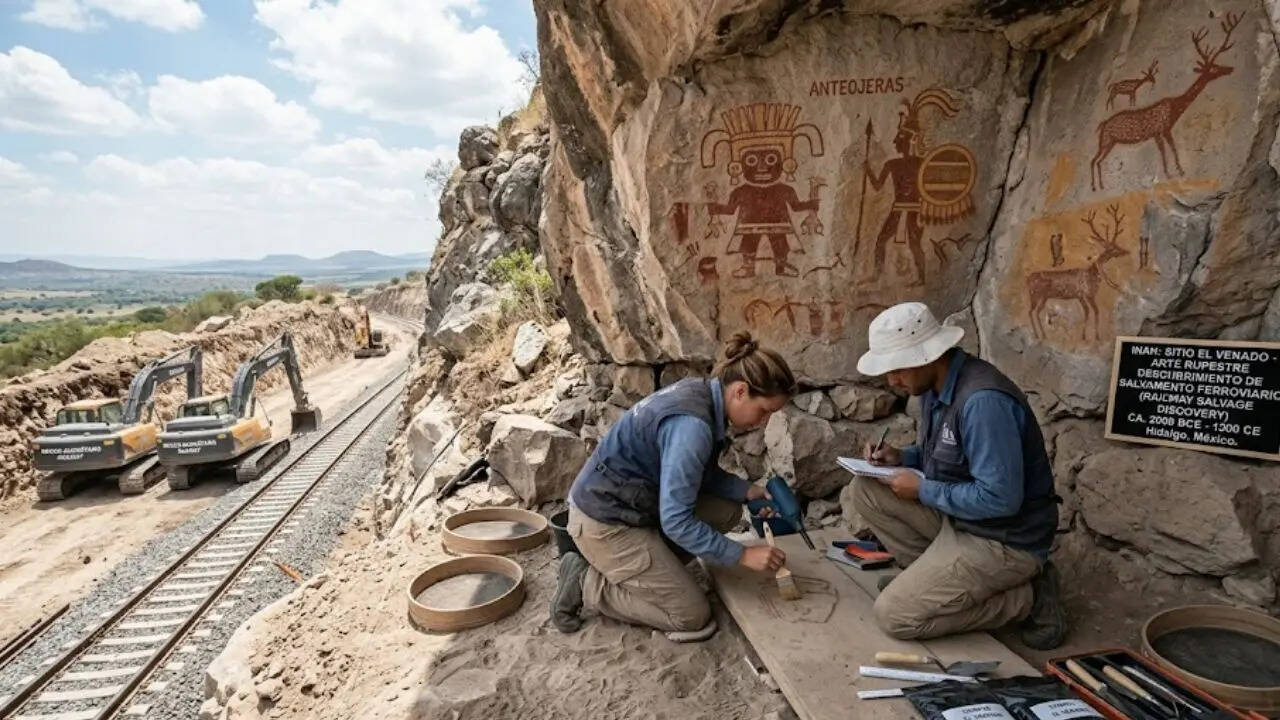
Research conducted on the construction of the passenger railway connecting Mexico City and Querétaro has resulted in an extraordinary archaeological finding: a breakthrough in the study of the Tula region’s cultural evolution. Archaeologists from the National Institute of Anthropology and History (INAH) recently identified 16 newly discovered rock-art sites at El Venado, Hidalgo.
These sites constitute a ceremonial landscape that provides a chronological view of four thousand years of history from the Archaic period hunter-gatherer groups up to the time of the Postclassic Toltec Empire. There are complex petroglyphs and pictographs representing various forms of gods, shields, and the rain god Tlaloc. The government of Mexico has officially changed the course of the railway so that these culturally significant sites can be saved, creating a unique occasion where cultural preservation won out against the expansion of modern industry. This landmark decision sets a vital precedent for future infrastructure projects, ensuring that irreplaceable national heritage remains protected for generations to come.