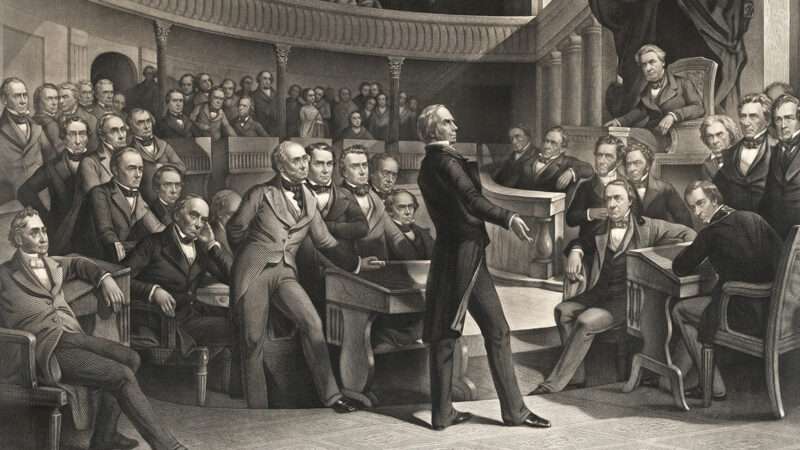
It was a Tuesday, January 29, 1850, and Sen. Henry Clay had set himself the none-too-modest goal of solving the seemingly intractable problem of American slavery once and for all.
By the Kentucky Whig's own none-too-modest reckoning, he had nearly done that very thing once before. Thirty years earlier, while serving as speaker of the House of Representatives, Clay had been the driving force behind the landmark legislation that came to be known as the Missouri Compromise. That storied law had admitted Missouri to the Union as a slave state while simultaneously admitting Maine to the Union as a free state; it also bisected the young nation, slashing a line across the map that prohibited slavery "north of thirty-six degrees and thirty minutes north latitude" in the remaining federal territory acquired from France in the Louisiana Purchase. Clay's legislative maneuverings had thus preserved the tenuous sectional balance between slave states and free states. The Union remained intact.