Get all your news in one place.
100's of premium titles.
One app.
Start reading
Cycling Weekly
Cycling Weekly
Sport
Andy Turner

Helmet choice is pivotal to time trial aerodynamics – I'm an aero consultant, and this is why and how to get it right

Pauline Ferrand Prevot during TT.

Pauline Ferrand-Prévot suffered a major setback to her Tour de France Femmes avec Zwift title defence yesterday in a time trial that saw her lose over two minutes to Marlen Reusser, and the difference between the two riders could not have been starker. Whereas Reusser had a position on the bike that looked sleek with every component of the bike, her kit, and helmet dialled in to produce a bullet-like shape, Ferrand-Prévot looked a very different rider altogether.

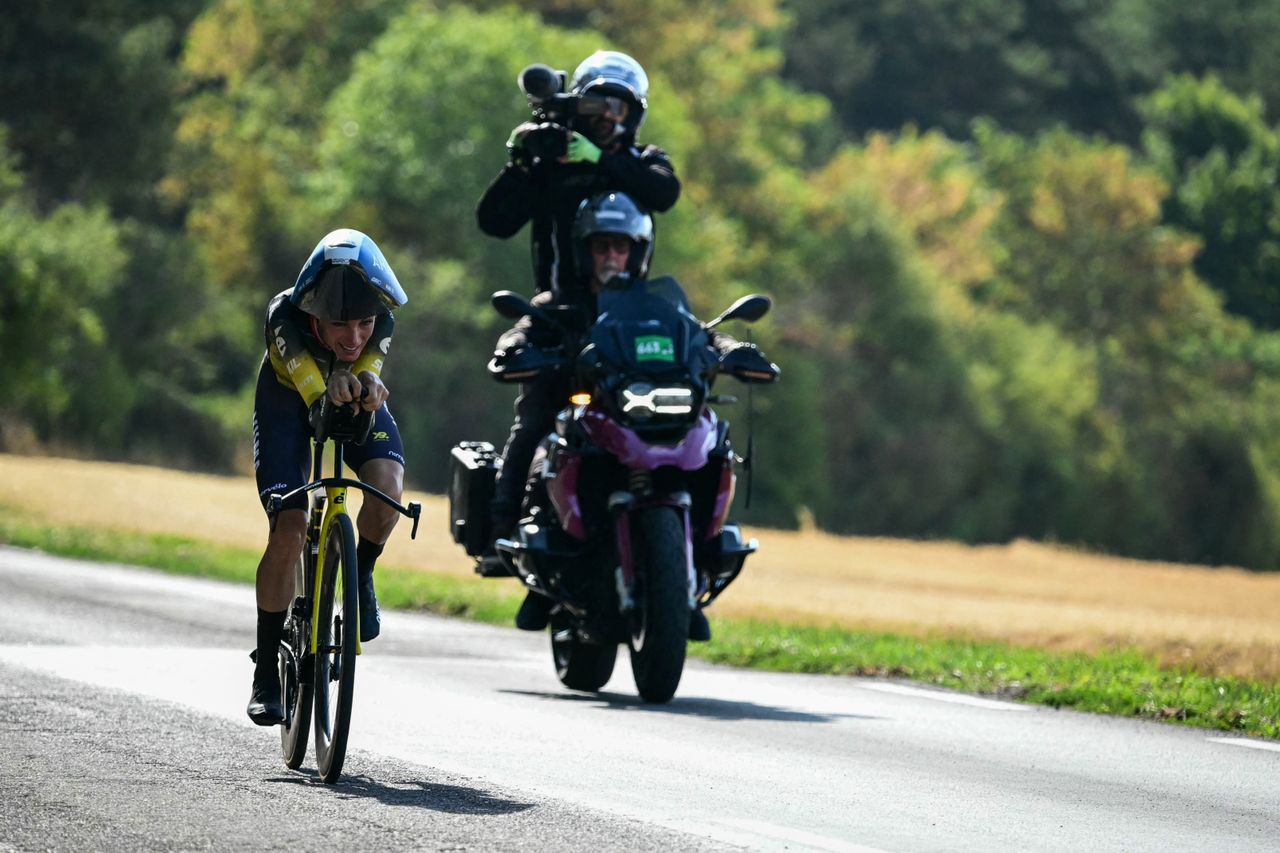
The most prevalent aspect of her setup that just didn’t look right was the large Giro Aerohead II helmet that she was wearing. It was wider than her shoulders, and her position on the bike meant that it stuck out above her back when looking at her from the camera motorbike behind’s view.
In my experience as an Aerodynamics Consultant at Venturi Dynamics, I would confidently say that this was almost certainly not the optimal helmet shape for Ferrand-Prévot's preferred position on the bike.

The French rider, who finished 34th on the day, hadn't raced a time trial in over five years. Asked ahead of the race if she felt she was starting from zero in her time trial preparation, she laughed that it was more “minus 10 – [but] I did my homework quite well”. A rider we expect to fly when the race hits the mountains, Visma-Lease a Bike's GC contender has to adapt her TT position around two major surgeries she had to treat iliac artery endofibrosis, admitting herself, “it wasn’t the prettiest sight, it wasn’t the fastest for everyone else in the peloton, but it was the fastest for me.”

The Giro Aerohead II has proved phenomenally fast on plenty of riders. So, why might one of the best time trial helmets work for one rider, but not for another?

Over the last few years in professional cycling, aero optimisation has taken centre stage. With the head and shoulders of a rider pivotal to drag reduction, most obvious in this aero pursuit is the influx of different helmet designs, especially in the time trial market.

The POC Tempor may have started the trend back in 2012 at the Olympics, but it really took hold once Giro updated the Giro Aerohead II with its huge, bulbous, elongated design. But there is an interesting dilemma with these helmets: their performance can be very position-dependent. This even occurs within the aero road helmet market, but not quite to the same extent.

An interesting side note is that both the Lidl-Trek men and women’s teams, and FDJ men’s team, allow riders to use whatever time trial helmet they want. This is because helmets can be very individual to the rider in how they perform. I heard from one WorldTour rider that when a new TT helmet was released, they had to continue using the old one because the new one performed far worse for them, specifically.

But how can we account for this, and how can we ensure we get the right helmet for us?

Same Giro Aerohead II, but on the men's Visma team. Note the helmet looks relatively smaller on them (Image credit: Getty Images)

How these new TT helmets work

A prevalent theme with recently released TT helmets is the huge flared designs on both sides of the helmets, and, in conjunction with that, the large flared visors. The Giro Aerohead II, the latest unreleased POC TT helmet used by EF Education-EasyPost and Oatley teams, Rudy Project Wingdream, Abus TimeShifter, and Ekoi Pure Aero, for example, all have a large flared-out design.

The predominant reason for this is that the optimal time trial position situates the head lower down, often slightly below the line of the back. In this position, the shoulders are a large barrier to the oncoming air and a large contributor to the total drag generated by the body, some 80% of the total drag equation in a time trial position.

What this requires is that the helmet features an outward flare to smooth the junction between the head and the shoulders of the rider, providing a more arrow-like profile rather than the bulky, blunt shift from neck to shoulder. In conjunction with this, the visors are often enlarged, either to close the gap between the rider’s arm and the helmet, or to create a turbulent flow of air that works for some rider positions. Think of the new Kask Mistral Pro visor as used by Filippo Ganna, but not all the riders on the Netcompany-Ineos team.

But that leads us to the next issue: some helmets work well with certain positions, and not with others. Often, these TT helmets are designed around a key rider associated with the sponsored team or the rider themselves. The Specialized TT5, for example, was designed in conjunction with Remco Evenepoel, while the Giro Aerohead II was designed in part for Jonas Vingegaard and Wout van Aert. However, speaking with a WorldTour rider, they divulged that when a new TT helmet was released, aero testing confirmed that the previous version of the helmet was significantly faster on them than the new version.

Scott found a way to combat this, with its latest Split TT helmet featuring a modular design wherein the tail of the helmet can be switched between a wider tail fairing and a narrower one depending on the rider's shape and how they hold their head. This was previously done with the Giro Selector TT helmet. Having two different designs gives scope to have one helmet with two different settings that can be faster across a broader range of rider positions.

Lidl-Trek takes this a step further by not having a time trial helmet from helmet sponsor Trek. Instead, the team uses a mix of different brands, selected after hours of wind tunnel testing with riders to find the helmet that will be fastest on them. This is the best approach, but sponsor commitments limit most teams in this regard.

What you can do to ensure that you go for the correct helmet

It's likely that, if you're reading this, your own helmet choice is not determined by sponsor commitment. Happily, this will leave you spoilt for choice when it comes to TT helmet shopping; but how do you choose the right shape for you?

A good general rule of thumb is that if you have a more upright position on the TT bike where your head extends above your back, you want a narrower-profiled helmet that won’t add to the surface area, with a tail that can fit as flush against your back as possible. Often this means wearing the helmet so that, when off the bike, you are not looking through the visor, and the helmet is rotated rearwards. However, when in the TT position, you are looking up through the visor.

If you move your head around a lot, or end up looking down, then a stubby profiled TT helmet is going to be the best option. The original Giro Aerohead, for example, or the old Kask Bambino cater for this sort of position, as does the POC Procen.

If, however, you are able to keep your back more horizontal with your head tucked, or aptly named ‘turtled’, then the spate of new wider-bodied TT helmets may work well. However, if possible, you want to measure the width of your shoulders along with the width of the TT helmet to ensure that, especially for narrower riders, it will not be too wide when worn.

Even then, the speed at which you race will also impact which helmet is fastest, but specific testing is required to determine this. Either wind tunnel or velodrome testing, using software such as MyWindSock, to the Chung Method.

Considerations for road helmets

Aero road helmets are a lot more conventional looking (Image credit: Getty Images)

There is still a consideration when it comes to road helmets, although the differences are not quite as extreme.

To an extent, the same principles apply: for a more upright head position, a narrow-profiled, shorter-tailed helmet will generally be faster. But when riders are better able to stay in a flatter-backed breakaway style position, road helmets with extended tails such as the Trek Ballista can perform better. Additionally, the shape of that helmet channels the air across the back, but is often less effective when worn in a more upright position, or if riders drop their heads down more. The Giro Eclipse Pro, for example, excluded a longer tail because aerodynamically it was found not to make a large difference in the optimal position, but the short tail design was faster across a far wider array of head positions.

Sign up to read this article
Read news from 100's of titles, curated specifically for you.
Already a member? Sign in here
Related Stories
Top stories on inkl right now
One subscription that gives you access to news from hundreds of sites
Already a member? Sign in here
Our Picks
Fourteen days free
Download the app
One app. One membership.
100+ trusted global sources.