Get all your news in one place.
100’s of premium titles.
One app.
Start reading
The Independent UK
The Independent UK
Simon Calder

Everything you need to know about Heathrow’s expansion plans

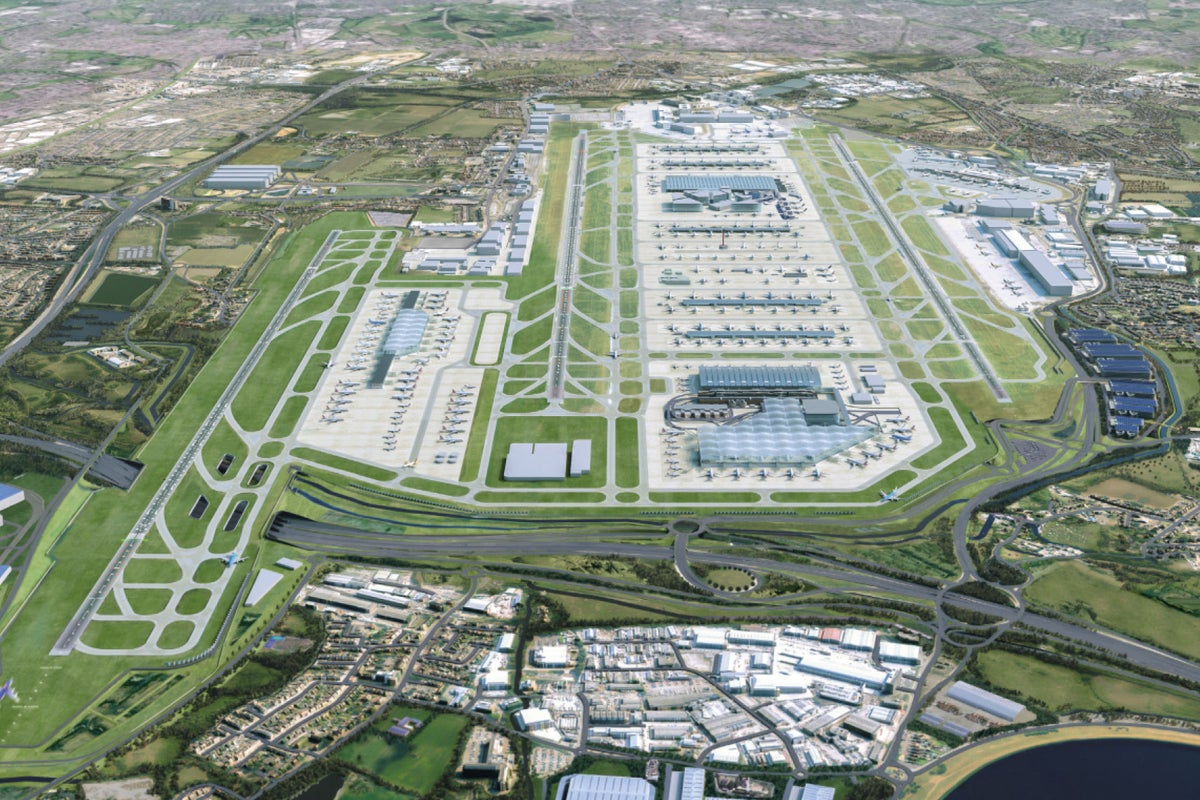
Bigger and better? Artist's impression of an expanded Heathrow. The new runway is shown on the left, crossing the M25 motorway - (Heathrow Airport Ltd)

Ministers have thrown their weight behind Heathrow’s controversial £49bn expansion plan at the UK’s busiest hub airport, including a third runway and new terminals. Britain’s busiest airport could have extra capacity within a decade, allowing new entrants such as easyJet to set up operations.

But the cost – £21bn for the runway, plus £12bn for new terminal and stand capacity – has alarmed airlines, who fear passengers will be paying in advance for something that won’t benefit them.

The hotelier and property tycoon Surinder Arora had set out a competing plan for a cheaper and shorter runway – which was backed by British Airways chief executive, Sean Doyle, who says: “If you can avoid moving the M25, you should avoid moving the M25.” But the Arora Group scheme was dismissed by the government in favour of the “official” plan from Heathrow Airport Ltd, which owns the hub.

Environmentalists argue that any expansion would be a disaster, while history suggests that having a third runway operational by 2035 – the government’s stated aim – is highly optimistic.

Simon Calder has been covering the airport expansion debate for decades.

What’s the problem with Heathrow?

An absurd lack of capacity. London is the world capital of aviation, with far more people flying in and out than any other city on the planet. Heathrow is by far the biggest of London’s six airports; the others, in descending order of passenger numbers, are Gatwick, Stansted, Luton, London City and Southend.

Heathrow is by far the biggest of London’s six airports (Alamy/PA)

Heathrow is the only London airport with two runways in permanent use, and is the busiest such airport in the world. All the rest have only one runway; Gatwick, south of London, is the world’s busiest single-runway airport.

Heathrow airport handled 83.9 million passengers in 2024 and is operating very close to its annual limit of 480,000 take-offs and landings. At peak times one plane lands and another takes off every 80 seconds.

Many inbound aircraft fly holding patterns before being cleared to land, increasing journey times, noise, fuel consumption and emissions. As Martin Rolfe, chief executive of the air-traffic control provider Nats, says: “Heathrow is so constrained that the only way to ensure the runway is in use every second is to have several aircraft effectively circling, ready to come in.”

Outbound departures often have to queue for long spells before take-off.

In bad weather, dozens of flights are cancelled as the air traffic control “flow rate” is reduced.

Heathrow airport handled 83.9 million passengers in 2024 (Getty Images)

Read more: Airports reveal their calmest periods for flight departures

Chief executive Thomas Woldbye says the airport is “operating at capacity to the detriment of trade and connectivity” and that “it has never been more important or urgent to expand Heathrow.”

He says: “We are ready to mobilise and start investing this year in our supply chain across the country. We are uniquely placed to do this for the country; it is time to clear the way for take-off.”

What is Heathrow proposing?

Heathrow has a “shovel-ready” plan for a “100 per cent privately-financed third runway, capable of flights taking off within a decade”.

As recommended by the 2015 Davies Commission and approved by parliament, the 3,500m-long third runway would be built to the northwest of the present two, which will require the M25 to be moved and placed in a tunnel 130 metres west of the existing motorway.

The expansion could see Heathrow traffic increase by more than half to 756,000 movements, and passengers rising by 80 per cent to 150 million each year.

CEO Thomas Woldbye says: “Every penny will be delivered efficiently, affordably, at no cost to the taxpayer and at pace.”

Terminal 5 – used by British Airways – will be expanded, initially by extending the length of one of its satellites, T5C. Another satellite, T5X, will be built to the west behind the existing T5, and will eventually be connected to a new terminal, called T5XN.

The extra runway and terminal capacity, airport bosses say, would mean:

  • “Cheaper fares through an expanded airline selection
  • At least 30 new daily routes, 10 of them longhaul
  • Extra domestic connections
  • A better selection of flight times to the most popular destinations
  • Flights quicker to take off.”
Under Heathrow’s official proposals, T5 would be expanded (Heathrow Airport Limited)

Read more: What is an ETA and how can European visitors to the UK apply for the new visa?

Releasing many more slots could mean budget airlines are enticed in. EasyJet, the UK’s biggest low-cost carrier, has never flown from Heathrow because it is unable to get enough slots for a profitable operation. But easyJet’s chief executive, Kenton Jarvis, believes a third runway could provide a chance for his airline to launch flights at Heathrow.

He says expansion “represents a unique opportunity for easyJet to operate from the airport at scale for the first time and bring with it lower fares”.

Ryanair’s chief executive, Michael O'Leary, has predicted the third runway will not be ready until 2040 at the earliest. He says the airline is not interested flying from Heathrow.

Growing plans: Heathrow Terminal 5 will be expanded to handle the extra traffic from the third runway (Stuart Bailey / British Airways)

What is the price tag?

Heathrow says the runway and associated airfield infrastructure will cost £21bn. That is 50 per cent more than the figure quoted in 2018, when the price was set at £14bn. Consumer prices have risen only 30 per cent over those seven years, so if the cost was in line it would have risen by £4.2bn rather than £7bn. Heathrow says the additional £2.8bn is due to the higher rate of “construction inflation”.

The cost of the new runways and taxiways is only the start. New terminal and stand capacity – principally the new T5X – will cost another £12bn.

Vast amounts of new car parking is proposed to the north and south of the runways. Opponents say the cost is absurd. Paul McGuinness, chair of the No 3rd Runway Coalition, said: “The price tag for just one of its planned new super car parks is £3bn.”

“Modernising the current airport through expanding Terminal 2 and ultimately closing Terminal 3” will cost a further £15bn. This would be likely to happen even without a third runway.

In total, the proposals are priced at £49bn by Heathrow. Sir Howard Davies, whose Airport Commission first recommended the basic third runway plan in 2015, says: “Yes, it would be expensive, but if you want to have the best airport for transit passengers and indeed an airport that is worthy of the UK's major city and probably still the hub for Europe, then it's going to cost money.”

The Arora Group’s proposal avoids the need to build over the M25 (Arora Group)

Who will pay?

The airport’s main shareholders comprise a French private equity fund, Ardian, as well as the Qatari and Saudi sovereign wealth funds. They want current passengers to contribute for future expansion. This would be achieved by persuading the Civil Aviation Authority to increase substantially the current price cap per departing passenger of around £25, which is currently charged as part of passengers' fares.

The airlines are furious – particularly British Airways. While BA says in principle it is in favour of expansion, it stands to lose its majority holding of slots at Heathrow. While the airline would get a reasonable number of additional slots, its current 52 per cent holding could be cut to around 40 per cent. For its passengers to subsidise the building of extra capacity that would mainly benefit other airlines is unconscionable for British Airways.

Carriers say the payback should come only when passenger numbers rise. Willie Walsh, former chief executive of BA and now director general of the International Air Transport Association (Iata), said: “We applaud the government’s decision to support the UK’s global aspirations by advancing plans to expand Heathrow. This must not, however, come at any cost or make any assumption that the current operator is best placed to deliver the value that the UK’s economy will critically need for growth.

“The billions of pounds that have already been invested in Heathrow have under-performed, disappointing both passengers and airlines. So it is doubly important for the billions that will be invested in any expansion to be much better spent. That means focusing on efficiency in all aspects—cost, operations, and customer experience.”

A Virgin Atlantic spokesperson said: “The current regulatory regime is not fit for purpose, guaranteeing the airport inflation-linked returns on their investment, which is ultimately paid for by consumers and airlines through higher charges.”

Sir Richard Branson’s airline uses Heathrow’s oldest terminal, T3, which is 64 years old.

Read more: How do Britain’s rail fares compare with train ticket prices in Europe?

Who will run the project?

The assumption has always been that Heathrow Airport Ltd would, if given approval, manage the expansion. Yet the door has been left open to the Arora Group to remain involved – with the possibility that his organisation rather than Heathrow Airport Limited could be the promoter to deliver the project.

Mr Arora said: “We welcome the government not having chosen a promoter for the scheme and that the option for a promoter other than Heathrow Airport Limited remains possible.

“It’s imperative there is a clear and transparent process for selecting a promoter to ensure it best serves the interests of consumers.

“We have long argued that regulatory reform and the introduction of competition at Heathrow Airport is absolutely imperative to keep costs under control at the airport.”

Who is against Heathrow expansion?

Expansion plans face widespread opposition from local residents concerned about extra noise and traffic, as well as environmentalists who say plans to sharply increase the number of flights are completely incompatible with commitments on carbon emissions.

Dr Douglas Parr, policy director for Greenpeace UK, said: “The government has decided yet again to prioritise more leisure opportunities for a comparatively small group of frequent fliers, whilst the rest of us have to live with the consequences of their disproportionate polluting.

“The thousands who live on and around the site of the new runway will see their lives put on hold for a few more years while more money and time is wasted on a doomed scheme to export more tourism wealth out of the UK in the most polluting way possible, until everyone is forced to admit that there will never be enough genuinely ‘sustainable’ aviation fuel to reduce the industry’s emissions, and the economic case for the whole debacle just will not fly.”

Expansion plans face widespread opposition from local residents and environmentalists (Getty Images)

Read more: Christmas rail strikes to hit CrossCountry passengers as workers announce walkout

Paul McGuinness, chair of the No 3rd Runway Coalition, said: “Not only is Heathrow’s third runway proposal set to be by far the most expensive and least cost-effective airport expansion anywhere in the world for each extra passenger, but ratings agents have already said that Heathrow would struggle to raise even half of the £48bn required to fund the project, given the airport’s current debt burden.

“So, even if the taxpayer is called in to foot the bill for the decade of disruptive construction, it seems that Ryanair’s boss wasn't a lone voice when he described the government’s support for Heathrow expansion as ‘HS2 all over again’.”

What happens next?

The labyrinthine planning process is about to begin. The transport secretary, Heidi Alexander. says: “The government will move at speed to review the Airports National Policy Statement.”

Next, the Development Consent Order (DCO) process is expected to last around 18 months and will involve yet another public consultation on the expansion plans. The government says it is “working towards securing development consent this parliament”.

British Airways has reacted strongly to the competing proposals (PA Wire)

The Planning Inspectorate will consider the application and make a recommendation to the Transport Secretary, who will decide whether to grant the DCO.

If the scheme is approved, opponents of expansion will launch judicial reviews of the minister’s decision. Unless these legal challenges are successful, Heathrow can begin construction of the third runway. The theoretical opening date is 2035.

What about the effect on Gatwick?

Were easyJet to set up at Heathrow, the obvious source of planes, pilots and cabin crew would be its large Gatwick operation. In theory that could reduce choice and increase fares at the Sussex airport. But other airlines might well move in to fill any space created.

But Gatwick has its own cunning plan to bring its standby runway into permanent use. Stewart Wingate, UK managing director for Vinci Airports – which owns the Sussex hub – says: “Gatwick's privately financed, £2.2bn plans to bring the existing Northern Runway into routine use has the potential to create 14,000 jobs and generate £1bn a year in economic benefits.

“The project could be fully operational by around the turn of the decade, if approved with the right conditions to allow quick implementation.”

This piece was first published in September 2025 and has been updated with the latest information.

For more travel news and advice, listen to Simon Calder’s podcast

Sign up to read this article
Read news from 100’s of titles, curated specifically for you.
Already a member? Sign in here
Related Stories
Top stories on inkl right now
One subscription that gives you access to news from hundreds of sites
Already a member? Sign in here
Our Picks
Fourteen days free
Download the app
One app. One membership.
100+ trusted global sources.