
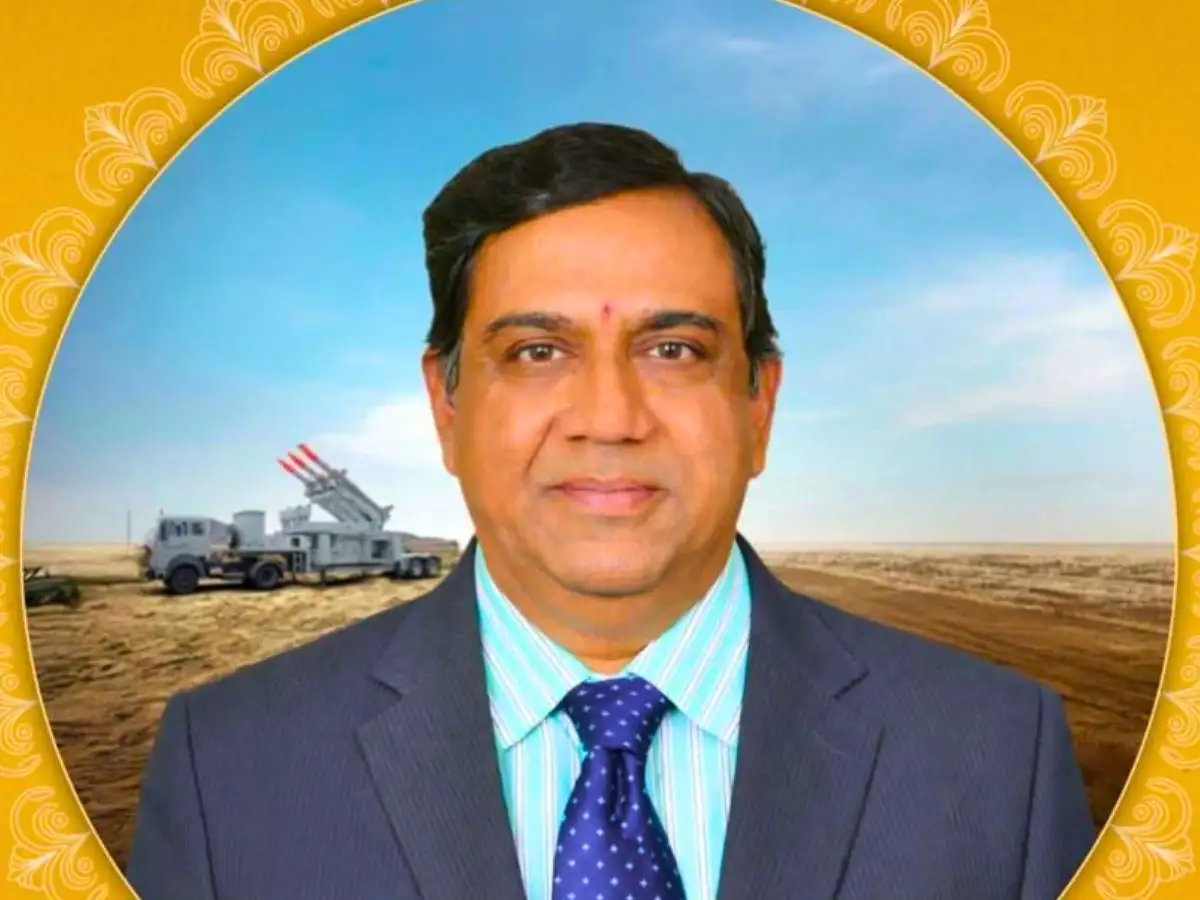
Dr Chandramouli Gaddamanugu has been one of the central figures behind Akash, the indigenous surface-to-air missile system that became one of India’s most significant defence achievements.
A former Outstanding Scientist and Project Director of Akash at DRDL, Hyderabad, he spent more than 34 years working on the programme from its earliest stage to its eventual induction into the Indian Army and Indian Air Force.

He joined Project Akash in 1983 as a young scientist, when the team consisted of just two scientists. From there, he became part of nearly every major phase of the system’s development, including design, technology development, system integration, flight testing and validation.
Building Akash
Akash was not simply a missile project. It was a large integrated defence system built to detect, track and intercept aerial threats.
Dr Chandramouli worked on the configuration of the missile and ground systems, finalising the layout of radars, launchers and command centres across five distinct platforms. His role also involved coordinating multidisciplinary teams across several work centres and ensuring the different components worked together as a single system.
He supervised more than 100 missile flight tests over the years, a process that was essential for design verification and performance validation. That testing helped establish the system’s reliability and paved the way for production and deployment.
From development to deployment
The Akash programme faced the usual long road of a major defence project: technical hurdles, integration challenges and years of refinement.
Dr Chandramouli remained part of that effort throughout. His work helped ensure the successful design, development, flight testing, production, delivery and induction of large numbers of Akash missile systems. The system was inducted into the Indian Army and Indian Air Force in 2015.
He also played a role in demonstrating the missile’s ability to consistently intercept aerial UAV targets in different mission profiles, which helped build user confidence and secure production orders.
Wider impact
As Project Director, Dr Chandramouli guided stakeholders through production, inspection, acceptance testing and delivery for ten years. Later, as Programme Director, he helped conceptualise Akash 1S, QRSAM and Akash Prime, and supported project directors in hardware realisation and flight testing.
His work also extended to design and technology transfer documents that have been used in other projects. In that sense, his contribution went beyond a single missile system and into the wider development of India’s defence manufacturing ecosystem.
According to PIB, the project created revenue, saved foreign exchange, generated employment and helped Indian industry build capability in missiles, radars, launchers and control centres. Some of those systems are now exported as well.
Background and recognition
Born on 5 April 1958 in Madhira town of Khammam district, Telangana, Dr Chandramouli studied mechanical engineering at NIT Warangal, later earned a master’s degree from IIT Delhi and completed his PhD from Osmania University in 2021.
His work has been recognised with several awards, including the Agni Award for excellence in self-reliance from DRDO, the Sir Mokshagundam Visvesvaraya Award, the Scientist of the Year Award from DRDO and the Global R and D Award from FICCI.
Even after his formal role, he has continued to offer technical advisory services for tactical missile projects. For a programme like Akash, his name is tied to the long, difficult work that turned a concept into a system in service.







