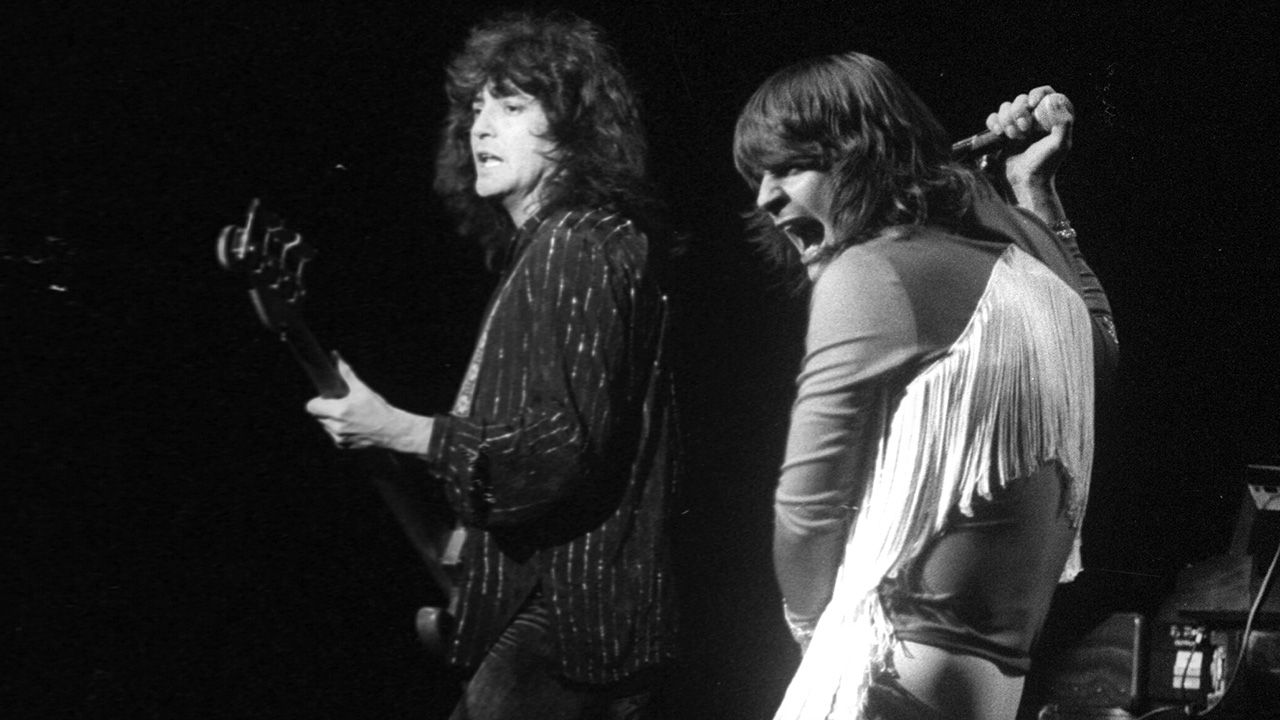
Regardless of misinformation, Bob Daisley played bass on, wrote the lyrics for, and was bandleader during the recording of Ozzy’s first two post-Sabbath solo albums, 1980’s The Blizzard of Ozz, and 1981’s Diary of a Madman.
Though his role as an “official member” of Ozzy’s band changed, his role didn’t. During the sessions for 1983’s Bark at the Moon, 1986’s The Ultimate Sin, 1988’s No Rest for the Wicked and 1991’s No More Tears, – aka the Prince of Darkness’ golden era – Daisley was pivotal.
But things didn’t remain the same between the leading musicians. “It felt like I was working for Blizzard of Ozz, the band I’d helped form,” Daisley says. “The dynamic had changed considerably.” Hit songs and setlist staples like Bark at the Moon, The Ultimate Sin, Magic Man and Mama, I’m Comin’ Home simply wouldn’t be the same without Daisley’s lyrics and basslines.
His writing and experience was integral for young guitarist Jake E. Lee, who replaced the deceased Randy Rhoads; and for Zakk Wylde, who joined after Lee was fired in 1987. Sadly, after No More Tears, a record that some fans believe exceeds the greatness of the Randy Rhoads era, Daisley and Ozzy’s partnership ended.
“As for No More Tears being ‘better’ than our first two Blizzard of Ozz albums with Randy – no way,” Daisley says. “No More Tears wouldn’t exist without our first albums. They were the foundation.”
After Diary of a Madman and prior to Bark at the Moon there was an issue with credits, right?
Just ask me what I thought of Rudy Sarzo being credited on Diary of a Madman! That was a travesty, a true crime against Lee Kerslake and me. I’d worked hard on that album – as I do with every album that I’ve been involved with – with the playing and writing aspects and the production.
To see all my hard work credited to someone who’d had nothing to do with any of it was heartbreaking; the same goes for Lee. I remember the day Lee and I saw the album and those erroneous credits for the first time. It was like a punch in the solar plexus. I would love to see proper accreditation on that album before I take the long dirt nap.
What was your role with Ozzy by the time of Bark at the Moon?
My role was always the same – co-write music, write all lyrics, arrange the songs, and inspire in general. Bark at the Moon was no different. When Ozzy and Sharon kept on at me, trying to get me to agree to replacing Lee with Tommy Aldridge during the 1980 UK tour, then again in 1981, I would never agree.
They asked time and time again. But it wasn’t out of blind loyalty to Lee that I wouldn’t agree; I just knew it was wrong because the chemistry was perfect and the formula was working well. Eventually they got rid of both of us and then, six weeks later, asked me back to do another album with Randy, Ozzy and Tommy. It was to be written and recorded in 1982, which I agreed to.
Then, in March of ’82, Randy was killed, and that album was put on the back burner. I was in Uriah Heep at the time with Lee, Micky Box, John Sinclair, and Pete Goalby, so my contributions and performances on the planned third album would have been as a ‘session’ player.
What led to your working with Jake E. Lee in a songwriting capacity?
When the time came to do that third album, Bark at the Moon, Ozzy asked me to play at the US Festival just before we were to commence the writing and rehearsals. That was my first encounter with Jake – an impressive guitarist whom I had no doubts about as far as his abilities.
The shoes Randy had left behind were not easy to fill. But Jake did an admirable job and made those songs his, and retained the essence of Randy at the same time. After the US Festival, we all flew to New York and began writing for the album, which went very well.
One day Ozzy came into the studio and watched as Jake and I were putting ideas together, and he just blurted out, “I’d forgotten how much you had to do with the writing.” I said nothing; how quickly his “convenient amnesia” had kicked in.
What was Ozzy’s state of mind as far as his substance abuse and emotional state after Randy passed?
Ozzy was a bit messed up on booze and drugs, but Sharon kept an eye on him; so he was mostly kept under control, to a point. The loss of Randy was felt by us all. But I wasn’t there when the plane crashed, so I’m not an eyewitness – thankfully.
Ozzy was asked how he achieved such a miracle. His answer was, ‘With one finger on a piano.’ Oh dear!
Why do you think Ozzy chose Jake to replace Randy?
Jake was a good replacement for Randy. I mean, no one could really replace him, but Jake was a good guitarist, and he could come up with good song ideas and riffs. He certainly fit the bill.
Tell us about playing bass on Bark at the Moon and Rock ‘n’ Roll Rebel.
I played on all of the album. I co-wrote the whole album, including extra tracks such as Slow Down and Spiders.
Which songs would you call out?
On So Tired, I used a Fender Hybrid bass, – a rare 1966 slab body that was non-contoured, with the split Precision pickup. On Spiders, I used a Guild fretless bass through the same rig [an Ampeg SVT with an 8x10 cab]. Tommy Aldridge came up with the initial drum pattern that inspired Spiders.
He wasn’t credited, was he?
I would have given him a writing credit, but no one got a writing credit on that album – all songs were credited to Ozzy for reasons that I won’t go into here. But during an interview with International Musician magazine, Ozzy was asked how he, as a non-musician and non-lyricist, achieved such a miracle. His answer was, ‘With one finger on a piano.’ Oh dear!
What were your thoughts about Jake not being paid properly for Bark at the Moon, let alone no one being credited?
I didn’t get involved in other people’s business affairs; my own were complicated enough! But considering how much Jake and I had done, how we were treated was unfair, disrespectful, and unforgivable; I’ll say that much.
Ozzy had you help with songwriting again for The Ultimate Sin, but you didn’t play bass. Why is that?
Jake and I put the music together in Palm Springs while Ozzy was in the Betty Ford Clinic; so yes, I wrote all of the basslines while we were co-writing the music. After we’d demoed four of the songs in London, Ozzy and I had a clash because he hadn’t been turning up to rehearsals.
When we had to record those four songs in just two days, he began drinking and smoking pot and wanting to change parts. I told him that he should have come to rehearsals and that it was too late to start changing things now.
The next day I got the phone call – I was out. Then a couple of weeks later, he phoned and asked me to write the lyrics for the whole album. Because I’d already put so much into it, I agreed. I wrote the lyrics at home in the garden and took them to Ozzy in London.
What did you think of Phil Soussan’s playing, and how different would the album have been with you on bass?
Ozzy told me, ‘You were right about Lee Kerslake.’ I didn’t even comment. It was 12 years too late
Phil’s playing was okay; a sort of simplified version of what I’d done. As for me being there, of course it would have made a difference; I was an integral part of what the Ozzy sound and direction. Ozzy and I were the nucleus, and Jake and I were the machine behind it.
Why do you think Ozzy let Jake go?
I don’t know the full circumstances; I wasn’t working with Ozzy then. But the band wasn’t as good as it could have been rhythm-section-wise. Jake and Ozzy had had their issues, but I can’t be accurate or definite about a situation I didn’t experience.
What did you think of Zakk Wylde?
He was only 20 or 21 when he joined, but he was already a good writer; well, he and I wrote well together. He was a bit young and green, but he soon matured!
You played bass again on No Rest for the Wicked. What was making that album like?
I had fun writing the lyrics and co-writing music or that album. Particularly Miracle Man – which was about Jimmy Swaggart – and Demon Alcohol. I really liked what I did on fretless bass, and lyric-wise on The Liar. I thought John Sinclair did a great job on keyboards; he and I always had a great laugh together.
Did your overall rig change much for No Rest for the Wicked and the album that came next, No More Tears?
No. I used an Ampeg SVT and an 8x10 cab again. Nowadays I use Markbass amps – they’re brilliant! The bass that I used for most of No More Tears was a 1955 Fender Precision, including the title track.
Zakk seemed to come into his own on No More Tears. Where was your relationship with Ozzy and Zakk at by then?
I was called in at the last minute to record that album. Michael Inez had been on bass up until then. I was meant to be writing lyrics as well, but after we finished recording I got my marching orders. There were no problems or issues – just a change of plan, I guess.
It was during the recording of that album in early 1991 at A&M Studios in Hollywood that Ozzy told me, “You were right, you know, about Lee Kerslake,” which I wasn’t expecting and which I didn’t even comment on. It was 12 years too late.
Was there any friction with Mike Inez?
I have to say Michael Inez was a true gentleman about me playing on the album. He’d sometimes pop into the studio and watch me record, and he was always pleasant, complimentary and respectful – a nice chap.
What do you remember about putting together No More Tears, Mama, I’m Coming Home and Hellraiser?
No More Tears was finished writing-wise in the studio, although the basics had been established before that, before I’d come in. The opening bass riff was Michael Inez’s, although I turned it around by changing where the “one” fell, musically speaking.
I used a fretless bass on Mama I’m Coming Home and I think that it was ideal for a song like that; it helped to give it its mood and emotion. Hellraiser always brings back memories of having a laugh with John Sinclair in the car on the way to the studio. He and I used to sing the chorus together in an exaggerated French accent for a laugh, “hell razzairrr!”
How do you view your role within all Ozzy’s “best” albums, and that, debatably, his music’s quality declined after you stopped working with him?
As I’ve already said, Ozzy and I were the nucleus of that music, regardless of which guitarist was involved. None of it would have happened if The Blizzard of Ozz hadn’t happened. Obviously it was meant to happen – it was fated, destined – and I’m glad and honored to have been a part of it. When Ozzy’s and my relationship ended, that music ended; it was never the same again.