
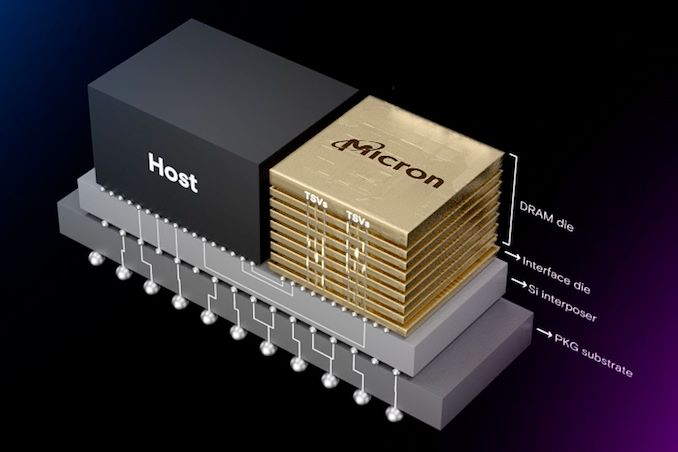
High-bandwidth memory has been around for about a decade, and throughout its its continued development it has steadily increased in speed, starting at a data transfer rate from 1 GT/s (the original HBM) and reaching upwards of 9 GT/s with the forthcoming HBM3E. This has made for an impressive jump in bandwidth in less than 10 years, making HBM an important cornerstone for whole new classes of HPC accelerators that have since hit the market. But it's also a pace that's getting harder to sustain as memory transfer rates increase, especially as the underlying physics of DRAM cells have not changed. As a result, for HBM4 the major memory manufacturers behind the spec are planning on making a more substantial change to the high-bandwidth memory technology, starting with an even wider 2048-bit memory interface.
Designed as a wide-but-slow memory technology that utilizes an ultra-wide interface running at a relatively modest clockspeed, HBM's current 1024-bit memory interface has been a defining characteristic of the technology. Meanwhile its modest clockspeeds have become increasingly less modest in order to keep improving memory bandwidth. This has worked thus far, but as clockspeeds increase, the highly parallel memory is risking running into the same signal integrity and energy efficiency issues that challenge GDDR and other highly serial memory technologies.














